




Nell Jackson: Track & Field
American Star of the Women’s International Sports Hall of Fame
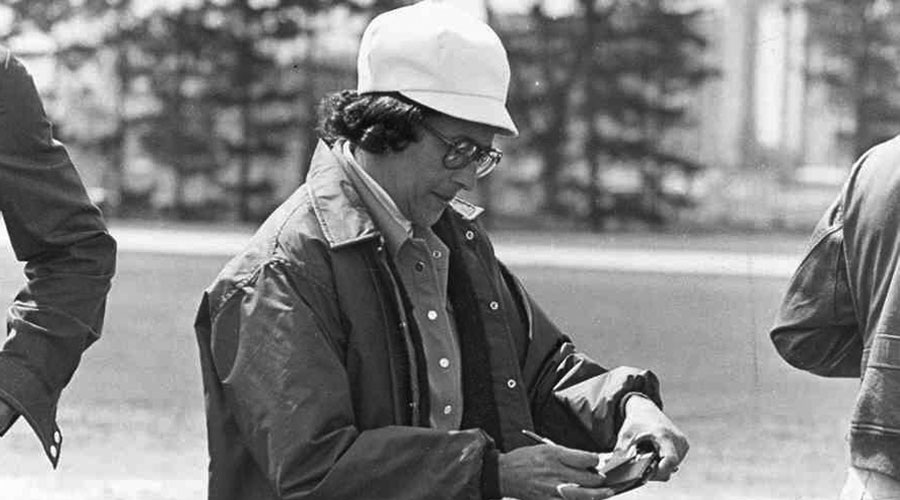
Dr. Nell Jackson, USTFCCCA Special Inductee
Coaching at any level requires patience, strong listening skills, and extensive knowledge of the sport. Coaching at the Olympic level, however, brings additional pressure and extremely high expectations. Because of these high standards, it is truly an honor to be selected as a head coach of an Olympic team. When Nell Jackson was named as the head coach for the track and field team, she added to this honor by breaking an incredible barrier for African-American women.
A native of Athens, Georgia, Jackson ignored the obstacles and lack of opportunities for an African-American woman born in 1929. From a young age, Jackson excelled in track and field and at only 15 years old, she competed in her first national championship. The following year she had the opportunity to race against the reigning Olympic champion, Stella Walsh, in the 200-meter dash. Although she placed second to Walsh, Jackson showed incredible potential. At age 17, she was named to the U.S. All-American team.
Her accomplishments caught the eye of head coach and Hall of Famer, Cleve Abbott, at the Tuskegee Institute, where Jackson had the opportunity to train with other amazing athletes like Mary Mc- Nabb, Catherine Johnson, and Evelyn Lawler. In addition to being the star on Tuskegee’s team, Jackson was a leader serving as a captain and providing constant support for her younger, less experienced teammates. In fact, fellow teammate and future Olympian, Mary McNabb, credits Jackson for helping with her slow start.1 In 1948, the 19-year-old earned a spot on the U.S. Olympic team. Jackson ran the 200-meter and teamed up with Mae Faggs on the 400- meter relay. Although she did not earn a medal in the London Games, her career was just beginning to blossom.
Upon returning home, Jackson did not waste any time in expanding her impressive resume. In 1949, Jackson etched her name in the record books as she set a new American record in the 200-meter dash with a time of 24.2 seconds. The following year Jackson would have a rematch with her rival, Stella Walsh, at the national championships.
With her newfound confidence from her record-breaking performance, Jackson would, this time, be victorious. In 1951, Jackson was invited to compete in the inaugural Pan American Games. She once again showed her dominance by winning the sprint team relay and placing second in the individual 200-meter dash. Although Jackson was still a competitive force in the track world, she opted not to compete in the 1952 Olympics in Helsinki, Finland. Instead, she shifted her focus to coaching. She began at her alma mater, but would later have coaching stints at Illinois State, the University of Illinois, and Michigan State. Showing her incredible impact as a coach, Jackson was given the ultimate opportunity— coaching the 1956 Olympic team. Not only was this a true testament to Jackson’s influence as a coach, but it also broke a major barrier for African-American women as she became the first to be named head coach of any U.S. Olympic team. Jackson held this position again in 1972 at the Munich Olympics. She was a true trailblazer, as she paved the way for many other African-American female coaches.
Her influence did not stop at coaching from the sidelines. In addition to serving as an administrator for the U.S. Olympic Committee (USOC) and the International Association of Athletics Federations (IAAF), Jackson spent many years with The Athletics Congress (TAC), now known as USA Track and Field (USATF). Jackson served as vice president of the organization for many years, but held the role of secretary until the time of her death in 1988.
Nell Jackson’s legacy will continue on, as each year, one athletics administrator is awarded the NACWAA Nell Jackson Award. In addition to being an active member of the National Association of Collegiate Women Athletics Administrators (NACWAA), the recipient must demonstrate leadership, courage, compassion, conviction, tenacity, and vision—all qualities shared with the late Nell Jackson.2 This award is a prestigious honor for the annual recipient, but more important, it is a tribute to a true pioneer and role model.
Notes
1. Michael D. Davis, Black American Women in Olympic Track and Field (Jefferson, N.C.: McFarland & Company, Inc, Publishers, 1992).
2. National Association of Collegiate Athletic Administrators, “Nell Jackson Award,” http://www.nacwaa.org/aw/awards_nj.php.
The previous excerpt was written by Sara Jane Baker
IN SEASON:
Tue, Oct 1 at 12:03pm
Fri, Sep 6 at 9:32am
Fri, Nov 8 at 9:29pm
Fri, Nov 1 at 4:39pm
Today at 9:09am
Today at 9:04am
Sun, Nov 10 at 6:59pm
Thu, Nov 7 at 9:08pm
LATEST ARTICLES & POSTS
posted by Swish Appeal
Mon at 9:13am
posted by Swish Appeal
Mon at 9:11am
posted by All White Kit
Sun at 6:42pm

-
The body of this profile is an excerpt from 100 Trailblazers: Great Women Athletes Who Opened Doors for Future Generations.
This book is available on Amazon.com:
This book was written by Dr. Richard Lapchick, chair of the renowned DeVos Sport Business Management Program at the University of Central Florida, along with several of his students in the renowned program:
- Sara Jane Baker
- Jessica Bartter
- Catherine Lahey
- Stacy Martin-Tenney
- Horacio Ruiz
- Ryan Sleeper

The DeVos program offers students the opportunity to earn their Masters in Sports Business Management and a Masters in Business Administration. Focusing on ethics, diversity, leadership, and community service, the DeVos Program attracts some of the brightest and most committed students from across the country and across the globe.
-
This profile was built by:

Taunita Stephenson
About Taunita:
~*Member of the DeVos Sport Business Program (Top 4 Sport Business Programs in the Nation!), Class of 2012*~ ~*Class of 2009, Delaware State University Graduate-Making My Mark on the World!" ~*I am enthusiastic about equality and diversity and hope to begin a career in Player Development or Diversity Initiatives!*~ God, Family, Friends, Career Goals, Jay-Z, Lakers, Fashion-In that order! What I Live By: "Vision without action and a plan is an illusion"