




Val Ackerman: Basketball
National Reform Leader---Pro Sport
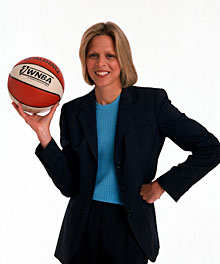
Val Ackerman was appointed president of the Women’s National Basketball Association (WNBA) in August 1996, when the women’s league was just a concept in development. Tip-off for the inaugural season was set for June 1997, leaving Ackerman with less than one year to find coaches, players, and cities to host franchises. In her first year, Ackerman was making decisions on everything from the size and color of the basketball and the way the uniforms would look, to setting the salaries for her players. There had already been 15 documented attempts at establishing a women’s basketball league, all of which failed for one reason or another. Ackerman’s job was to make sure that what had happened 15 times before did not happen to the WNBA.
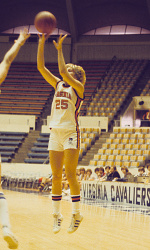
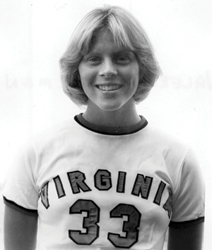
Ackerman had an early recollection of her first failure. The granddaughter and daughter of collegiate and high school athletic directors, Ackerman grew up playing sports with the boys on her block. In the seventh grade, she tried out for the only organized team that her middle school provided for girls—the cheerleading squad. She practiced every day and at night she tried to perfect the routines in front of her bedroom mirror. When it was time to find out if she had made the squad, Ackerman did not see her name on a list posted outside the locker room. She was so embarrassed that she did not want to go back to school for a week. But Ackerman’s father reminded her that in high school she would be able to play any sport that she wanted. Once in high school, she earned 10 varsity letters in field hockey, track, and basketball. She earned a scholarship to play basketball at the University of Virginia, where she was a four-year starter, three-year captain, and two-time Academic All-American. Ackerman would go on to play professionally for one year in France, then earn her law degree from the University of California, Los Angeles, in 1985.
By 2004, Ackerman’s last year as president of the WNBA, she had grown a business that included 17 highly recognizable corporate sponsors and television contracts that broadcast games on ABC, ESPN, and ESPN2. Sure, the WNBA had received a tremendous amount of support from its brother association, the National Basketball Association (NBA), but women’s basketball had been woven into the social fabric of major professional sports leagues. The WNBA had become the leading women’s basketball league in the world, with broadcasts across more than 125 countries and with a number of the best international players playing in the league. Despite encountering some tough labor issues, changes in team ownership, team relocations, and the dissolution of some franchises, Ackerman was the first woman to successfully launch a women’s teamoriented sports league and she guided the league for its first eight seasons, averaging more than 9,300 fans over the course of her tenure. She had done the exact opposite of fail; she had been a grand success as the founding president and more than anything, she shined a light on women’s basketball players like never before.
Through the marketing, sales, and financial plans, Ackerman was working to achieve something deeper than making sure her league succeeded financially. In May of 2000, she told a reporter a story about a girl that asked for her autograph. Standing to the side was the girl’s father. “You must be the dad, you must be proud,” Ackerman said to him.1Afew days later, Ackerman received a note from the father, thanking her for giving him an opportunity to bond with his daughter and noting that the girl had higher self-esteem for being a fan of women players. Ackerman had created an institution different from the surroundings she grew up in. As a teenager, she hung up posters of her sports heroes, John Havlicek and Jerry West—both men. She also cited that nearly 75 percent of WNBA attendees were women and girls, giving them, to some sense, a league of their own.
“We were able with the WNBA to get women’s basketball to its rightful place in our country, meaning a place where we can have not only young girls playing at the youth level and the high school and collegiate levels, but also a viable pro outlet for the very best players,” Ackerman said. “There had been many attempts to start leagues prior to the launch of the WNBA. None of them made it and I think the fact that the WNBA has been here 12 seasons is a testament to how strong the women’s game has gotten, how popular it is as a spectator sport, and how much potential it continues to have. With each passing year, the quality of play only escalates and the number of people who accept as a fact of life that women’s pro basketball is here to stay, that number of people solidifies.”2
Just as the man had thanked Ackerman for allowing him to bond with his daughter, Ackerman realized she needed to do the same with her two daughters. In 2004, Ackerman resigned from her post as president of the WNBAto spend more time with her daughters. “This was entirely my decision, and it’s a very difficult one because in many ways I think of the WNBA as a third child,” Ackerman said at the time. “But it’s required a great deal of time and it’s required a great deal of energy. I felt very strongly that this was, and is, the right decision for my two daughters. I would hope this isn’t taken in any way as an indictment on working motherhood because it can absolutely be done. We have many women in the league who are parents and have been able to form balanced situations. I didn’t feel that in this job that was possible.”3
Ackerman stayed as a consultant with the WNBAand in 2005, she was the first woman elected as president of USA Basketball to lead the organization through the 2008 Beijing Olympics. Under her leadership, both the men’s and women’s basketball teams won gold medals at Beijing. Her previous Olympic experience extended from 1995 to 1996, when Ackerman was the main force in directing the Women’s Senior National Team that finished with a 60-0 record and a gold medal at the 1996 Atlanta Olympics.
Just after arriving in the United States following the successes at Beijing, the Naismith Memorial Basketball Hall of Fame honored Ackerman with its highest distinction outside of enshrinement, awarding her with the John W. Bunn Lifetime Achievement Award. In addition to recognizing her pioneering work with the WNBAand USA Basketball, the Hall of Fame took into consideration her work with the New York law firm of Simpson Thacher & Bartlett for two years, her post at the NBA League Office as a staff attorney where she worked closely with Commissioner David Stern, and her positions as NBA director and, later, vice president of Business Affairs, before being chosen to lead the WNBA.
“This is a tremendous and very unexpected honor, and I’m deeply grateful to the Hall of Fame for the recognition,” said Ackerman after learning of the award. “It has been a privilege for me to work in basketball and to witness many of the exciting developments in our game over the past 20 years, especially in women’s basketball, which I know will only continue to grow in popularity in the years to come.”4
Ackerman currently serves on the Executive Committee of the Naismith Memorial Basketball Hall of Fame, the National Board of Trustees for the March of Dimes, the National Board of Girls Incorporated, and the Knight Commission on Intercollegiate Athletics. In her role as president of USA Basketball, she restructured the board of directors to include youth basketball organizations and is looking to partner with the National Collegiate Athletic Association (NCAA) to spearhead youth basketball initiatives.
Notes
1. Jan Hoffman, “A League President in the Dreams Business,” New York Times, May 26, 2000.
2. John Hareas, Q & A with Val Ackerman. http://www.nba.com/news/ackerman_080904.html (accessed September 22, 2008).
3. Patricia B. McGraw, “Family Needs Come First for Ackerman,” Daily Herald, October 23, 2004.
4. Naismith Memorial Basketball Hall of Fame, Val Ackerman recipient of 2008 hall of fame John W. Bunn lifetime achievement award, http://hoophall.com/genrel/082008aac.html (accessed September 22, 2008).
The previous excerpt was written by Horacio Ruiz
IN SEASON:
Tue, Oct 1 at 12:03pm
Fri, Sep 6 at 9:32am
Fri, Nov 8 at 9:29pm
Fri, Nov 1 at 4:39pm
Today at 9:09am
Today at 9:04am
Sun, Nov 10 at 6:59pm
Thu, Nov 7 at 9:08pm
LATEST ARTICLES & POSTS
posted by Swish Appeal
Mon at 9:13am
posted by Swish Appeal
Mon at 9:11am
posted by All White Kit
Sun at 6:42pm

-
The body of this profile is an excerpt from 100 Trailblazers: Great Women Athletes Who Opened Doors for Future Generations.
This book is available on Amazon.com:
This book was written by Dr. Richard Lapchick, chair of the renowned DeVos Sport Business Management Program at the University of Central Florida, along with several of his students in the renowned program:
- Sara Jane Baker
- Jessica Bartter
- Catherine Lahey
- Stacy Martin-Tenney
- Horacio Ruiz
- Ryan Sleeper

The DeVos program offers students the opportunity to earn their Masters in Sports Business Management and a Masters in Business Administration. Focusing on ethics, diversity, leadership, and community service, the DeVos Program attracts some of the brightest and most committed students from across the country and across the globe.
-
This profile was built by:
Taunita Stephenson
About Taunita:
~*Member of the DeVos Sport Business Program (Top 4 Sport Business Programs in the Nation!), Class of 2012*~ ~*Class of 2009, Delaware State University Graduate-Making My Mark on the World!" ~*I am enthusiastic about equality and diversity and hope to begin a career in Player Development or Diversity Initiatives!*~ God, Family, Friends, Career Goals, Jay-Z, Lakers, Fashion-In that order! What I Live By: "Vision without action and a plan is an illusion"