




Pat McCormick: Swimming
American Star of the Women’s International Sports Hall of Fame
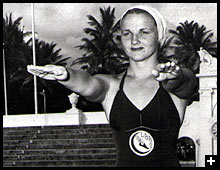
I share a difficult moment in my life with Pat McCormick, an “ouchy” as she calls it, because she asks that I share with her after she shared a few of hers with me. She is the only woman and only one of two divers to win two gold medals from the springboard and platform in consecutive Summer Olympics, and yet, McCormick talks about the importance of getting through the difficult times. She says she would be very disappointed if I wrote about everything she told me. No worries, our “ouchies” are meant to be trusted secrets. But, what McCormick has accomplished in and out of athletics should never be kept secret.
“Failures are our blessings,” McCormick says. “You have to get through it. Some way, you have to.”1
It was one of McCormick’s earlier disappointments that catapulted her into becoming one of the most decorated American athletes in Olympic history. McCormick fell 1/100th of a point short of making the 1948 U.S. Olympic Diving Team, recalling how she sat in the showers crying, and how in her disappointment she dedicated herself to becoming the best diver in the world. She is modest in saying that she had so much support around her that it would have been impossible for her to not be good.
Sammy Lee, a two-time gold medal-winning Olympian and one of McCormick’s trusted mentors, said he didn’t think McCormick had the ability to be a great diver. He mentioned how she could not point her toes and recalled the thunderous noises McCormick would make on failed dive attempts.
“Pat—she has a lot of guts, and she crashed,” Lee said of her painful flops during practices. “Pat was not a natural diver. She had to work at it.”2 Lee underestimated McCormick’s determination and her relentless work ethic. McCormick was a wonder from an early age, having strongmen in Los Angeles’s Muscle Beach flip her up in the air where she would perform her acrobatics. There is a picture of her when she was no more than 10 years old holding up a well-built man who is standing on her shoulders, with well-defined muscles popping from her little arms and shoulders. She spent her youth at the beach and in the water, sometimes daring to jump off bridges.
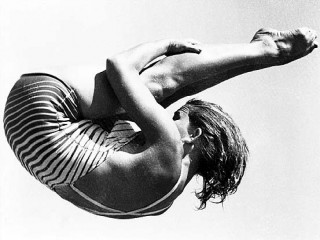
After completing her “double-double” at the 1952 Helsinki Olympics and the 1956 Melbourne Olympics, McCormick was Sports Illustrated’s “Athlete of the Year” and the AP’s “Woman Athlete of the Year.” What she vowed to do while wiping away her tears in 1948 had become a reality.
“It becomes a very personal thing,” McCormick said. “That was my passion and my goal and anytime you accomplish something like that there’s a sense of peace.”3
And then? McCormick hit a depression, finding herself with an emptiness that had not been there before. Accustomed to training eight to 10 hours a day for the Olympics, sometimes with lacerations and bruised ribs, the life she had known as an athlete for so long was suddenly gone. After a life’s worth of preparation, McCormick reached the apex of her athletic career. The rest of her life lay before her, a life she had not prepared for. But just as she said, she found a way to press on and get through her post-Olympic blues.
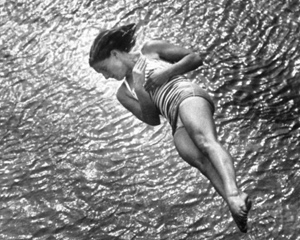
“The trick is to stay on that victory stand,” McCormick told journalist Jim Murray. “Never step down from it.”4
After making Olympic history, McCormick stayed busy raising her family, being a mother and wife, and standing behind her daughter, Kelly, as she developed into a world-class diver of her own. Kelly would win a silver medal in the 1984 Los Angeles Olympics and a bronze in the 1988 Seoul Olympics. The McCormicks are the only mother-daughter medal winning combination in Olympic history.

In 1984, McCormick was chosen to be a member of the Los Angeles Olympic Organizing Committee. It would change her life. She was picked to speak at Wing Lane Elementary in La Puente, just a few minutes southeast of Los Angeles. After she had given a 45- minute speech, a teacher told McCormick that more than 100 students at the school were failing. The teacher asked McCormick if there was anything she could do, but McCormick couldn’t think of what to do to help. Another teacher said the kids were “nothing but a bunch of losers.”
McCormick was struck by the comment. She made a commitment to 25 third graders, visiting the school twice a month to work with them. The first three months were a disaster, but then she enlisted a mentor, boxer Paul Gonzalez. Gonzalez, a Southern California native who was training for the Los Angeles Olympics, was a hit with the students as he recalled his involvement with a gang and how he would surely be dead if not for the help of a Los Angeles policeman. He would go on to win a gold medal later that summer. McCormick continued her program, hopeful with every bit of progress she was making, instilling confidence and love in the children. She tracked the progress of the 25 students she began her work with. Her program included aspects of inspiration, mentoring, parenting classes, nutrition education, and tutors. Eighteen of the children graduated from high school and some went on to colleges and universities. Her program would eventually come to be known as “Pat’s Champs,” set upon the foundation of her own Olympic success. Her program currently has six steps: dream, work, “ouchies,” being with good people, helping others, and staying healthy and fit.
“Pat has taught me that there are people that do care about me and those people have taught me to care about myself,”5 said Sandy Hernandez, a student in McCormick’s program.
Over the years, McCormick’s work has spread through the Pat McCormick Educational Foundation, which has also included the Life Skills Training Program, which is focused on tobacco, alcohol, and drug use education for adolescents. Her programs have been implemented in several school districts in California and also are in the states of Washington and Vermont. She recently pledged a 10-year commitment for the continued implementation of her programs throughout the California school districts and beyond. The work has been a grind for McCormick, who these days is trying to find enough time to golf and to do some gardening in her yard, but it’s a labor of love that has kept her on the victory stand all her life. “God love you, and I know you’re going to be a success,” she tells me.6 It makes me feel good hearing that as we finish our conversation.
Notes
1. Pat McCormick, interview with author, February 8, 2008.
2. Women Who Won Gold—Pat McCormick Bio. Video.
3. Pat McCormick, interview with author, February 8, 2008.
4. Jim Murray, “Diving in from the Highboard,” Los Angeles Times.
5. Women Who Won Gold—Pat McCormick Bio. Video.
6. Pat McCormick, interview with author, February 8, 2008.
The previous excerpt was written by Horacio Ruiz
IN SEASON:
Tue, Oct 1 at 12:03pm
Fri, Sep 6 at 9:32am
Fri, Nov 8 at 9:29pm
Fri, Nov 1 at 4:39pm
Today at 9:09am
Today at 9:04am
Sun, Nov 10 at 6:59pm
Thu, Nov 7 at 9:08pm
LATEST ARTICLES & POSTS
posted by Swish Appeal
Mon at 9:13am
posted by Swish Appeal
Mon at 9:11am
posted by All White Kit
Sun at 6:42pm

-
The body of this profile is an excerpt from 100 Trailblazers: Great Women Athletes Who Opened Doors for Future Generations.
This book is available on Amazon.com: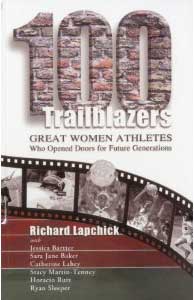
This book was written by Dr. Richard Lapchick, chair of the renowned DeVos Sport Business Management Program at the University of Central Florida, along with several of his students in the renowned program:
- Sara Jane Baker
- Jessica Bartter
- Catherine Lahey
- Stacy Martin-Tenney
- Horacio Ruiz
- Ryan Sleeper
The DeVos program offers students the opportunity to earn their Masters in Sports Business Management and a Masters in Business Administration. Focusing on ethics, diversity, leadership, and community service, the DeVos Program attracts some of the brightest and most committed students from across the country and across the globe.
-
This profile was built by:
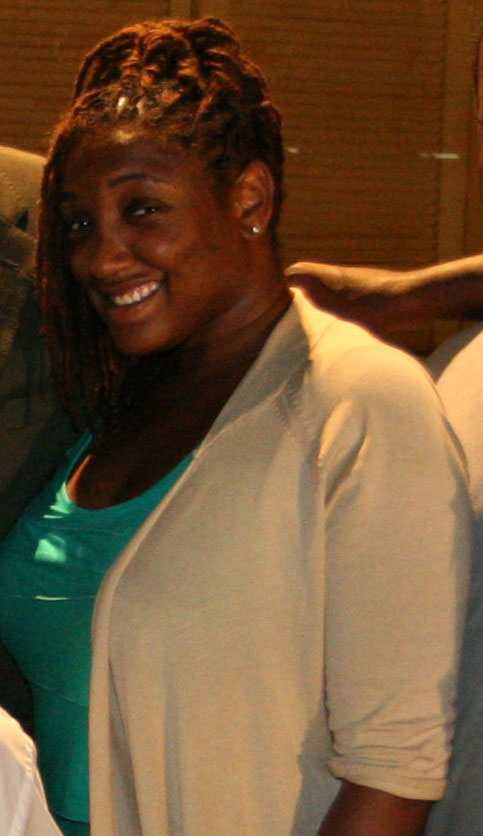
Taunita Stephenson
About Taunita:
~*Member of the DeVos Sport Business Program (Top 4 Sport Business Programs in the Nation!), Class of 2012*~ ~*Class of 2009, Delaware State University Graduate-Making My Mark on the World!" ~*I am enthusiastic about equality and diversity and hope to begin a career in Player Development or Diversity Initiatives!*~ God, Family, Friends, Career Goals, Jay-Z, Lakers, Fashion-In that order! What I Live By: "Vision without action and a plan is an illusion"