




Tracy Caulkins: Swimming
American Star of the Women’s International Sports Hall of Fame
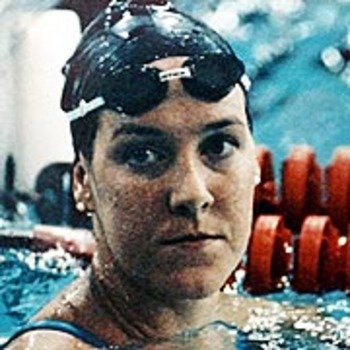
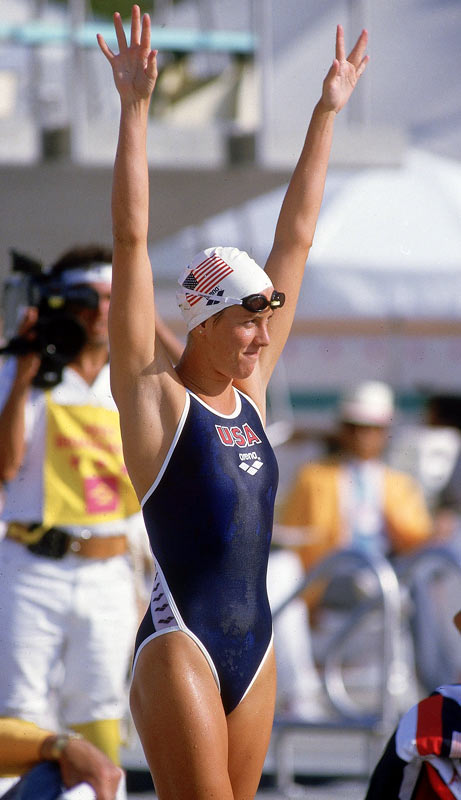
The story goes that at eight years old, the woman considered to be the greatest all-around swimmer in American history agreed to join the neighborhood swim club on the condition that she would only do the backstroke so that her face would not get wet. Nearly 40 years since joining the swim club, the accolades keep coming in for Tracy Caulkins, who proved to be skilled far beyond just the backstroke. In 2006, she was named the Division I’s most outstanding swimmer in women’s championships over the previous 25 years. During her swimming career at the University of Florida, Caulkins claimed 16 national championships, including 12 individual championships, the most ever by any swimmer or diver. In 1982 and 1984, Caulkins received the Broderick Cup, given annually to the nation’s top collegiate female athlete. Caulkins burst onto the international swimming scene at the 1978 World Championships in Berlin by winning five gold medals and one silver medal. That performance earned her the 1978 James E. Sullivan Award as the most outstanding amateur athlete in the United States; at age 15 she was the youngest winner of the award to date.
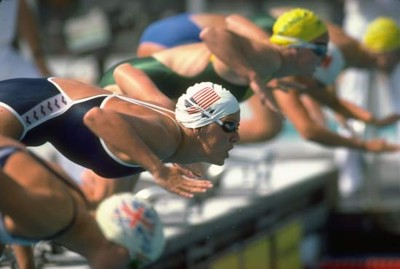
At the 1980 Moscow Olympic Games, Caulkins was supposed to showcase her talents to the world, but the United States boycotted the Games because of political disagreement with the Soviet Union. Caulkins was hit hard. At the 1982 World Championships, Caulkins failed to finish higher than third in any event, and even while winning the gold medal at the 1983 Pan American Games, her times were much slower than they had been at the 1978 World Championships. There were whispers that she could no longer compete at an elite level. But Caulkins regained her swimming dominance in January 1984 while winning the 200-meter and 400-meter individual medleys at the U.S. Swimming International meet. “I think a lot of people have counted me out,” she said after the meet. “They better watch out.”1
At the 1984 Los Angeles Olympics, Caulkins captained the U.S. swimming team while winning individual gold medals in the 200-meter individual medley and the 400-meter individual medley, and swimming the breaststroke on the 400-meter medley relay. Her swimming career had come full circle, and she retired following the Los Angeles Games. “It [the 1984 Olympics] was the realization of a dream,” Caulkins said. “After all, swimming had always been a focus. Now, after all the work, there are great opportunities.”2
All told, Caulkins set five world records. Her 63 American records and 48 national titles are both the most by any swimmer, and she is the only swimmer to set U.S. records in every stroke. Caulkins’s swimming legacy was as a master of all four strokes, and according to the Sullivan Award website, “Caulkins was respected and admired by her teammates for her understanding and compassion as well as for her talents.” Following her retirement, Caulkins used her broadcasting degree to take several television analyst positions for swim meets and she became an advisory board member for the Women’s Sports Foundation (WSF). In 1985, she actively promoted a survey commissioned by the WSF that found more young women and girls were choosing to compete athletically with men, and girls who grew up competing with boys or in mixed groups were more likely to continue sport activities as adults. “When I read the report, I felt it really hit on the things that I had experienced in sports,” Caulkins said in 1985. “It [co-ed competition] is a social issue that people are going to have to deal with. But I know that I have competed with guys every day since I was eight. And I know at Florida it was good for both the men and the women in the swimming program.”3
The 1984 Games brought more than gold medals to Caulkins; the Games also brought her a husband. Australian sprint swimmer Mark Stockwell jumped into the warm-up pool in Los Angeles to introduce himself to Caulkins. That move sparked a relationship that led to their marriage in 1991 in Nashville, Tennessee, Caulkins’s hometown. The wedding was a cross-cultural affair, with a barn dance with southern cooking serving as the backdrop for the rehearsal dinner, a sit-down dinner at the wedding with the reading of telegrams from all over the world, and the following day, with Stockwell’s friends and family teaching the Americans how to play cricket. Despite her disappointment with the boycott of the 1980 Olympics, Caulkins looks back and thinks there may have been a purpose. “If there hadn’t been a boycott in 1980, I might not have gone on to 1984, where at 21, I was the ‘old lady’ on the team,” she said. “Then I might never have met my husband.”4
Caulkins moved to Australia with Stockwell in 1991 and settled in Brisbane. Together, they have four children, all of whom are involved in swimming. In Australia, Caulkins has worked part-time for a construction and development company that both she and her husband own. She also has served as the executive officer for the Queensland Academy of Sport, which provides support to elite and identified developing athletes. In 2006, Caulkins added yet another medal to her vast collection when she was awarded the Medal of the Order of Australia “for service to sport as an administrator and proponent of sporting opportunities for women.”
Notes
1. AAU Sullivan Award, “Tracy Caulkins,” http://www.aausullivan.org/winners_1978.html.
2. Brian Hanley, “Caulkins Becomes a Trail Blazer,” Chicago Sun-Times, June 25, 1986.
3. Ibid.
4. Phillip Whitten, “Still Kicking,” Swimming World Magazine, April 2005.
IN SEASON:
Tue, Oct 1 at 12:03pm
Fri, Sep 6 at 9:32am
Fri, Nov 8 at 9:29pm
Fri, Nov 1 at 4:39pm
Today at 9:09am
Today at 9:04am
Sun, Nov 10 at 6:59pm
Thu, Nov 7 at 9:08pm
LATEST ARTICLES & POSTS
posted by Swish Appeal
Mon at 9:13am
posted by Swish Appeal
Mon at 9:11am
posted by All White Kit
Sun at 6:42pm

-
The body of this profile is an excerpt from 100 Trailblazers: Great Women Athletes Who Opened Doors for Future Generations.
This book is available on Amazon.com: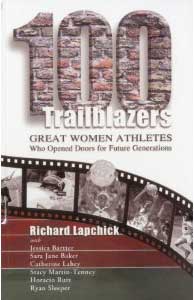
This book was written by Dr. Richard Lapchick, chair of the renowned DeVos Sport Business Management Program at the University of Central Florida, along with several of his students in the renowned program:
- Sara Jane Baker
- Jessica Bartter
- Catherine Lahey
- Stacy Martin-Tenney
- Horacio Ruiz
- Ryan Sleeper

The DeVos program offers students the opportunity to earn their Masters in Sports Business Management and a Masters in Business Administration. Focusing on ethics, diversity, leadership, and community service, the DeVos Program attracts some of the brightest and most committed students from across the country and across the globe.
-
This profile was built by:

Taunita Stephenson
About Taunita:
~*Member of the DeVos Sport Business Program (Top 4 Sport Business Programs in the Nation!), Class of 2012*~ ~*Class of 2009, Delaware State University Graduate-Making My Mark on the World!" ~*I am enthusiastic about equality and diversity and hope to begin a career in Player Development or Diversity Initiatives!*~ God, Family, Friends, Career Goals, Jay-Z, Lakers, Fashion-In that order! What I Live By: "Vision without action and a plan is an illusion"