




Tina Sloan Green: Lacrosse
National Reform Leader and American Star of the Women's international Sports Hall of Fame


The National Collegiate Athletic Association (NCAA) basketball tournament is so greatly followed that the term “March Madness” has been coined to refer to the month-long, über-popular championship series. Yet, contrary to popular belief, it is the Men’s Lacrosse Championship that is the most highly attended NCAA national championship. The 2008 NCAA finals included a record 48,970 fans in attendance. If you haven’t been there in person, it may be hard to imagine the magnitude of the lacrosse finals.
It may be even harder to imagine a tradition born to breed warriors using hundreds, even thousands of men to compete across a territory that spread miles and days long and resulted in serious injuries and even death has evolved into the game we now know as lacrosse. But this history would not surprise those who have stepped on the field to battle their opponents while whipping hard sticks, or “crosses,” to send a little, hard ball traveling over 100 miles per hour while wearing minimal protection. Lacrosse, the original sport of the North American continent, actually predates the United States by hundreds of years. First invented by Native Americans, it was intended to settle inter- and intra-tribal disputes, or to prepare warriors for battle and was sometimes played for religious purposes. The game of lacrosse, “born of the North American Indian, christened by the French, and adapted and raised by the Canadians” is still known as “The Creator’s Game” to Native Americans.1
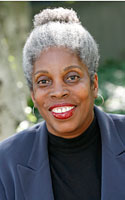
A creator in her own right, Tina Sloan Green has been creating opportunities for women and African-Americans as players and coaches in sports like lacrosse, tennis, golf, and field hockey for more than 40 years. After receiving the rare opportunity for a young girl in the 1950s and 1960s to get a chance to play organized sports, Sloan Green credits team sports with her taking more of an interest in her teachers, friends, and grades.2 She has since dedicated her life to ensure that other young girls are afforded the same opportunities and life lessons sport has provided her.
After she started as a field hockey player at West Chester State University in Pennsylvania, Sloan Green was recruited to the lacrosse team by her field hockey coach who doubled as the coach for both teams. Sloan Green’s field hockey passion was matched by her discovery of lacrosse and she learned to juggle both, a choice certainly supported by her coach, who discovered she could utilize Sloan Green’s talent on both fields. Sloan Green also added badminton to her varsity repertoire for three years. While earning her bachelor’s degree in health and physical education, Sloan Green received All-American field hockey honors in 1965 and 1966 and played on the U.S. National Field Hockey squad in 1969. She also competed with the U.S. Women’s Lacrosse team from 1968 to 1972. In doing so, she became the first African-American woman to be named to the squad. In 1970, she earned her master’s in physical education from Temple University.
Upon completion of her graduate degree and while continuing her international touring with the national lacrosse team, Sloan Green served as the lacrosse coach, basketball coach, cheerleader advisor, and physical education instructor at Lincoln University. She stayed at Lincoln for four years.
In 1974, Sloan Green returned to her first passion of field hockey, this time on the sidelines with the Temple University women’s team as its head coach. She led the field hockey team for five years, earning a 44-33-10 record and three Association for Intercollegiate Athletics for Women (AIAW) National Championships.
Also in 1974, Sloan Green added the Owls lacrosse team to her coaching responsibilities and was the coach of both teams until 1980, when she left her field hockey coaching position. She stayed on the Temple Owls lacrosse field sidelines for 18 seasons, boasting a record of 207-62-4 (a .758 winning percentage), including an NCAArecord 29 straight wins from 1984 to 1985. Between 1973 and 1992, she guided 18 of her players to follow in her prestigious footsteps of earning All-American honors. In 1988, Sloan Green’s Temple team earned its first undefeated season with a 15-7 victory over Penn State University in the NCAA Championship. This victory was the team’s second national championship under Sloan Green, as they had captured the 1984 lacrosse title as well.
Though she had a late start in lacrosse, she has left her impression on the sport nonetheless. When she accepted Temple’s head coaching position in 1975, she became the first African-American head coach in the history of women’s intercollegiate lacrosse.3 She was also the first female African-American and only the second African-American head coach ever to win a NCAA Division I title in 1984.
All the while, Sloan Green was a professor of sport and culture at Temple University. In 1992, Sloan Green left the coaching sidelines, but not Temple University. She turned her focus entirely on her teaching and advancing opportunities for African-American females in sport. As co-founder and head of the Black Women in Sports Foundation, Sloan Green has provided young females the exposure and opportunity to participate in typically white “preppy” sports like tennis and golf. She also founded the Inner City Field Hockey and Lacrosse Program in Philadelphia. Also while a professor at Temple, Sloan Green was co-principal investigator of Sisters in Sports Science, a National Science Foundation-funded program, and directed the university’s National Youth Sports Program. She also authored two books, Black Women in Sport and Modern Women’s Lacrosse, before becoming professor emeritus in the College of Education in 2006 after 32 years of teaching.
In her retirement, Sloan Green gets her greatest satisfaction from watching the prospering career of her daughter, Traci Green. While it was no secret where her passion lay, Sloan Green did not push lacrosse on Traci. Regardless, Traci inherited her mother’s passion for sports, both playing and teaching. But Traci’s skill was undeniably in tennis. Fortunate enough to have Arthur Ashe as a mentor and her mother as a constant supporter, Traci was destined for greatness. After a championship collegiate career, Traci filled the tremendous shoes of her mother and became Harvard University’s first African- American female head coach in the Ivy League school’s history of intercollegiate sports in 2007. Prior to Harvard, Traci coached Temple’s tennis team to its first ever nationally ranked season.
To African-American women like her daughter, Sloan Green offers the following advice, “Education is power.” She suggests, “Get a terminal degree if possible—a law or doctorate degree in your chosen field. Learn your craft. Learn and understand the corporate model of sports, but appreciate and understand the grassroots model as well.”4
Sloan Green’s advice on diversity is equally important. “It is not enough to tolerate diversity,” she says. “To be an effective leader in this day and age, you must embrace diversity. You must treat everyone with dignity and respect.” Coming from someone who has walked the walk more often than talking the talk, it can be as simple as “Be real. Be yourself.”5
Upon her induction into the Black Lacrosse Hall of Fame in 2007, Sloan Green described lacrosse as “the best sport on two feet.” She said, “You can run and gun all the way down the field, you can be physical if you need to be, it’s graceful, especially the women’s game, it’s powerful, and you have to be smart. It requires teamwork, and a level of timing and athleticism and skill that is unparalleled.”6 Most would use such words as physical, graceful, powerful, smart, team player, athletic, and unparalleled skill to describe Tina Sloan Green in all aspects of her career, not just on the field. It is no wonder why she has mastered the art—or rather sport—of lacrosse.
Notes
1. The National Governing Body of Lacrosse, http://www.lacrosse.org/the_sport/index.phtml (accessed March 31, 2008).
2. Ben Hammer, “Reconstructing the status of Title IX; critics say the mandate shortchanges some men’s teams, while proponent argue women’s sports remain under funded,” Black Issues in Higher Education, April 10, 2003.
3. www.cstv.com Temple: Sloan Green to be honored at 1st annual black lacrosse hall of fame induction ceremony, November 17, 2006.
4. Email from Tina Sloan Green to author, June 24, 2008.
5. Ibid.
6. Carla Peay, “Black Lacrosse Pioneers Honored at Hall of Fame Ceremony,”BlackAthlete Sports Network, February 10, 2007, www.blackathlete.net/artman/publish/printer_2877.shtml (accessed March 4, 2008).
The previous excerpt was written by Jessica Barter
IN SEASON:
Tue, Oct 1 at 12:03pm
Fri, Sep 6 at 9:32am
Fri, Nov 8 at 9:29pm
Fri, Nov 1 at 4:39pm
Today at 9:09am
Today at 9:04am
Sun, Nov 10 at 6:59pm
Thu, Nov 7 at 9:08pm
LATEST ARTICLES & POSTS
posted by Swish Appeal
Mon at 9:13am
posted by Swish Appeal
Mon at 9:11am
posted by All White Kit
Sun at 6:42pm

-
The body of this profile is an excerpt from 100 Trailblazers: Great Women Athletes Who Opened Doors for Future Generations.
This book is available on Amazon.com:
This book was written by Dr. Richard Lapchick, chair of the renowned DeVos Sport Business Management Program at the University of Central Florida, along with several of his students in the renowned program:
- Sara Jane Baker
- Jessica Bartter
- Catherine Lahey
- Stacy Martin-Tenney
- Horacio Ruiz
- Ryan Sleeper

The DeVos program offers students the opportunity to earn their Masters in Sports Business Management and a Masters in Business Administration. Focusing on ethics, diversity, leadership, and community service, the DeVos Program attracts some of the brightest and most committed students from across the country and across the globe.
-
This profile was built by:

Taunita Stephenson
About Taunita:
~*Member of the DeVos Sport Business Program (Top 4 Sport Business Programs in the Nation!), Class of 2012*~ ~*Class of 2009, Delaware State University Graduate-Making My Mark on the World!" ~*I am enthusiastic about equality and diversity and hope to begin a career in Player Development or Diversity Initiatives!*~ God, Family, Friends, Career Goals, Jay-Z, Lakers, Fashion-In that order! What I Live By: "Vision without action and a plan is an illusion"