




Patricia "Patty" Berg: Golf
American Star of the Women’s International Sports Hall of Fame
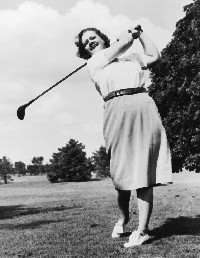
“I’m very happy I gave up football, or I wouldn’t be here tonight,” said Patty “Dynamite” Berg upon her inception into the Ladies Professional Golf Association (LPGA) Hall of Fame in 1951.1 Indeed, thousands of women’s golf fans around the world should be happy she gave up football, and perhaps owe some gratitude to her father, who insisted she stop playing contact sports with growing boys when she became a teenager. After all, some have said that Berg introduced golf to more women than any other player. In recognition of this sentiment, the LPGA’s Patty Berg Award was established in 1978, and continues to be awarded annually to “the lady golfer who has made the greatest contribution to women’s golf during the year.” This award has been given to the likes of Kathy Whitworth, Louise Suggs, and, most recently, Annika Sorenstam. All recipients of the Patty Berg Award have done an honorable job of carrying on her legacy of not only growing women’s golf, but doing so in a classy way. Berg often encouraged people to “shake a hand, and make a friend.”2
Patty Berg was born February 13, 1918, in Minneapolis, Minnesota, where she would later attend the University of Minnesota before becoming a golf legend. She grew up a tomboy with an interest in sports and was a very talented track and field athlete as well as a speed skater; in fact, she was the runner-up in speed skating in the 1933 national girls’ championships. Another sport she enjoyed playing was football. As a youngster, she played quarterback for a local all-boys team, the 50th Street Tigers, where she shared snaps with the eventual, legendary coach of the Oklahoma Sooners, Bud Wilkinson. Also, as a guard and quarterback just years after his time with the Tigers, Wilkinson would lead Berg’s alma mater, the Minnesota Golden Gophers, to three consecutive national football titles from 1934 to 1936. Holding her own with such talent was not uncommon for Berg, but her parents became concerned about her participation with males in aggressive, contact sports such as football. To promote her transition to, as they called it, a more “lady-like” game such as golf, her father purchased a used set of clubs for her as well as a country club membership. Berg’s love of her new game was evident from the start, as she was so enamored with her new gift that she would bring her clubs with her to sleep every night and stack them against her bedroom wall. Her passion for golf and her dedication to improving her skills would result in her winning the Minneapolis City Championship and reaching the semifinals of the United States Women’s Amateur tournament just three years after picking up the game. Berg once said, “There is nothing in this game of golf that can’t be improved upon if you practice.”3
While it has been said that “Patty Berg’s achievements in golf are not measured by tournaments won or checks received,” she certainly did more than her fair share of both during her career.4 After winning her first amateur title in 1934, Berg would go on to win more than 28 amateur titles. Along the way, she gained national notoriety by playing in the finals of the 1935 U.S. Women’s Amateur, where she lost to Glenna Collett-Vare in what was Collett-Vare’s final amateur victory. Upon turning professional in 1940, at the age of 22, Berg had won every single amateur championship title the United States had to offer. Among her most notable amateur achievements are three Minnesota Women’s State Amateur titles in 1935, 1936, and 1938, as well as the U.S. Women’s Amateur title in 1938. She was also a two-time member of the U.S. Curtis Cup team in1936 and 1938. The Curtis Cup is an international competition held biennially that pits teams against each other from the United States, England, Ireland, Northern Ireland, Scotland, and Wales. Berg was recognized as the AP Female Athlete of the Year, for the first of three times, as an amateur in 1938.
There was no organized professional golf tour for women in 1940, but that did not stop Berg from turning professional that year. Riding the fame she had gained through her countless amateur achievements, she was able to travel the country and charge for clinics and exhibitions. It was estimated that she traveled 60,000 miles per year to make her living, and by her own account, she taught over 16,000 clinics and introduced the game to over 500,000 new players in her lifetime. Patty also signed a lucrative endorsement deal with Wilson Sporting Goods, who produced a set of Patty Berg Golf Clubs.
Unfortunately, Berg’s first stint at making money while playing the game she loved was curtailed by injuries she sustained in aserious automobile accident in 1941. These injuries would set her back 18 months in the prime of her career. Most professional athletes would be eager to return to work after a serious injury so as to maximize their short window of opportunity to compete at the highest possible level. Instead, upon recovery, Berg enlisted in the Marine Corps and served four years as a lieutenant during World War II. She passed on the opportunity to make thousands of dollars from 1942 to 1945 so that she could serve her country. Berg’s sense of community and patriotism are truly admirable. Actions like these make it even clearer why people that knew Berg would tell you her accomplishments should not be measured by the amount of tournaments she won or how much money she made.
After the war, Berg rededicated herself to golf full-time. Without even missing a beat after being away from the game for five years, she won her first U.S. Women’s Open Championship in 1946. During this time, the Women’s Professional Golf Association (WPGA), the first professional tour for women, was developing. Despite Berg’s undeniable dominance, the tour struggled. Then in 1950, Berg, along with other notable female golfers of the time Mildred Didrikson Zaharias, Betty Jameson, and Louise Suggs, formed the LPGA. For their contribution to the game, these four women were the first four inducted into the LPGA’s new Hall of Fame in 1951. While this is perhaps Berg’s biggest and most lasting contribution to not only golf, but to the world of sports, her resume is loaded with titles, awards, and honors. As a professional, she earned 60 tour victories, including 15 major championships. She also garnered two additional AP Female Athlete of the Year awards. She was the LPGATour money leader in 1954, 1955, and 1956, as well as the tour’s scoring leader in 1953, 1955, and 1956. She would preach “the will to win, not the wish to win.”5
Perhaps more important, she was also honored with the 1963 Bob Jones Award, recognizing sportsmanship and respect for the game, and the 1976 Humanitarian Sports Award by the United Cerebral Palsy Foundation. Furthermore, for her dedication to community service, she was recognized by the Professional Golfers Association (PGA) in 1995 as their Distinguished Service Award winner, as well as by the Minnesota Golf Association a year later as their Distinguished Service Award winner. Finally, in 1997, Patty Berg was awarded the Spirit Lifetime Achievement Award after 66 years in the game of golf.
Sadly, Berg had to endure cancer and hip and back surgeries from 1971 to 1989, but she never gave up playing golf, and even recorded a hole-in-one in 1991 at the age of 73. Patty Berg passed away September 10, 2006, in Fort Meyers, Florida, from complications that arose from her Alzheimer’s disease. To hear her speak late in her life, she was as electrifying as ever. In an interview with The Golf Channel, she said, “Our key thing was to get women’s professional golf off the ground.”6 When Berg started playing, spectators were charged $2.20 and Berg’s official professional tour winnings totaled $190,760. Last year, the LPGA’s total prize money amounted to $54,285,000. Congratulations, Patty Berg—women’s professional golf is off the ground.
Notes
1. Judy Hasday, Extraordinary Women Athletes (Danbury, Conn.: Children’s Press, 2000), 40.
2. Brent Kelley, About.com: Golf, “Biography of Golfer Patty Berg,” http://golf.about.com/od/golferswomen/p/patty_berg.htm (accessed March 23, 2008).
3. Kelley, About.com: Golf, “Biography of Golfer Patty Berg.”
4. Elinor Nickerson, Golf: A Women’s History (Jefferson, N.C.: McFarland &Company, Inc., 1987), 49.
5. Greg Hardwig, Naplesnews.com, “Berg Keeps Giving Back to the Game She Loves,” http://www.naplesnews.com/news/2006/sep/13/berg_keeps_giving_back_game_she_loves/?printer=1/ (accessed March 23, 2008).
6. LPGA.com, “Patty Berg,” http://www.LPGA.com/content_1.aspx?pid=8002&mid=2 (accessed March 12, 2008).
The previous excerpt was written by Ryan Sleeper
IN SEASON:
Tue, Oct 1 at 12:03pm
Fri, Sep 6 at 9:32am
Fri, Nov 8 at 9:29pm
Fri, Nov 1 at 4:39pm
Today at 9:09am
Today at 9:04am
Sun, Nov 10 at 6:59pm
Thu, Nov 7 at 9:08pm
LATEST ARTICLES & POSTS
posted by Swish Appeal
Mon at 9:13am
posted by Swish Appeal
Mon at 9:11am
posted by All White Kit
Sun at 6:42pm

-
The body of this profile is an excerpt from 100 Trailblazers: Great Women Athletes Who Opened Doors for Future Generations.
This book is available on Amazon.com:
This book was written by Dr. Richard Lapchick, chair of the renowned DeVos Sport Business Management Program at the University of Central Florida, along with several of his students in the renowned program:
- Sara Jane Baker
- Jessica Bartter
- Catherine Lahey
- Stacy Martin-Tenney
- Horacio Ruiz
- Ryan Sleeper

The DeVos program offers students the opportunity to earn their Masters in Sports Business Management and a Masters in Business Administration. Focusing on ethics, diversity, leadership, and community service, the DeVos Program attracts some of the brightest and most committed students from across the country and across the globe.
-
This profile was built by:

Taunita Stephenson
About Taunita:
~*Member of the DeVos Sport Business Program (Top 4 Sport Business Programs in the Nation!), Class of 2012*~ ~*Class of 2009, Delaware State University Graduate-Making My Mark on the World!" ~*I am enthusiastic about equality and diversity and hope to begin a career in Player Development or Diversity Initiatives!*~ God, Family, Friends, Career Goals, Jay-Z, Lakers, Fashion-In that order! What I Live By: "Vision without action and a plan is an illusion"