




Peggy Fleming Jenkins: Wintersports
American Star of the Women’s International Sports Hall of Fame
Website: http://www.peggyfleming.com/
Fleming Jenkins Vineyards & Winery


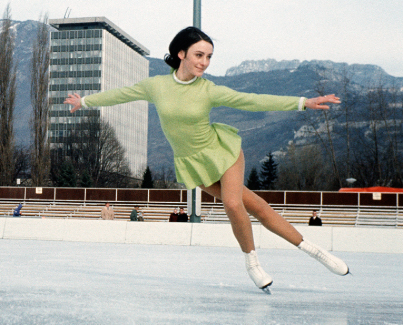
The early 1960s marked a dark period in the illustrious history of U.S. figure skating. At a time when the National Anthem should have been booming over podiums full of American skaters, there was only an eerie silence. In 1961, a tragic plane crash took the lives of all 18 members of the U.S. Figure Skating Team and numerous coaches, officials, friends, and family members. The victims of this crash, on their way to an undoubtedly brilliant showing at the World Championships in Prague, comprised the heart of the American figure skating community. Among the deceased were Maribel Vinson Owen, an extremely talented skater and one-time coach to Tenley Albright and Mabel Fairbanks; her 16-year-old daughter Laurence, the 1961 U.S. Ladies Champion; and 20-year-old daughter Maribel, the 1961 U.S. Pairs Champion.1 In a single instant, the best and brightest American skaters and coaches were gone, a devastating and demoralizing loss. Shining out of this darkness came the delicate but steady light of Peggy Fleming.
Just 12 years old at the time of the crash, Peggy Fleming was an exceptional skater already being coached by William Kipp, one of the elite-level instructors killed in the tragedy. Even without a coach, the loss of America’s best threw the slight, elegant young lady into the national spotlight almost immediately. In 1964, at the tender age of 15, Fleming competed in her first Olympic Games, finishing an impressive sixth in ladies singles. The same year, she captured her first of five consecutive U.S. National Championships. From the smoldering wreckage of the U.S. National Figure Skating Program, Peggy Fleming was rising like the mythical phoenix, restoring hope and life to American figure skating.
In 1966, Fleming took the world by surprise by winning her first World Championship. While reporters focused on her beauty and diminutive size, Fleming concentrated on approaching her physically demanding routines with precision, skill, and grace. Although many female skaters forced themselves into a powerfully athletic approach, Fleming sought to be “ballet-like” and the judges loved her for it.2 She was often compared to former U.S. figure skater Tenley Albright, an athlete known for her beauty, grace, and competitive creativity. Fleming soon became the darling of figure skating, drawing compliments from coaches and competitors alike. She would go on to win two more World Championships in 1967 and 1968.
Though already a U.S. and World champion, Fleming enjoyed her greatest triumph during the 1968 Winter Olympics in Grenoble, France. Fleming skated nearly flawlessly, awing the crowd and handily surpassing the talents of her competition. Just seven years after the loss of the best American skaters and coaches, Peggy Fleming won an Olympic gold medal, returning figure skating glory to the United States. She garnered the only gold medal for the United States at those Olympic Games.
Soon after, Fleming embarked on a professional career, starring in highly popular ice shows and televised skating specials. She later accepted roles on popular television shows, did commercial endorsements, and served as an analyst of figure skating coverage for ABC Sports. Fleming has skated at the White House and at the unveiling of the restored Statue of Liberty. Her talents have won her numerous awards and honors, including 1967 ABC Athlete of the Year, 1968 AP Female Athlete of the Year, and the 2003 Vince Lombardi Award of Excellence. In 1999, Sports Illustrated named her one of seven “Athletes Who Changed the Game,” an honor whose elite company includes Billie Jean King and Jackie Robinson.3
While all of these awards are impressive, one of the most telling stories about Fleming took place at a time when her amazing athletic career was just beginning to bloom. After the 18-year-old sensation won her second world title, a reporter asked her how someone of her small stature and delicate nature could possibly perform such physically taxing routines. In response, Fleming smiled and spoke only two words: “Inner guts.”4
It was these “inner guts” that Fleming called upon in 1998, when she was diagnosed with breast cancer on the 30th anniversary of her gold medal win. With the help of the physical and mental strength she gained over her time as an elite athlete, Fleming was able to approach her cancer as she would an opponent on the rink. “This is another kind of competition, but I’m being coached by an excellent team and I’ve got a real strong competitive spirit.”5 Fleming defeated her diagnosis and became an outspoken advocate for breast cancer awareness.
Today, Fleming owns and operates a winery with her husband Dr. Greg Jenkins. Although she has taken many roles and supported many causes, Fleming may be best remembered for being a beautiful, steady light in a dark time in American athletics. Her poise and performance touched a nation and in return, she garnered the courage to face the darkest time in her own life with hope and strength.
Notes
1. “History of the Memorial Fund,” U.S. Figure Skating, http://www.usfigure skating.org/About.asp?id=206.
2. Bob Ottum, “Crystal and Steel on the Ice,” Sports Illustrated, March 13, 1967.
3. “Peggy Fleming,” Winter Athlete Bios, United States Olympic Committee, http:/www.usoc.org/26_13370.htm.
4. Bob Ottum, “Crystal and Steel on the Ice.”
5. “Peggy Fleming,” Winter Athlete Bios, United States Olympic Committee, http://www.usoc.org/26_13370.htm.
The previous excerpt was written by Catherine Lahey
IN SEASON:
Tue, Oct 1 at 12:03pm
Fri, Sep 6 at 9:32am
Fri, Nov 8 at 9:29pm
Fri, Nov 1 at 4:39pm
Today at 9:09am
Today at 9:04am
Sun, Nov 10 at 6:59pm
Thu, Nov 7 at 9:08pm
LATEST ARTICLES & POSTS
posted by Swish Appeal
Mon at 9:13am
posted by Swish Appeal
Mon at 9:11am
posted by All White Kit
Sun at 6:42pm

-
The body of this profile is an excerpt from 100 Trailblazers: Great Women Athletes Who Opened Doors for Future Generations.
This book is available on Amazon.com: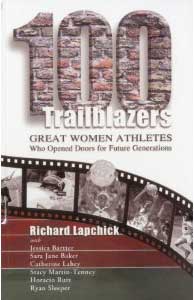
This book was written by Dr. Richard Lapchick, chair of the renowned DeVos Sport Business Management Program at the University of Central Florida, along with several of his students in the renowned program:
- Sara Jane Baker
- Jessica Bartter
- Catherine Lahey
- Stacy Martin-Tenney
- Horacio Ruiz
- Ryan Sleeper

The DeVos program offers students the opportunity to earn their Masters in Sports Business Management and a Masters in Business Administration. Focusing on ethics, diversity, leadership, and community service, the DeVos Program attracts some of the brightest and most committed students from across the country and across the globe.
-
This profile was built by:
Taunita Stephenson
About Taunita:
~*Member of the DeVos Sport Business Program (Top 4 Sport Business Programs in the Nation!), Class of 2012*~ ~*Class of 2009, Delaware State University Graduate-Making My Mark on the World!" ~*I am enthusiastic about equality and diversity and hope to begin a career in Player Development or Diversity Initiatives!*~ God, Family, Friends, Career Goals, Jay-Z, Lakers, Fashion-In that order! What I Live By: "Vision without action and a plan is an illusion"