




Michelle Akers: Soccer
Hall of Famer
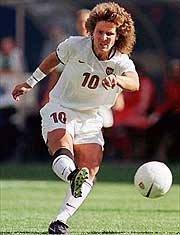
Photo: usatoday.com
Michelle Akers Horse Rescue & Outreach

With three gold medals and two World Cup Championships to date, the U.S. Women’s National Soccer Team has experienced tremendous success. These accomplishments are especially amazing considering it was only 1985 when the United States launched its first women’s team. Michelle Akers had been with the U.S. team since its beginning and deserves much of the credit for growing and increasing the popularity of soccer. Now retired, she set an example and standard for today’s top players as someone who never gave up and who always played with passion and heart.
Although Akers’s parents divorced when she was in sixth grade, she was never without strong role models in her life. Akers’s mother broke a barrier for women when she became the first female firefighter in the city of Seattle, Washington. Like her mother, Akers had big dreams, a competitive spirit, and lots of energy. “My dream was to play for the Pittsburg Steelers like ‘Mean’ Joe Greene and one day win the Super Bowl by catching the ‘Hail Mary’ pass as the last second on the scoreboard ticked down,” Akers remembers.1 She was completely unaware of societal norms and expectations of women and cried when her teacher told her girls do not play football. Instead, Akers’s mother enrolled her in softball, basketball, volleyball, and soccer. Soccer quickly became her passion and by high school, she was the starting center midfielder. She was so good that the men’s coach asked her to train with his team.
After high school, her talent took her all the way to Orlando, Florida, where she was offered a scholarship to the University of Central Florida (UCF). Not surprisingly, Akers’s incredible work ethic, passion, and focus made her the most decorated soccer player in UCF’s history. In addition to earning All-American honors four times, Akers was twice named UCF’s Athlete of the Year, and she led the team to three National Collegiate Athletic Association (NCAA) tournament appearances. Akers left UCF as the all-time leading scorer, and her No. 10 jersey was retired.
In 1985, at only 19 years old, Akers joined the first-ever U.S. National Team. It did not take long for Akers to establish herself as the star of the team. In the second-ever full international game against Denmark, Akers scored the first goal in the history of the program. For the next five years, Akers continued to lead the team in scoring with 15 goals in 24 games. In 1991, the inaugural FIFA Women’s World Cup was held in China. Akers led the U.S. team to its first world championship as the top scorer and winner of the Golden Boot, a prestigious award given to the leading scorer in European League matches. Her international fame brought about the opportunity to sign an endorsement deal and thus, she became the first female soccer player to have a paid sponsor. Akers even pursued her childhood dream of playing in the National Football League (NFL) by trying out as a place kicker for the Dallas Cowboys.
Akers was recognized internationally and had established herself as the top female soccer player in the world. She was at the top of her game. Then, suddenly in 1993, Akers collapsed during a match at the Olympic Sports Festival in San Antonio. What appeared to be mononucleosis advanced into a diagnosis of Epstein-Barr Virus, or Chronic Fatigue Syndrome. If this illness was not enough, a year later, Akers divorced her husband of four years, Roby Stahl. The once dominant player and incredible competitor quickly seemed to be losing confidence and motivation. In a 1996 journal entry, Akers wrote:
I can honestly say these few years were pure hell for me. I went through a divorce. I struggled to get through the day or hour, depending on how bad I was feeling. I desperately searched for medical answers and help but found very little. I frequently asked myself, what happened to that strong, dynamic, tireless Michelle Akers? Will I ever see her again? And who am I now? I was alone. I was scared. I was in agony.2
While most players would have used this illness as an excuse to retire, Akers, once again, proved why she was the top player in the world. Through her perseverance, dedication, and strong faith in God, Akers worked to get back to her old form. However, it was no easy task. Akers struggled to take a five-minute walk without getting out of breath, and after a game, Akers required two liters of intravenous fluid to rehydrate. To add to these circumstances, Akers had 13 knee surgeries, countless stitches, broken facial bones, and concussions. In fact, Julie Foudy, another standout on the U.S. National Team calls her one of the most unlucky players in the game. “She plays a very physical game and things happen, but it’s just so unfortunate that it happens to her so often.”3
Despite the many obstacles, Akers’s play on the field never deteriorated. After winning a gold medal at the Atlanta Olympics in 1996, Akers looked toward the 1999 World Cup. However, she was uncertain whether or not her body would hold up. While her teammates were doing media interviews and photo shoots, Akers kept to herself focusing solely on the World Cup. “The tension of ‘do-or-die’ produces steel-minded strength. I could feel myself sharpening mentally, focusing deep inside me. Still I was bracing myself for the [physical] cost of going 90 minutes,”4 Akers remembered of her preparation.
Finally, at the Rose Bowl in front of 90,187 fans and 40 million TV viewers—the highest number for a women’s sporting event— the World Cup stage was set. Battling 110-degree heat, Akers played almost the entire 90 minutes of the championship match. However, when the game went into overtime, Akers was unable to participate. While Akers was in the locker room hooked up to a heart monitor and IVs, Akers’s teammates battled to the end, winning the game in a shootout. Although Akers was still recovering during the immediate team celebration, her passion and heart did not go unnoticed. U.S. coach Tony DiCicco said, “We all witnessed one of the greatest women athletes in history—a true champion leaving it all on the field, fighting for her teammates.”5
 Akers officially retired in 2001. It was an emotional departure for her teammates and fans, but the fatigue had become too much for her to handle. Although soccer had always been Akers’s passion, she wasted no time in finding a new one. Akers launched Soccer Outreach International (SOI) with a goal “to seek out and inspire kids of all nations to become leaders of quality character, faith, and clear purpose through the game of soccer.” Akers’s love for animals and intuition for horses also motivated her to start the Michelle Akers Sundance Horse Rescue and Outreach. In addition, she has authored three books: The Game and the Glory, Standing Fast, and Face to Face. Akers’s most important role, however, is one of a mother and wife. In 2003, Akers married attorney Steve Eichenblatt, and together they have a son, Cody.
Recently, Michelle Akers was named to the FIFA 100, a list dedicated to the greatest living soccer players. This is an amazing accomplishment considering Mia Hamm was the only other American honored. It also attests to her level of talent; however, it cannot begin to depict her incredible contribution to the game of soccer. As one of the biggest trailblazers in the sport, she laid the foundation for the future of U.S. women’s soccer, and she illustrated, better than anyone else, what it means to play with tremendous courage and heart.
Notes
1. Judith A. Nelson, “Michelle’s Higher Goal,” Today’s Christian, http://www.christianitytoday.com/tc/2000/ 002/1.18.html. March/April 2000.
2. Pocantico Hills Central School, “Michelle Akers,” http://www.pocanticohills.org/womenenc/akers.htm (accessed September 11, 2008).
3. Nelson, “Michelle’s Higher Goal.”
4. Ibid.
5. Ibid.
IN SEASON:
Tue, Oct 1 at 12:03pm
Fri, Sep 6 at 9:32am
Fri, Nov 8 at 9:29pm
Fri, Nov 1 at 4:39pm
Today at 9:09am
Today at 9:04am
Sun, Nov 10 at 6:59pm
Thu, Nov 7 at 9:08pm
LATEST ARTICLES & POSTS
posted by Swish Appeal
Mon at 9:13am
posted by Swish Appeal
Mon at 9:11am
posted by All White Kit
Sun at 6:42pm

-
The body of this profile is an excerpt from 100 Trailblazers: Great Women Athletes Who Opened Doors for Future Generations.
This book is available on Amazon.com: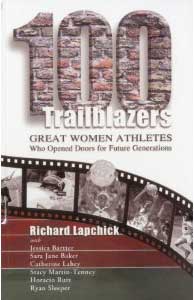
This book was written by Dr. Richard Lapchick, chair of the renowned DeVos Sport Business Management Program at the University of Central Florida, along with several of his students in the renowned program:
- Sara Jane Baker
- Jessica Bartter
- Catherine Lahey
- Stacy Martin-Tenney
- Horacio Ruiz
- Ryan Sleeper

The DeVos program offers students the opportunity to earn their Masters in Sports Business Management and a Masters in Business Administration. Focusing on ethics, diversity, leadership, and community service, the DeVos Program attracts some of the brightest and most committed students from across the country and across the globe.
-
This profile was built by:

Elizabeth Schulz
Orlando, FL
About Elizabeth:
Originally from Little Falls, MN Elizabeth is currently pursuing her MBA and Master's in Sport Business Management at the University of Central Florida. At UCF she is a graduate assistant for The Institute for Diversity and Ethics in Sport. Elizabeth is currently working with the Orlando Magic and has experience working for the Fargo Force and Alexandria Blizzard.