




Katarina Witt: Skating
International Star of the Women’s International Sports Hall of Fame
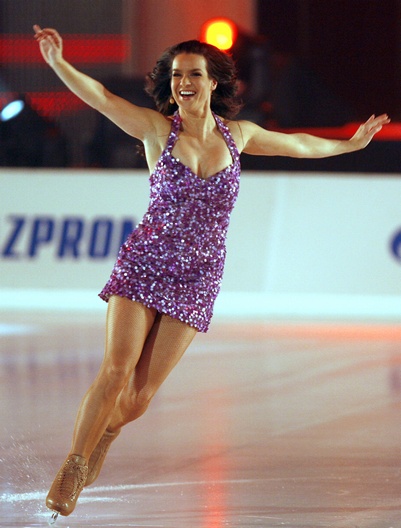
Photo: fitceleb.com


Katarina Witt, a decorated German figure skater, has never been overly concerned by the rules of the game. While she trained relentlessly, followed her diet strictly and strove for athletic greatness, she also drove fast, danced with abandon, and flirted mischievously with all of her adorers. Even as a product of the notoriously rigid East German athletic system, Witt never failed to charmingly assert her individuality. In an East German television interview early in her career, the interviewer attempted to coerce Witt into linking figure skating with physics and scientific development. Witt never budged, refusing to confirm that either aspect was a central part of the sport she loved. While the reporter fumed, Witt glided away on her skates, smiling innocently.1 For Witt, the most decorated figure skater of all time, figure skating was never about the technicality and the hard science.
In keeping with this philosophy, Witt is best known for breathtaking beauty, interpretive and complex routines, and her ability to engage and awe the crowd. For these incredible qualities, Katarina Witt is remembered as one of the most talented and most admired female athletes of all time. Witt began skating as a five-year-old in her hometown of Karl-Marx-Stadt (now Chemnitz), East Germany. By the age of seven, the young prodigy was winning competitions and at age 10 she became a student of Jutta Müeller, the most successful and demanding coach in the East German system.2 Under Frau Müeller’s watchful eye, the talented and spirited Witt developed into an incredible skater with powerful spins and impeccable style. As a coach, Müeller stressed the importance of presentation, storytelling, and style, focusing on the aesthetic elements of skating as much as the technical ones. Witt, often self-described as a person who “likes to flirt,” turned out to be the ideal student for Müeller’s skating philosophy.3 Soon, Witt exploded to prominence and popularity on a grand level. As a teenager in 1981, Witt won her first of eight consecutive National Championships. Two years later, she won the prestigious European Championship, the first of six during her career. After these accomplishments, her stardom was beginning to shine on an international level and 1984 marked a breakout year as she captured a World Championship and competed in her first Olympic Games.
Although not the favorite to win the Sarajevo Games, Witt awed the judges and the audience with her raw and engaging performance, capturing the gold medal. Instantly, Witt’s beauty and playful charm catapulted her to international superstardom both on and off the ice. Love letters from all over the world began to pile up at her door, eventually filling her bathtub when all other storage spaces were exhausted. Her love of life flowed joyfully through her skating and the world was captivated.
Witt soaked up the attention and applied that energy to her skating. Though many in the skating world expected that Witt would retire from skating soon after the 1984 Olympics, she continued to train behind the iron curtain, ignoring offers of citizenship from other nations. Witt’s hard work paid off as she again won the title of World Champion in 1985, 1987 and 1988. Her continued success secured the admiration and respect of her countrymen, elevating her to the status of a national hero. Entering the 1988 Winter Olympic Games, Witt made no secret of the fact that she was ready to retire from amateur skating and that she was absolutely determined to go out on top.
In what has been referred to as the “Dueling Carmens,” East Germany’s Witt and the United States’s Debi Thomas faced off in Olympic competition, both skating their long programs to music from the opera Carmen. As the defending Olympic gold medalist, many saw Witt at a disadvantage because Sonja Henie, in 1936, was the last figure skater to defend her Olympic title. Additionally, the talk of the Games was Witt’s performance attire, as competitors sniped that her garments were far too revealing and detracted from the honor and beauty of the sport. Though Witt and Müeller strongly disagreed, they did slightly modify her short program outfit and Witt internalized the criticism to her advantage. Motivated by the controversy and her desire to close her amateur career as a champion, Witt proved to be the better Carmen, again earning Olympic gold.4
Shortly after the Olympics, Witt turned professional and began touring with famed U.S. skater Brian Boitano. She also spent four years as a performer in Stars on Ice and has created skating shows entitled “Divas on Ice” and “Enjoy the Stars.” In 1990, Witt won an Emmy for her performance in the television special “Carmen on Ice” and has appeared in or produced numerous films and television programs. Also a businesswoman, Witt is a founding partner of the production company With Witt and also has been a spokeswoman for a number of major corporations. Even with all of these roles and achievements, Witt has maintained that “the role I like best is [the role] of the champion.”5 Remembered as the consummate performer, Witt also gives of herself in order to help others. Due to an unprecedented ruling by the International Skating Union (ISU), Witt and other recently declared professionals were able to participate in the 1994 Winter Olympics in Norway. Witt, remembering Sarajevo, the city of her first gold medal victory, dedicated her performance to those suffering in the Bosnian conflict. Though she did not win, the crowd responded emotionally to her impassioned performance, grasping its gravity.6
Today, Witt uses her fame to promote the Katarina Witt Foundation, an organization that seeks to return mobility to children who have physical disabilities. Though Witt’s external beauty made her memorable, it is her internal beauty that has made a lasting impression. Katarina Witt’s talent and commitment to giving back make her the vision of a true champion.
Notes
1. Rick Reilly, “Behold the Shining Star of the G.d.r.,” Sports Illustrated, January 20, 1986.
2. “Competitive Skating,” Biography, Katarina Witt, http://www.katarina.de/index.php?article_id=1&clang=1.
3. Reilly, “Behold the Shining Star of the G.d.r.”
4. E. M. Swift, “To Witt, The Victory,” Sports Illustrated, March 7, 1988.
5. Ibid.
6. Ian Thomsen, “Katarina Witt,” Sports Illustrated, January 31, 1994.
The above excerpt was written by Catherine Lahey.
IN SEASON:
Tue, Oct 1 at 12:03pm
Fri, Sep 6 at 9:32am
Fri, Nov 8 at 9:29pm
Fri, Nov 1 at 4:39pm
Today at 9:09am
Today at 9:04am
Sun, Nov 10 at 6:59pm
Thu, Nov 7 at 9:08pm
LATEST ARTICLES & POSTS
posted by Swish Appeal
Mon at 9:13am
posted by Swish Appeal
Mon at 9:11am
posted by All White Kit
Sun at 6:42pm

-
The body of this profile is an excerpt from 100 Trailblazers: Great Women Athletes Who Opened Doors for Future Generations.
This book is available on Amazon.com:
This book was written by Dr. Richard Lapchick, chair of the renowned DeVos Sport Business Management Program at the University of Central Florida, along with several of his students in the renowned program:
- Sara Jane Baker
- Jessica Bartter
- Catherine Lahey
- Stacy Martin-Tenney
- Horacio Ruiz
- Ryan Sleeper

The DeVos program offers students the opportunity to earn their Masters in Sports Business Management and a Masters in Business Administration. Focusing on ethics, diversity, leadership, and community service, the DeVos Program attracts some of the brightest and most committed students from across the country and across the globe.
-
This profile was built by:

Elizabeth Schulz
Orlando, FL
About Elizabeth:
Originally from Little Falls, MN Elizabeth is currently pursuing her MBA and Master's in Sport Business Management at the University of Central Florida. At UCF she is a graduate assistant for The Institute for Diversity and Ethics in Sport. Elizabeth is currently working with the Orlando Magic and has experience working for the Fargo Force and Alexandria Blizzard.