




Micki King: Swimming
American Star of the Women International Sports Hall of Fame
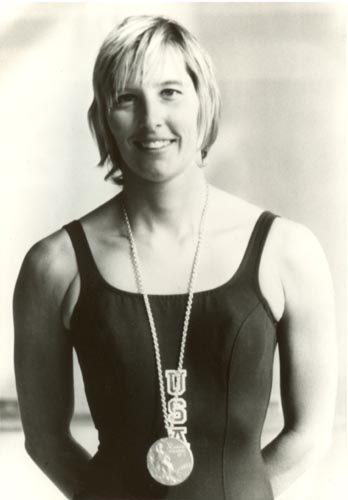
Photo: USA Diving
It was a nightmare; the kind that could linger the rest of one’s life. Olympic diver Air Force lieutenant Micki King was leading the competition in the 3-meter springboard after eight of ten mandatory dives in the 1968 Olympic Games in Mexico City. It happened on the ninth dive. King’s arm hit the springboard as she executed her second to last dive. The accident happened so quickly and innocently, very few people watching even realized she hit. Only two judges caught the mistake and judged her low, but it was missed by the other five judges. She remained in first place with one dive left. Ignoring the mistake, pretending there was not a “bump” on her arm, and fighting off doubts that tried to flood her mind, she performed her last dive—her best dive—a reverse one and a half somersault with one and a half twists. Her arm hurt more than she thought it would, and her poor attempt dropped King off the winner’s podium from first place to fourth. The next day, X-rays showed the “bump” on her arm that she did the last dive with was actually a broken ulna bone.
“I was in shock. I was devastated. I couldn’t believe I blew it,” King said. “I was 24 years old in Mexico City and I had an Air Force career ahead of me. How could I make a stupid mistake like this when the medal was all but mine? I was lost and depressed for long time afterward. And, at that point, I had no plans to make a comeback.”1
King took 30 days’ leave from Air Force duties after her Olympic nightmare and returned to her hometown to visit her parents while she recovered from the broken arm and depression over the ordeal she had just experienced. As close as she had come to being an Olympic champion, it hurt even more to have lost the way she did. King’s parents worried about her, seeing her Olympics tarnished by injury. One day she and her father had a long talk and he reminded her that she was one of the best athletes in the world at Mexico City; that she had met exciting new people from across the globe; and that it was those unique experiences as an Olympian that would always remain special despite missing the medal. But the nightmare still haunted her. “I simply believed I would have to live with my Mexico mistake,”2 she said. King was certain her time had come and gone.
But in 1969, University of Michigan diving Coach Dick Kimball, who had coached King while she was a student at Michigan, convinced her he could get her back into top form. Kimball would sneak King through the backdoors of the diving facilities to get past the administrators who were located at the front door because women were not allowed to compete for Michigan athletics. That year, she made her comeback when she captured the U.S. national diving championship in the 3-meter springboard. It was then that King decided to put the 1968 Olympics behind her and try for the gold once again. She knew exactly what was ahead of her over the next three years leading to the 1972 Games. No one would hand her the gold medal in 1972 because of the accident in 1968. The Air Force supported her request to continue diving and stationed her at an Air Force base near Olympic-caliber facilities, where she practiced diving when she was off duty. She did hundreds of dives a week leading up to the 1972 Munich Olympics. Four years older, King focused solely on the gold medal. “When I headed to Munich I had a whole different attitude. This was my second Olympics, I was 28, I extended my commitment in the Air Force and had begun a career path, but I still had this Olympic goal,” King said. “I was a whole new personality type. The glamour and pageantry in Mexico was certainly there in Munich too, but I was looking beyond that and had one mission, to win the gold.”3
After the preliminary dives, King was in third place, behind two Swedish divers. Prior to the beginning of the competition, Kimball shocked King by telling her that while he would love for her to be 15 points ahead going into the final dives, it would be alright if she found herself two or three points behind the leaders. “I was confused at first,” she said. “My coach had been with me at meets for 10 years. I knew him, he knew me. We had kind of a pattern so we were comfortable with each other. He never gave me a license to not finish first in the prelims.”
After finding herself in third place and three points behind the leader heading into the final dives, King, surprised that Kimball had predicted everything, asked him why he was okay with her being in third place. Kimball pointed across the pool where the two Swedish divers were being interviewed on worldwide television. Dealing with television interviews after her event would be a new experience for King and Kimball did not want her distracted by reporters asking about the broken arm incident from four years prior. By not being first in the prelims, he felt the reporters were less likely to question her. Kimball also knew the other two divers had used their best dives to get to where they were—King was saving her best for last. “He reminded me they used up their best dives while I was coming in with my strongest dives. Besides, they also knew I had my strongest dives left; and I knew they knew I knew.
“The reverse one and a half somersault with one and a half twists that knocked her out in Mexico City was the same dive that catapulted her to the gold in Munich four years later. The nightmare of Mexico was no more.
The 1972 Munich Olympics proved to be an impetus for major changes in U.S. sports. Following her triumph on the 3-meter springboard, King found herself among Olympic teammates who were largely demoralized. There were instances of disappointing performances, disqualifications, the first-ever loss by the U.S. men’s basketball team in Olympic competition, and the tragedy of 11 Israeli athletes killed by terrorists. King remembered the tall basketball players sitting in the back of the U.S. Olympic team plane with their knees nearly up to their chins, while the wives of Olympic Committee officers sat in the front in more spacious seats. The tension was close to spilling over; athletes had no voice in matters that affected them directly. On the plane trip home from Munich, several outspoken athletes sat together and made a list of problems that needed attention. King sat among these athletes from several different sports and took notes. Within months after the Munich Games, a handful of these self-appointed members of the 1972 team set a meeting with the U.S. Olympic Committee (USOC) president Phillip O. Krumm.
Krumm, sensing the athletes’ frustration, recognized the need to include athletes in the Olympics’ decision-making process. Krumm, along with USOC executive director Colonel F. Don Miller, formally recognized the Athletes’ Advisory Council (AAC) as a standing forum of the U.S. Olympic Committee. At the inaugural meeting of the AAC, King was elected its first chairman and led the group for the first four years.
“Micki was a terrific chairman,” original AAC member Ed Williams said. “She was the perfect person for the job. She charmed people. She was a logical choice to be the first president. She was a hard worker, but she was a pleasure to work with.”4
“If it were not for Micki, we might not have had the AAC for a second four years,”5 Miller said.
In large part due to King, the AAC established a solid relationship with the USOC in which the two branches developed a mutual respect. It was this charter AAC under King’s leadership that hammered out the issues of team selection, coach selection, and 20 percent athlete representation on all USOC committees. President Gerald R. Ford appointed King to his Commission to Study Olympic Sports in 1975. This Presidential Commission studied the entire spectrum of amateur sports in the United States. The recommendations from the Commission’s two-year study were incorporated into the federal law known as the Amateur Sports Act (ASA) of 1978. The USOC, as it is known today, is the model recommended by the Sports Commission and included in the federal law. The ASA also incorporated most AAC concerns, including those derived from the athletes’ list on the Munich flight home.
After the Olympics, the Air Force assigned King to the Air Force Academy (AFA) athletic department, where she became the first woman to teach physical education and coach at any military academy. In her first stint as coach from 1973 to 1977, she became the first and only woman to ever coach a man to an individual National Collegiate Athletic Association (NCAA) championship. She was sent on assignments to Arizona, Washington, and Germany, before returning to the AFA in 1984 as an assistant athletic director as well as the diving coach. During this second stint, she was named NCAA Division II Coach of the Year three times and her divers won 11 All-American honors and claimed three individual national titles. In 1992, she retired from the Air Force as a full colonel to accept an assistant athletic director position at the University of Kentucky, a post she held through 2006.
In 1974, Congress passed a law to allow women to attend the then all-male military academies. As the only woman assigned to the AFA at the time, she played a key role in the athletic department transition from men-only to co-ed. She helped develop curriculums for physical education classes, design women’s locker rooms from the former men’s facilities, and plan for the new women’s varsity teams. Her daughter, Michelle Hogue, a 2004 graduate of the Air Force Academy, became a beneficiary of her mother’s work decades before. In appreciation, Michelle sent her mother a miniature AFA graduation ring as a gift with a note King will never forget.
“When she chose to go to the Academy it blew me away,” King said. “Her father and I didn’t push her. The truth is it didn’t occur to us that she would go there. It was her junior year when she wrote me that special note. It said, ‘Mom, if anyone deserves an Air Force Academy class ring—you do! You helped make it possible for me and all the other girls to be here and I don’t think I’ve ever thanked you. I hope this ring reminds you how special you are—not only to me but to so many people.’ Until her note, I never knew if she really understood my role in the co-ed transition, and if she knew how special it was to see my own daughter follow years later as a cadet herself. After I read the note, I knew she knew.”
In 1976, King was among the first members of the advisory board for the Women’s Sports Foundation. She was inducted into the Women’s Sports Foundation Hall of Fame in 1983 and served on its board of trustees from 1988 to 1990. She has served on the board of stewards since 1990. King was elected president of U.S.A. Diving from 1990 to 1994 and in 2005 was selected to serve a four-year term as vice president of the U.S. Olympians Association. Looking back at her career, King recalls milestones and achievements that had not crossed her mind in years, not least of which were her contributions toward advancing opportunities for women in sport. “I won the ultimate prize in sport, but never once did I represent my high school or my college in an athletic competition,” she said. “It wasn’t there for my generation and it was wrong. Now I can watch women’s national championships on television and say, “‘Damn, we did it.’”
Notes
1. Unless noted otherwise, the quotes in this article are by Micki King, from an interview with the author, May 20, 2008.
2. Ibid.
3. Julie Eversgerd, Springboard champion bounces back from broken arm, http://www.olympicusa.org/CFDOCS/Munich/feature_king.cfm.
4. Mike Spence, “Hogue Helped Athletes Become Part of U.S. Olympic Process,”Colorado Springs Gazette Telegraph, February 26, 1989.
5. Ibid.
The previous excerpt was written by Horacio Ruiz
IN SEASON:
Tue, Oct 1 at 12:03pm
Fri, Sep 6 at 9:32am
Fri, Nov 8 at 9:29pm
Fri, Nov 1 at 4:39pm
Today at 9:09am
Today at 9:04am
Sun, Nov 10 at 6:59pm
Thu, Nov 7 at 9:08pm
LATEST ARTICLES & POSTS
posted by Swish Appeal
Mon at 9:13am
posted by Swish Appeal
Mon at 9:11am
posted by All White Kit
Sun at 6:42pm

-
The body of this profile is an excerpt from 100 Trailblazers: Great Women Athletes Who Opened Doors for Future Generations.
This book is available on Amazon.com:
This book was written by Dr. Richard Lapchick, chair of the renowned DeVos Sport Business Management Program at the University of Central Florida, along with several of his students in the renowned program:
- Sara Jane Baker
- Jessica Bartter
- Catherine Lahey
- Stacy Martin-Tenney
- Horacio Ruiz
- Ryan Sleeper

The DeVos program offers students the opportunity to earn their Masters in Sports Business Management and a Masters in Business Administration. Focusing on ethics, diversity, leadership, and community service, the DeVos Program attracts some of the brightest and most committed students from across the country and across the globe.
-
This profile was built by:
Taunita Stephenson
About Taunita:
~*Member of the DeVos Sport Business Program (Top 4 Sport Business Programs in the Nation!), Class of 2012*~ ~*Class of 2009, Delaware State University Graduate-Making My Mark on the World!" ~*I am enthusiastic about equality and diversity and hope to begin a career in Player Development or Diversity Initiatives!*~ God, Family, Friends, Career Goals, Jay-Z, Lakers, Fashion-In that order! What I Live By: "Vision without action and a plan is an illusion"