




Alice Coachman: Track & Field
American Star of the Women’s International Sports Hall of Fame
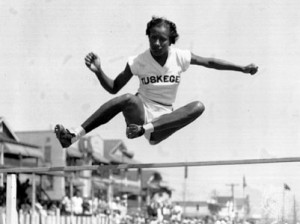
Photo: Leon Shepherd
Website: http://www.alicecoachman.org/


At the start of the 2008 Beijing Olympic Games, former Olympian Alice Coachman had more to smile about than the magnificent Opening Ceremony consisting of 2,008 male drummers who remained entirely in sync and the seemingly gravity-defying gliders who trotted the gigantic elevated globe. Most of the 596 American athletes walked the prestigious “parade of athletes” during what has been acclaimed as the most astounding Olympic Opening Ceremony to date.
One hundred and twenty-six of those athletes, close to half of whom were black, were set to compete in track and field events, something the African-American Coachman truly pioneered. Born in 1923 in Albany, Georgia, she was the fifth of 10 children born to Fred and Evelyn Jackson Coachman. With plenty of brothers and sisters to play with, Coachman was a very active child. Growing up in the segregated South did not allow her many opportunities to participate in organized sports, many of the activities in school, or even at the local YMCAs. She was also discouraged from pursuing sporting activities because of her gender. Needless to say, Coachman’s formative years were characterized by a lack of support for her athletic ability. Without a proper training facility, she was
forced to train on back roads, on playgrounds, and in open fields. Coachman created her own training routine using whatever materials she could find, including her usually bare feet. Despite the less than-ideal training conditions, Coachman was a gifted athlete with the work ethic to succeed.
Perhaps because of her work ethic and seemingly endless ability, two women openly supported Coachman’s potential, encouraging her to use her gifts and talents as best she could: her fifth-grade teacher at Monroe Street Elementary School and her aunt, who supported and defended Coachman’s dreams against her parents’ wishes.
This support was enough to keep her motivated until she reached high school.
In 1938, Coachman attended Madison High School, where the boys’ track coach immediately took an interest in her. Since she had never received formal training, Coach Harry E. Lash was able to teach her and nurture her natural talent from the very basic fundamentals. Because her talent was so raw, even the slightest bit of coaching made a big difference. Just one year later, at age 16, Coachman was offered a scholarship to attend the Tuskegee Preparatory School in Alabama, a big step for her, both athletically and academically.
In her first Amateur Athletic Union (AAU) national championship competition, prior to starting classes at Tuskegee, Coachman broke the AAU high school and college women’s high jump records in her usual fashion—barefoot. While competing at Tuskegee from 1940 to 1946, Coachman went on to win national track and field championships in the 50- and 100-meter dashes, the 4 × 100-meter relay, and the running high jump. She also led the Tuskegee basketball team to three consecutive conference championships as a guard.
Coachman’s love for sports was matched by her commitment to her education. She earned a degree in dress making from Tuskegee in 1946, before moving on to Albany State College in Georgia. Coachman continued her education and her training at Albany State, where she received a bachelor’s of arts in home economics in 1949.
Had the 1940 and 1944 Olympic Games not been cancelled because of World War II, it is likely that Coachman would have competed victoriously in both. Coachman was a dominant high jumper and sprinter for a decade. The peak of her success came when she qualified for the 1948 London Olympic Games with a 5-foot-4-inch jump, despite experiencing back problems. The previous record had been a 5-foot-31/4-inch jump in 1932.
One of Coachman’s teammates, Audrey Patterson, was the first African-American to win a medal at the 1948 Olympics, earning a bronze medal in the 200-meter dash. Not to be outdone by her teammate, Coachman jumped 5 feet, 61/ 8 inches in the high jump event. Her biggest rival in that event was Great Britain’s Dorothy Tyler, who seemed to be mimicking Coachman’s every move. Coachman noticed her copycat and decided to alter her starting position on the runway just a bit; Tyler did the same, but she could not handle the adjustment and she had trouble with the height. Tyler did eventually jump the same height as Coachman, but only after her second attempt, making Coachman the gold medal winner.
The king of England personally presented the medal to Coachman at the awards ceremony. She was not only the first African-American woman to win a gold medal, but also the first American woman to bring home the gold in a track and field event. She was also the only American woman to win a gold medal in the 1948 Games.
After receiving her medal from the king in her Olympic debut, Coachman returned to the United States, where she was treated like royalty. There were parties thrown for her and banquets held in her honor. In the end, however, she decided to retire from athletic competition. She was only 25 years old and in peak physical condition, but like many wise athletes before and after her, she decided to go out on top.
In addition to her Olympic gold medal, Coachman won a total of 25 indoor and outdoor AAU championships during her career. In retirement, she would continue to benefit from endorsements, a rarity for African-American athletes of her time. In 1952, Coachman became the first African-American female athlete to sign a product endorsement with a multinational corporation, The Coca-Cola Company.
Coachman also gave back to many of the institutions that had offered her so many wonderful opportunities both educationally and athletically. She began teaching high school physical education in her hometown of Albany, Georgia. She also eventually taught at South Carolina State College, Albany State College, and Tuskegee High School.
Building off of the experiences she had as a young child and as an Olympic athlete, Coachman founded the Coachman Track and Field Foundation, a nonprofit organization that provides assistance to young athletes and helps former Olympic athletes adjust to life after the Games. She wanted to make sure that every child who wants to chase after her or his athletic dreams has the opportunity to do so.
At the 1996 Atlanta Olympic Games, Coachman was honored as one of the 100 greatest Olympic athletes in history, a very fitting honor for a phenomenal athlete and pioneer. She paved the way for many African-American female athletes to follow in her footsteps, leading to an extremely diverse group of American Olympic competitors today. Her sweat and toil did not go unnoticed, as she has been inducted into several halls of fame, including the National Track and Field Hall of Fame, the Black Athletes Hall of Fame, the Bob Douglas Hall of Fame, the Helm’s Hall of Fame, the Georgia State Hall of Fame, and the Tuskegee Hall of Fame.
Coachman preached a message to people in all walks of life: if you believe and work hard to achieve, victory is yours to receive. With her diligent work ethic, dedication, and passion, she was able to overcome many obstacles and reach her Olympic dreams. Her accomplishments have allowed others like her to dream big.
This excerpt was written by Jessica Bartter
IN SEASON:
Tue, Oct 1 at 12:03pm
Fri, Sep 6 at 9:32am
Fri, Nov 8 at 9:29pm
Fri, Nov 1 at 4:39pm
Today at 9:09am
Today at 9:04am
Sun, Nov 10 at 6:59pm
Thu, Nov 7 at 9:08pm
LATEST ARTICLES & POSTS
posted by Swish Appeal
Mon at 9:13am
posted by Swish Appeal
Mon at 9:11am
posted by All White Kit
Sun at 6:42pm

-
The body of this profile is an excerpt from 100 Trailblazers: Great Women Athletes Who Opened Doors for Future Generations.
This book is available on Amazon.com: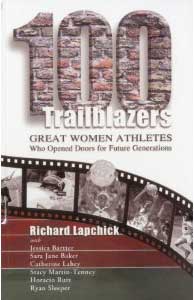
This book was written by Dr. Richard Lapchick, chair of the renowned DeVos Sport Business Management Program at the University of Central Florida, along with several of his students in the renowned program:
- Sara Jane Baker
- Jessica Bartter
- Catherine Lahey
- Stacy Martin-Tenney
- Horacio Ruiz
- Ryan Sleeper

The DeVos program offers students the opportunity to earn their Masters in Sports Business Management and a Masters in Business Administration. Focusing on ethics, diversity, leadership, and community service, the DeVos Program attracts some of the brightest and most committed students from across the country and across the globe.
-
This profile was built by:
Anna Florzak
http://tenniesandtutus.tumblr.com/
@eleanorflorzak
Kansas City, Mo & Orlando, Fla