




Kristi Yamaguchi: Olympics, Skating
American Star of the Women’s International Sports Hall of Fame
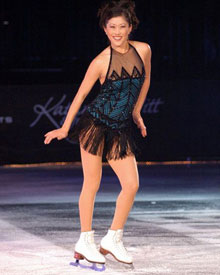
Photo: blogspot.com
Kristi Yamaguchi Always Dream Foundation
Kristi Yamaguchi Power Workout DVD


Through the controversy and scandal on ice that occurred between Nancy Kerrigan and Tonya Harding came a shining star and savior of American figure skating: Kristi Yamaguchi. At first, Yamaguchi struggled with the idea of being an ambassador for figure skating but her undeniable appeal and talent thrust her into the limelight. Despite her resistance, she “always viewed serving as a role model an honor. It’s not something one should have to try and be, but simply being yourself and being responsible is what will serve as a positive example.”1 Yamaguchi learned this lesson first from her skating hero and inspiration, Dorothy Hamill, the 1976 Olympic champion.
Born in Hayward, California, on July 12, 1971, Yamaguchi began skating at six years old as a form of therapy for her club feet. The lessons begot great results by improving her ability to walk and also developing her into an international sensation on ice. As a teenager in 1986, Yamaguchi and partner Rudy Galindo won the pairs U.S. Junior Championships. She followed that performance with a World Junior Championship singles title. Yamaguchi and Galindo were unique in that both were successful individual skaters before being paired with one another. Their individual abilities bettered their team appearance while performing difficult elements that today’s pairs teams are still unable to coordinate.
Galindo and Yamaguchi enjoyed several years of success as a team with a World Juniors Championship title during the 1987–88 season and two more U.S. Championships during the 1988–89 and 1989–90 seasons. But juggling both an individual career with the pairs competition became taxing on Yamaguchi’s overall performance and she was faced with the decision to pick one or the other. In 1990, Yamaguchi was entered in both the ladies singles and the pairs categories for the World Championships and recalls being “exhausted from skating both categories back-to-back” to the point that she “didn’t skate well in either event.”2 Even the International Skating Union officials started putting pressure on the 18-year-old to pick between the two events she loved.
In the end, Yamaguchi chose to focus on her individual career. Almost immediately she enjoyed the fruits of her labor with three event victories during the 1990–91 season: the World Championships, Skate America, and the Nations Cup.
In 1991, Yamaguchi took her focus to the next level by moving to Edmonton, Alberta, to train with legendary coach Christy Ness. That year, Yamaguchi earned her third consecutive silver medal at the U.S. Championships, losing to Tonya Harding. Harding, Yamaguchi, and Nancy Kerrigan traveled to Munich, Germany, a month later for the World Championships. Yamaguchi’s focus on her individual routines was finally breeding success as she earned her first perfect score while on one of the grandest stages of competition, the World Championship! The American team became the first and only ladies team to sweep the medals as Yamaguchi placed first, Harding second, and Kerrigan third.
The streak of second place finishes at the U.S. Championships was finally broken in 1992, when Yamaguchi again beat out Kerrigan and Harding for the title, her first U.S. title. All three earned the honor to travel to Albertville, France, to represent the United States in the 1992 Winter Olympics. Yamaguchi followed in the skates of her role model, Dorothy Hamill, and became the first American woman to skate to Olympic gold since Hamill had done so in 1976.
Kristi Yamaguchi did not take representing her country lightly, as the third-generation Japanese-American recognizes the significance of the American flag. During World War II, her grandparents were forced into American internment camps, where her mother was actually born. Yamaguchi heard firsthand stories from her grandparents that helped build great pride in her heritage and herself as an Asian-American. Some believe Yamaguchi’s Asian heritage has affected her bottom line when it comes to big name endorsements. While marketers may think she lacks the “wholesome All-American” girl image, they can’t argue with a recent 2008 Harris Poll that found Yamaguchi in the top 10 of the United States’ favorite female athletes. Sixteen years after her Olympic stardom, Yamaguchi’s appeal is still undeniable.
Much of Yamaguchi’s lasting-appeal can be directly linked to her huge success with Stars on Ice. After the 1992 season, Yamaguchi turned professional and avoided the mistake many athletes make by refusing to go out on top. After winning Olympic gold, Yamaguchi had reached the epitome of her career and though she kept her competitive spirit, she fulfilled her remaining passion for figure skating with the traveling skating show of Stars on Ice until 2002.
While winning the Olympic gold medal in 1992 was the crowning glory of her professional career, Yamaguchi came home from Albertville with an important gift to her personal life as well. While in France she met her future husband and fellow Olympian, Bret Hedican, a member of the American ice hockey team. The ice-loving pair wed in 2000 and now have two daughters, Keara and Emma.
Most recently, Yamaguchi again won over the hearts of Americans through her participation and domination of ABC’s Dancing with the Stars. Yamaguchi broke many records with her scores during the show’s sixth season. Although she was not new to choreographed routines, dancing on hardwood presented a very different challenge than she was accustomed to on the ice. As always, Yamaguchi practiced hard and performed perfectly to become just the second female star to win Dancing with the Stars.
In 2008, Yamaguchi received the Inspiration Award at the Asian Excellence Awards. Also in 2008, she received the Sonja Henie Award from the Professional Skaters Association. Yamaguchi was also honored with the Women’s Sports Foundation Flo Hyman Award. Both Henie and Hyman are trailblazers included in this book. Yamaguchi joins good company.
Equally important, but lesser known than Yamaguchi’s Olympic triumphs, is her founding of an organization that “helps children fulfill their dreams.” It is rightfully named after her favorite motto: Always Dream. Kristi Yamaguchi’s career is one of a young girl who dared to dream big. From hitting the rink at 5:00 a.m. as a six-year old to standing atop many triumphant podiums along the way, Yamaguchi has given countless young “all-American” girls, particularly Asian-Americans, the opportunity to always dream.

Notes
1. Ethen Lieser, “Golden Girl: Ten Years after Winning the Medal, Kristi Yamaguchi Is Still Celebrating,” AsianWeek, January 20, 2002.
2. “Magic on Ice: Figure Skater Kristi Yamaguchi,” Today’s Woman, March 31, 2002.
This except was written by Jessica Bartter.
Articles Tagged with "Kristi Yamaguchi" on WomenTalkSports.com:
IN SEASON:
Tue, Oct 1 at 12:03pm
Fri, Sep 6 at 9:32am
Fri, Nov 8 at 9:29pm
Fri, Nov 1 at 4:39pm
Today at 9:09am
Today at 9:04am
Sun, Nov 10 at 6:59pm
Thu, Nov 7 at 9:08pm
LATEST ARTICLES & POSTS
posted by Swish Appeal
Mon at 9:13am
posted by Swish Appeal
Mon at 9:11am
posted by All White Kit
Sun at 6:42pm

-
The body of this profile is an excerpt from 100 Trailblazers: Great Women Athletes Who Opened Doors for Future Generations.
This book is available on Amazon.com: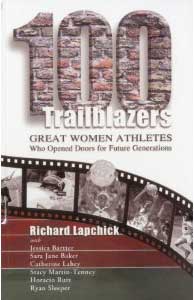
This book was written by Dr. Richard Lapchick, chair of the renowned DeVos Sport Business Management Program at the University of Central Florida, along with several of his students in the renowned program:
- Sara Jane Baker
- Jessica Bartter
- Catherine Lahey
- Stacy Martin-Tenney
- Horacio Ruiz
- Ryan Sleeper

The DeVos program offers students the opportunity to earn their Masters in Sports Business Management and a Masters in Business Administration. Focusing on ethics, diversity, leadership, and community service, the DeVos Program attracts some of the brightest and most committed students from across the country and across the globe.
-
This profile was built by:

Elizabeth Schulz
Orlando, FL
About Elizabeth:
Originally from Little Falls, MN Elizabeth is currently pursuing her MBA and Master's in Sport Business Management at the University of Central Florida. At UCF she is a graduate assistant for The Institute for Diversity and Ethics in Sport. Elizabeth is currently working with the Orlando Magic and has experience working for the Fargo Force and Alexandria Blizzard.