




Althea Gibson: Tennis
American Star of the Women’s International Sports Hall of Fame

Photo: http://browngirlnextdoor.com/
Website: http://www.altheagibson.com/
Black History Minute: Althea Gibson


As the Williams sisters reached the 2008 Wimbledon finals, many noted the great athletic accomplishments for the sisters while fewer noted it as another racial milestone in sports. Venus’s sixth Grand Slam singles title was surely remarkable, but it paled in comparison to the trailblazing efforts of Althea Gibson at Wimbledon in 1957, 51 years earlier.
We honored Arthur Ashe when I was director of Northeastern University’s Center for the Study of Sport in Society. After tennis luminary Bud Collins rightly extolled all of Ashe’s accomplishments and virtues, the first thing Ashe said in his acceptance speech was that “I would not have had the chance to do what I have been able to do if Althea Gibson had not blazed the way for me.”
This daughter of a sharecropper titled her autobiography, I Always Wanted to Be Somebody. By the time the book was released in1958, she definitely was somebody. It came out two years after she had won her first Grand Slam event with victories in both the singles and doubles in the French Open. Her doubles partner was Angela Buxton, who was Jewish. Buxton and Gibson had confronted anti-Semitism and racism, respectively. They repeated their doubles victory at Wimbledon. Buxton was the first Jewish champion at Wimbledon and Gibson was the first African-American champion. An English newspaper reported their victory at Wimbledon under the headline “Minorities Win.”
Gibson was to win a great deal more, including Wimbledon in 1957 and 1958 and the U.S. Championships in 1957 and 1958. In 1957, she earned the No. 1 ranking in the world and was named the AP Female Athlete of the Year in 1957 and 1958. She was the first African-American female to win the AP award.
She suddenly retired from amateur tennis in 1958 in her prime at age 31. There was no prize money and were no endorsement deals for women in that era. Male tennis players had to give up their amateur status, but there was no pro tour for women so Gibson could earn money only in exhibition matches.
Gibson was driven to succeed and became a historical figure in and out of sport. Growing up in an impoverished Harlem, Althea Gibson would change tennis. She became the first African-American tennis star to be hailed internationally and seemed to be opening the door during an era when sexism and racism were abundant. The door was slow to open wider for others. The successes of Serena and Venus Williams, while so important, have been but faint knocks on the door at the elite level of tennis.
Although hopes were high when Gibson won at Wimbledon, it took 42 years for a repeat by an African-American woman. Other women of color to win that coveted crown were Australian Evonne Goolagong Cawley (1971 and 1980), Maria Bueno (1959, 1960, and 1964), and Conchita Martinez (1994).
Born in 1927 in Silver, South Carolina, in 1930 Gibson moved with her family to Harlem in New York City, where they lived on welfare for most of her youth. Gibson often skipped school and ran away from home.
Developing her early skills from table tennis in public recreation parks, she actually won Police Athletic Leagues and Parks Department sponsored tournaments. Musician Buddy Walker gave her the first opportunity to play tennis and helped her to become a member of the Harlem Cosmopolitan Tennis Club, a group of all African- American athletes. In 1942, Gibson played and won her first tournament, which was sponsored by the American Tennis Association (ATA). Later, Gibson was introduced to a physician from Lynchburg, Virginia, Dr. Walter Johnson. He mentored her and gave her the opportunity to play more and better tennis. Dr. Johnson would later be an influential person in the life of Arthur Ashe. In 1946, Gibson decided to further pursue her tennis career and moved to Wilmington, North Carolina, to work under Dr. Hubert A. Eaton while attending high school in North Carolina. Honing her great skills through steady practice, Gibson won her first of 10 straight ATA National Championships in 1947.
Her tennis career continued to rise fast while she was a student at Florida A&M University in Tallahassee, where she graduated in 1953.
Tennis was virtually a 100 percent segregated sport. In 1949, Gibson competed against white tennis players for the first time. Alice Marble wrote an editorial for the July 1950 edition of American Lawn Tennis Magazine. Marble said, “Miss Gibson is over a very cunningly wrought barrel, and I can only hope to loosen a few of its staves with one lone opinion. If tennis is a game for ladies and gentlemen, it’s also time we acted a little more like gentlepeople and less like sanctimonious hypocrites . . . If Althea Gibson represents a challenge to the present crop of women players, it’s only fair that they should meet that challenge on the courts.” Marble said that if Gibson were not given the opportunity to compete, “then there is an uneradicable mark against a game to which I have devoted most of my life, and I would be bitterly ashamed.” Gibson played in the U.S. Championships in 1950 for the first time.
In 1953, Gibson competed on a U.S. State Department to Southeast Asia goodwill tennis tour. When she returned from the tour, the big victories piled up and she won the 1956 French Open.
Gibson won 56 singles and doubles titles during her amateur career in the 1950s and won 10 major titles after the 1956 French Open. Gibson was inducted into the International Tennis Hall of Fame, the International Women’s Sports Hall of Fame, the International Scholar-Athletes Hall of Fame, and many others.
After her retirement from amateur tennis, she released a record album, Althea Gibson Sings, and later appeared in the film, The Horse Soldiers. Her “pro” tennis career included when she toured with the Harlem Globetrotters playing exhibition tennis, for which she reportedly made $100,000 in these matches before the Globetrotters games. In 1964, Gibson began playing professional golf on the Ladies Professional Golf Association (LPGA) tour.
She married Will Durben. In 1971, Gibson again tried to play professional tennis but was far past her prime at the age of 44 and could not compete with many of the younger players.
She became a tennis professional and taught instead. In 1975, Gibson was named the manager of the East Orange, New Jersey Department of Recreation and held the position for 10 years. She was also the New Jersey state commissioner of athletics from 1975 to 1985. Gibson then served on the State’s Athletics Control Board until 1988 and the Governor’s Council on Physical Fitness until 1992, when she retired.
Gibson began experiencing health problems in the 1990s and suffered from a stroke in 1992. She also had two cerebral aneurysms. These health problems caused a significant financial burden
on her and she became a recluse, rarely seeing people or being seen in public. Again living on welfare, Gibson was unable to pay for her medical or living costs. Eventually, Gibson called her old doubles partner, Angela Buxton, and told her she contemplated suicide. Without
informing Gibson, Buxton arranged for a letter requesting support to appear in a tennis magazine. Nearly $1 million poured in from around the world.
I attended the funerals of both Arthur Ashe and Althea Gibson. Arthur, who hailed her as his champion and role model, drew thousands from across the globe to his funeral in Richmond. Hundreds came to Gibson’s service, but did not quite fill the Trinity St. Phillip Cathedral in Newark, New Jersey.
Alan Schwartz, president of the United States Tennis Association,told those gathered that, “She simply changed the landscape of tennis . . . Gibson was no less a trailblazer than baseball great Jackie Robinson or tennis champion Arthur Ashe, although she received less recognition for her accomplishments. Arthur Ashe’s job was not easy, but if he had to climb a hill, Althea Gibson had to climb a mountain. She was the original breakthrough person.”
Zina Garrison was the next African-American woman after Gibson to reach the finals of Wimbledon 33 years later when she played Martina Navratilova in 1990. Garrison eulogized that Gibson was her inspiration: “Althea used to say she wanted me to be the one who broke her barrier, to take the burden off of her (as the only black woman to have won Wimbledon). She showed me the stall where she dressed and where she popped the champagne when she won. She knew she opened the door for all of us, and she was so excited about all the women who followed her.”
Venus Williams released a statement after Gibson passed away saying she had been a role model for her tennis career. “I am grateful to Althea Gibson for having the strength and courage to break through the racial barriers in tennis. Althea Gibson was the first African-American woman to rank number one and win Wimbledon, and I am honored to have followed in such great footsteps.” I surmised that Althea was there in spirit in June 2008 when Venus took her fourth Wimbledon title.
Her legacy is being carried on by the Althea Gibson Foundation, which was founded “for the primary purpose of identifying, encouraging, and providing financial support for urban youth who wish to develop their skills and talents in the sports of tennis or golf, and have decided to pursue a career as a student-athlete at the postsecondary level. The Foundation will continue her work to encourage young people to utilize sports to help improve upon the social condition of urban America and to promote global unity.”
Gibson once said, “I hope that I have accomplished just one thing: that I have been a credit to tennis and my country.” She was a credit to all of humanity.
This excerpt was written by Richard Lapchick
Articles Tagged with "Althea Gibson" on WomenTalkSports.com:
IN SEASON:
Tue, Oct 1 at 12:03pm
Fri, Sep 6 at 9:32am
Fri, Nov 8 at 9:29pm
Fri, Nov 1 at 4:39pm
Today at 9:09am
Today at 9:04am
Sun, Nov 10 at 6:59pm
Thu, Nov 7 at 9:08pm
LATEST ARTICLES & POSTS
posted by Swish Appeal
Mon at 9:13am
posted by Swish Appeal
Mon at 9:11am
posted by All White Kit
Sun at 6:42pm

-
The body of this profile is an excerpt from 100 Trailblazers: Great Women Athletes Who Opened Doors for Future Generations.
This book is available on Amazon.com: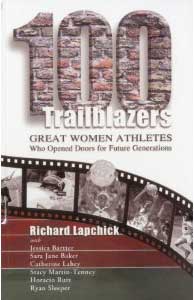
This book was written by Dr. Richard Lapchick, chair of the renowned DeVos Sport Business Management Program at the University of Central Florida, along with several of his students in the renowned program:
- Sara Jane Baker
- Jessica Bartter
- Catherine Lahey
- Stacy Martin-Tenney
- Horacio Ruiz
- Ryan Sleeper

The DeVos program offers students the opportunity to earn their Masters in Sports Business Management and a Masters in Business Administration. Focusing on ethics, diversity, leadership, and community service, the DeVos Program attracts some of the brightest and most committed students from across the country and across the globe.
-
This profile was built by:
Anna Florzak
http://tenniesandtutus.tumblr.com/
@eleanorflorzak
Kansas City, Mo & Orlando, Fla