




Maureen Connolly Brinker: Tennis
American Star of the Women’s International Sports Hall of Fame

Photo: nytimes.com
International Tennis Hall of Fame Profile

Despite a tennis career that lasted just three and a half years, Maureen Connolly Brinker was so well respected for her talent that the International Tennis Hall of Fame inducted her in 1969 and the Women’s International Sports Hall of Fame inducted her in 1987. Perhaps it was her 100 percent victory rate in each of the nine Grand Slam tournaments she entered, or the fact that in three and a half years, she won all but five matches. Better yet, maybe it was the fact that she was the first woman to achieve a Grand Slam by winning each of the four major national championships (United States, Great Britain, France, and Australia) in a single year. There are certainly many arguments that rightfully place Maureen Connolly Brinker in several halls of fame.
Born in San Diego, California, on September 17, 1934, Connolly Brinker initially fell in love with horses. Her parents divorced when she was three and she was raised by her mother and aunt. Her single mother could not afford horseback riding lessons, but luckily, Connolly Brinker’s passion for tennis blossomed, and later, provided her the opportunities with horses that she had always dreamt about.
At nine years old, Connolly Brinker discovered tennis while watching two men competitively rally on the University Heights’ courts just down the street from her home. Though her mother could not afford tennis lessons, Connolly Brinker made herself a useful presence on the courts by shagging balls for the tennis pro Wilbur Folsom, who had a prosthetic leg. In return, Folsom gave Connolly Brinker lessons and her first racquet. His first order of business was to change the natural left-hander into a righty. Through practicing three hours a day, five days a week, Connolly Brinker mastered the transition, though some attributed her weak serve to the fact that she was not a natural right-handed player.
Connolly Brinker increased her practice hours and intensity when, at 12 years old, she came under the tutelage of Eleanor “Teach” Tennant. “Teach improved Maureen’s game technically and molded her into an unyielding competitor by sheltering her and refusing to let her socialize or even practice with the other women players.”1 Teach also embedded a deep hatred into Connolly Brinker, forcing her to believe she had to loathe each of her opponents to be victorious.
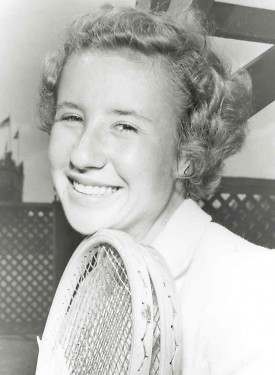 Victories were not a problem for Maureen Connolly Brinker, with or without the hatred she embodied for her competitors. By 14, Connolly Brinker had won 56 consecutive matches and was “beating the very best in the Los Angeles area.”2 In 1949, at age 14 she became the youngest player to ever win the National Girls 18 and under Championship. She defended her title at age 15. The young Connolly Brinker had been nicknamed “Little Mo” by a San Diego Tribune sportswriter after the battleship USS Missouri, which was known as “Big Mo.” The nickname “Little Mo” might conjure the image of a sweet, dainty, girlish individual, but she was nothing but a fierce, explosive competitor on the court, just like “Big Mo” was at sea.
Part of Connolly Brinker’s fierceness came from her preference to play the baseline. As a child, Connolly Brinker was hit in the face while playing the net and, as a result, she feared volleying. Consequently, she developed a fierce drive from the baseline, and she routinely hit the ball within inches of her competitor’s baseline with tremendous force.
In 1951, Connolly Brinker won the U.S. Championships, just weeks shy of her 17th birthday. This victory made Connolly Brinker the second youngest American champion since May Sutton, who had won at age 16 in 1904. The following year, Connolly Brinker defended her U.S. title and became the second youngest winner of Wimbledon when she defeated Louise Brough:
Small and compact, she hit with a tremendous power which she developed through more intensive practice than any woman who has yet played at Wimbledon . . . Her concentration was enormous and in order to unwind she would normally go straight from a tournament win to a practice court where she could gradually relax through hitting the ball smoothly and easily, rather than with the power and determination of match play. Even when she won the Wimbledon final she followed this routine, her perfectionist approach completely overcoming the natural glee of a seventeen-year-old girl winning what is virtually the championship of the world.3
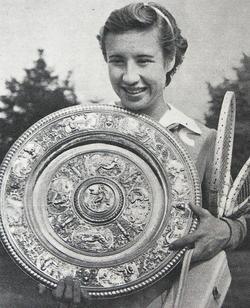 During 1953, Connolly Brinker had a new coach, Australian Harry Hopman, who convinced her for the first time to enter all four Grand Slam tournaments. Together they set their sights on Connolly Brinker becoming the first female player to win all four championships in a single season. She hoped to be the next Don Budge, who had successfully won his Grand Slam in 1938, “a year after he conceived of the idea.”4 Connolly Brinker first won the Australian title, then the French Open, where she lost the only set of the entire Grand Slam. She continued winning in England without dropping a set and played against Doris Hart in what many regarded as one of the greatest women’s finals ever played at Wimbledon. With a final score of 8-6 and 7-5, both sets were so close even Hart left the court feeling victorious, despite being defeated. At three-quarters of the way to her Grand Slam, Connolly Brinker traveled to New York to compete in the U.S. Championships. The stellar play of this 18-year-old was unstoppable and though she again met Doris Hart in the finals, Connolly Brinker handled Hart much easier this time in just 43 minutes with a score of 6-2, 6-4.
Despite Connolly Brinker’s period of great success in the tennis world, she went largely unrecognized by the major media outlets. At the pinnacle of her career, only devout tennis fans would have noticed Connolly’s feat of winning all four title tournaments. Despite the fact that Connolly Brinker was the first woman to accomplish such a feat, the New York Times had the men’s U.S. Open champion on the front page while mention of Maureen Connolly Brinker’s Grand Slam sweep could only be found buried within the sports section, no doubt indicative of the era’s attitude toward women. Connolly Brinker repeated her victories at the French and Wimbledon championships in 1954, but little did she know they would be the last of her career. Connolly Brinker returned home to San Diego and was horseback riding with friends “on a narrow side road when a noisy cement truck passed between them. [The horse] whirled. The truck’s rear mudguard caught Maureen’s right leg, throwing her to the ground. The impact tore the muscles below her knee and broke and exposed the bone.”5 The accident occurred just weeks after Connolly Brinker’s third Wimbledon title. A few months later, Connolly Brinker was forced to announce her retirement. She was only 20 years old and though she had accomplished many great challenges in the tennis world, it was almost certain she had not yet reached her prime.
Notwithstanding this calamity, Connolly Brinker did not steer clear of horses. In 1955, she married Norman Brinker, who was a member of the 1952 United States Olympic equestrian team. Together they had two children.
It was common knowledge, and Connolly Brinker agreed, that her tennis stroke was never affected by the accident. She continued to hit with immense power and pinpoint accuracy until the day she died, the only difference being her undeniable lack of movement to the ball. Maureen Connolly Brinker suffered another undeserved blow to her health in 1966, when she was diagnosed with cancer. While on vacation in Europe, Connolly Brinker experienced terrible back pains for which she sought treatment upon her return to the United States. The doctors informed her that she had cancer. Like her tennis career, Connolly Brinker fought for three years, but unlike her success on the court, she lost her battle with cancer on June 21, 1969, at the age of 34. Billie Jean King sums up Maureen Connolly Brinker well: “Her life, like her career, was fulfilling but too short.”6
Notes
1. Billie Jean King, We Have Come A Long Way (New York: McGraw-Hill Book Company, 1988), 84.
2. Ibid.
3. James Medlycott, 100 Years of the Wimbledon Tennis Champions (New York: Crescent Books, 1977), 61.
4. King, We Have Come a Long Way, 87.
5. Ibid., 88.
6. Ibid., 89.
This excerpt was written by Jessica Bartter.
IN SEASON:
Tue, Oct 1 at 12:03pm
Fri, Sep 6 at 9:32am
Fri, Nov 8 at 9:29pm
Fri, Nov 1 at 4:39pm
Today at 9:09am
Today at 9:04am
Sun, Nov 10 at 6:59pm
Thu, Nov 7 at 9:08pm
LATEST ARTICLES & POSTS
posted by Swish Appeal
Mon at 9:13am
posted by Swish Appeal
Mon at 9:11am
posted by All White Kit
Sun at 6:42pm

-
The body of this profile is an excerpt from 100 Trailblazers: Great Women Athletes Who Opened Doors for Future Generations.
This book is available on Amazon.com:
This book was written by Dr. Richard Lapchick, chair of the renowned DeVos Sport Business Management Program at the University of Central Florida, along with several of his students in the renowned program:
- Sara Jane Baker
- Jessica Bartter
- Catherine Lahey
- Stacy Martin-Tenney
- Horacio Ruiz
- Ryan Sleeper

The DeVos program offers students the opportunity to earn their Masters in Sports Business Management and a Masters in Business Administration. Focusing on ethics, diversity, leadership, and community service, the DeVos Program attracts some of the brightest and most committed students from across the country and across the globe.
-
This profile was built by:

Elizabeth Schulz
Orlando, FL
About Elizabeth:
Originally from Little Falls, MN Elizabeth is currently pursuing her MBA and Master's in Sport Business Management at the University of Central Florida. At UCF she is a graduate assistant for The Institute for Diversity and Ethics in Sport. Elizabeth is currently working with the Orlando Magic and has experience working for the Fargo Force and Alexandria Blizzard.