




Mary Kathyrn "Mickey" Wright: Golf
American Star of the Women’s International Sports Hall of Fame
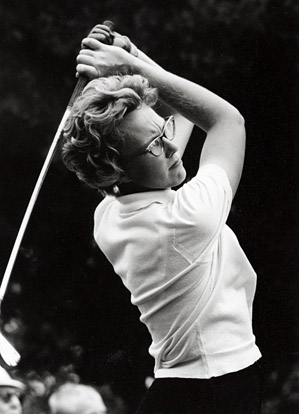
Photo: James Drake/SI
Valentine’s Day, 1935, Arthur Wright, an expectant father, was certain his wife Dorothy would give birth to a son he would call Michael. When the couple had a daughter, they ended up naming her Mary Kathryn Wright. Arthur had to improvise by nicknaming his girl, “Mickey.”
Since birth, Mickey has been challenging conventional gender roles and expectations.
Unlike her famous predecessors such as Babe Zaharias, who although an amazing athlete in her own right, packaged her abilities with extracurricular, attention-grabbing activities, Wright made no qualms about simply being a great golfer for a man or a woman, whether anybody liked it or not. While perhaps no other female player shattered barriers and stereotypes quite like Wright, she never purposely set out to do so. Her natural ability was enough to make people step back and think about everything women are capable of.
In an excerpt from Playing From the Rough: The Women of the LPGA Hall of Fame, author and golf insider Jackie Williams talks about Wright’s place in the golf world:
Wright had no “private agenda” to challenge accepted gender roles. Wright’s talent and hard work, and possibly fate had put her in a position that made her a threat—albeit, an unknown one—to conventional thought. Wright’s ability to play golf at a phenomenal level forced others in the golf world to deal with the issue as best they could.
Mickey Wright did not seek this role. Once placed in the situation, Wright demonstrated that she had the intelligence and courage to play it out with grace and honesty. In doing so, she unintentionally played a key role in unlocking a door which future women golfers would more easily open.1
“I wanted to be the best at something,” Wright said in a 1997 interview.2 Many certainly argue that she was the best women’s golfer of all time due to her awe-inspiring accomplishments. Wright won at least one tournament on the Ladies Professional Golf Association (LPGA) tour each of the first 14 years she competed from 1956 to 1969. That 14-year winning streak is second in LPGA history only to the great Kathy Whitworth, who also stands alone in front of Wright for most career tournament wins of all-time with 88; Wright’s career mark stands at 82 victories. These marks are even more impressive when you consider Wright retired at the age of 35. This means she potentially left many playing years on the table by retiring at a much younger age than most golfers. She also won 13 major championships, including a record four U.S. Women’s Opens (1958, 1959, 1961, and 1964), four LPGA Championships (1958, 1960, 1961, and 1964), three Western Opens (1962, 1963, and 1966), and two Titleholders Championships (1961 and 1962). Her amateur highlights include a U.S. Girls Junior Championship in 1952, a World Amateur Championship in 1954, and the U.S. Open low amateur score in 1954.
You could call Wright the prodigy of the group of women golfers among the pages of this book, having technically been introduced to the game by her father when she was just seven years old. That’s when her father bought her a complete set of toy golf clubs from a dime shop in San Diego. Wright swung the clubs so hard that she broke every one of them.3Abit of grace was added to that powerful swing over the years and eventually her swing was transformed into what fellow hard-hitting legend Ben Hogan would describe as “the finest I ever saw, man or woman.”4 This is quite a statement, considering Ben Hogan is renowned as the utmost authority on the mechanics of the golf swing, having revolutionized golf swing theory.
Wright likely inherited some of her athletic prowess from her father, who played football at the University of Michigan. Her athletic ability was present at a very young age when she started walking at nine months old and she has been very coordinated ever since. She attributes her great “ball sense,” which many female golfers consider so important, to the fact that her father began playing baseball with her when she was just four years old. However, when Wright began pestering her father to allow her to accompany him to the golf course when she was 11, he was reluctant.
“Take some lessons first and then I’ll play golf with you,” he promised.5 So Wright immediately began taking lessons with Johnny Bellante at the La Jolla Country Club. Bellante was also the first teacher of another great golfer, Gene Littler. In 1961, Bellante’s two star pupils, Gene Littler and Mickey Wright, captured both the Men’s and Women’s U.S. Opens!
Bellante was so impressed with Wright during their three years together that he asked the San Diego Union newspaper to send out a photographer to witness his future golf legend. The Union not only printed Wright’s picture in its paper, they captioned the photo, “The Next Babe?”6
This question was a sign of things to come, as just a few years later at the age of 19, Wright would have the torch symbolically passed to her by Babe Zaharias. It happened in 1954 at Wright’s very first U.S. Women’s Open when, on the last day of the tournament, Wright was paired with Zaharias. Although Zaharias ended up winning, Wright broke 80 in each round and she hung tough with arguably the greatest athlete of all time the entire day. Wright ended up finishing fourth overall, but was the lowest scoring amateur, and a star was born.
Despite this success, her father was still hesitant to give his daughter his blessing to pursue a career in golf. “I was ready to play professionally. My father was not that enthusiastic. He believed that women should have something that would offer security if they were unmarried. To him security meant a teaching certificate.”7
In order to pursue her dream, Wright made a deal with her father. Her father agreed to give her $1,000 to give the tour a shot. She promised that if she ran out of money, she would go back to school. Eighty-two victories and hundreds of thousands of dollars later, Wright has never looked back. This is quite a far cry from the $2,000 a year she would have earned teaching had she accepted the safer, gender-accepted role.
Notes
1. Jackie Williams, Playing from the Rough: The Women of the LPGA Hall of Fame (Las Vegas: Women of Diversity Productions, 2000), 84–85.
2. Ibid., 83.
3. Terri Leonard, In the Women’s Clubhouse: The Greatest Women Golfers in Their Own Words (Chicago: Contemporary Books, 2000), 165–166.
4. Ibid., 178.
5. Ibid., 168.
6. Ibid., 169.
7. Williams, Playing from the Rough, 88.
This excerpt was written by Ryan Sleeper.
IN SEASON:
Tue, Oct 1 at 12:03pm
Fri, Sep 6 at 9:32am
Fri, Nov 8 at 9:29pm
Fri, Nov 1 at 4:39pm
Today at 9:09am
Today at 9:04am
Sun, Nov 10 at 6:59pm
Thu, Nov 7 at 9:08pm
LATEST ARTICLES & POSTS
posted by Swish Appeal
Mon at 9:13am
posted by Swish Appeal
Mon at 9:11am
posted by All White Kit
Sun at 6:42pm

-
The body of this profile is an excerpt from 100 Trailblazers: Great Women Athletes Who Opened Doors for Future Generations.
This book is available on Amazon.com: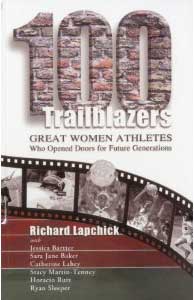
This book was written by Dr. Richard Lapchick, chair of the renowned DeVos Sport Business Management Program at the University of Central Florida, along with several of his students in the renowned program:
- Sara Jane Baker
- Jessica Bartter
- Catherine Lahey
- Stacy Martin-Tenney
- Horacio Ruiz
- Ryan Sleeper

The DeVos program offers students the opportunity to earn their Masters in Sports Business Management and a Masters in Business Administration. Focusing on ethics, diversity, leadership, and community service, the DeVos Program attracts some of the brightest and most committed students from across the country and across the globe.
-
This profile was built by:
Elizabeth Schulz
Orlando, FL
About Elizabeth:
Originally from Little Falls, MN Elizabeth is currently pursuing her MBA and Master's in Sport Business Management at the University of Central Florida. At UCF she is a graduate assistant for The Institute for Diversity and Ethics in Sport. Elizabeth is currently working with the Orlando Magic and has experience working for the Fargo Force and Alexandria Blizzard.