




Margaret Osbourne duPont: Tennis
American Star of the Women’s International Sports Hall of Fame
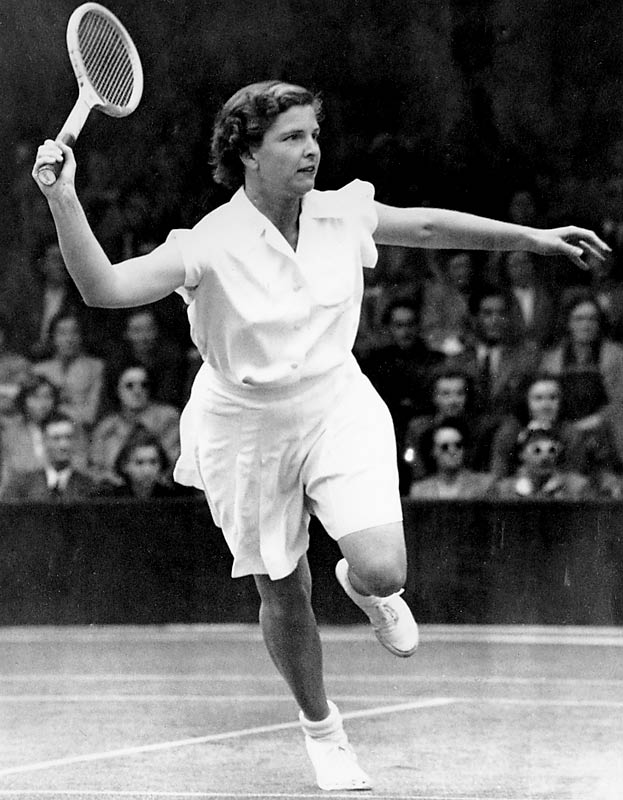
Photo: cnn.com
International Tennis Hall of Fame Profile

As the epitome of a trailblazer, Margaret Osborne duPont made her own path as she became an American tennis star whose career spanned across four decades from the late 1930s to the early 1960s. Born on a farm in 1918 in the small community of Joseph, Oregon, she cannot recall having any heroes to aspire after. Instead, she blazed her own trail.
Osborne duPont has since retired to El Paso, Texas, but the time in between has been a journey. The Osborne family left the Oregon farm due to the health of Margaret’s father. After two years in Spokane, Washington, they moved to San Francisco, where he found work as a car mechanic in a garage that was much more conducive to his medical condition in comparison to the hard labor of a farm.
One summer in Spokane, when Osborne duPont was 10 years old, her mother bought her and her older brother tennis racquets. Yet, rather than signing them up for tennis lessons, she sent the children to music classes. On her way to her music lesson, Osborne duPont made sure to pass the tennis courts, where she would stop to watch or shag balls. Then upon moving to San Francisco, Margaret and her brother, already familiar with the game, discovered the public courts at Golden Gate Park. She says they “played on every public court in San Francisco.”1
The lack of heroes or heroines did not make Osborne duPont exempt from being impressionable at a young age. She does recall a junior high graduation speaker who spoke about sports. He explained to the adolescents that “there is no such thing as a bad sport or a good sport. You are either a sport or not a sport. And from that day forward, sportsmanship was very high in [her] book.”2
Upon her High School of Commerce graduation in January 1936, Osborne duPont focused her attention on a career in tennis since her family could not afford to send her to college. Tennis brought her great opportunities to travel the world and she started with a trip to the Junior Nationals, where she won both the singles and doubles titles at 18 years old. She accepted side jobs writing for The American Lawn Tennis Magazine and working for the Northern California Tennis Association as the secretary treasurer to help sustain her while she focused most of her time on the practice court.
Despite her early victories at the Junior Nationals, Osborne duPont was not happy with her tennis game. She said she “couldn’t do what I wanted to do with the game I had,”3 so she took a year off solely to train with legendary coach Tom Stow. Day in and day out, she hit the court with him for a full year without getting burned out, because, as she told me, she had “too much ambition.”4
Osborne duPont won her first of 37 Grand Slam titles in 1941 at the U.S. Championships in women’s doubles. She went on to win a total of 21 women’s doubles, 10 mixed doubles, and six singles titles at the U.S Championships, Wimbledon, and French Open spanning from 1941 to 1962. Osborne duPont’s title-tally still ranks her fourth on the all-time list despite never competing in the fourth Grand Slam event, the Australian Open.
When reading Osborne duPont’s tennis bio, it is the numerous records she set and still holds that immediately jump out. Even more impressive is the length of time her records have stood, considering most were set over 50 years ago. Yet longevity is a theme of Margaret Osborne duPont’s career. Very few can claim the length of dominance Osborne duPont earned on the international tennis circuit. Writer and tennis enthusiast Stan Hart declared in his book Once a Champion that, in fact, no one can be compared with Osborne duPont’s longevity. Hart wrote, “for longevity, there is no one that I can think of who equals Margaret Osborne duPont.”5
While her career was lengthy, Osborne duPont is also known for a couple of particularly lengthy matches. The 1948 U.S. Championships final lasted the longest of any women’s singles final of that tournament. Osborne duPont battled Louise Brough point for point before edging her out 3-6, 6-4, and 15-13 at Forest Hills, New York. Margaret and Louise then joined the same side of the net to win the women’s doubles final, one of nine consecutive championships they earned together from 1941 through 1950. The Osborne duPont and Brough duo actually won a record of 20 Grand Slam women’s doubles titles, a number that has since been matched (but not exceeded) by partners Martina Navratilova and Pam Shriver.
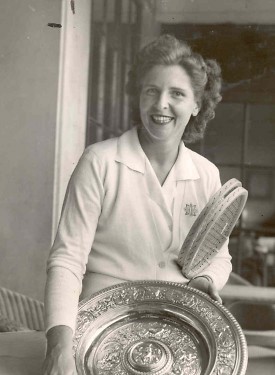
In what she remembers as the toughest doubles match she ever played in, Osborne duPont and partner Billy Talbert played a 71-game, two-day spanning match against Gussy Moran and Bob Falkenburg, also in 1948, during the mixed doubles’ semifinal. She recalls, “We had to end it on the first day at 22-all and then continued the next day. The wind was so strong that day at the grandstand court at Forest Hills that you couldn’t possibly win a game on one side of the court and you couldn’t possibly lose a game on the other. We just never could finish the set.”6 Finally, on their second day of competition, they did finish a set and were victorious 27-25, 5-7, 6-1. The 71-game record stood for 43 years until the 1991 Wimbledon final went 77 games.
Margaret Osborne duPont went on to win titles up until 1962. Between 1938 and 1958, she was ranked among the top 10 in the world 14 times. Fifty years later, in 2008, when asked what advice she could offer today’s stars, Osborne duPont doesn’t think she has much to offer. She points out the drastic difference in tennis from the World War II era to the new millennium by saying, “We played with wooden racquets, and the balls are much harder now. Our game was more about finesse, not so much power as today.” She adds that the stars of her day “did not receive any money,” so they truly played for the love of the game.7 The humble Margaret Osborne duPont did not realize that that is the best advice she could give: “play for the love of the game.”
Notes
1 Stan Hart, Once a Champion: Legendary Tennis Stars Revisited (New York: Dodd, Mead & Company, Inc., 1985), 397.
2 Ibid..
3 Interview with author, August 14, 2008.
4 Ibid.
5 Hart, Once a Champion, 391–92.
6 Ibid., 394.
7 Interview with author, August 14, 2008.
This excerpt was written by Jessica Bartter.
IN SEASON:
Tue, Oct 1 at 12:03pm
Fri, Sep 6 at 9:32am
Fri, Nov 8 at 9:29pm
Fri, Nov 1 at 4:39pm
Today at 9:09am
Today at 9:04am
Sun, Nov 10 at 6:59pm
Thu, Nov 7 at 9:08pm
LATEST ARTICLES & POSTS
posted by Swish Appeal
Mon at 9:13am
posted by Swish Appeal
Mon at 9:11am
posted by All White Kit
Sun at 6:42pm

-
The body of this profile is an excerpt from 100 Trailblazers: Great Women Athletes Who Opened Doors for Future Generations.
This book is available on Amazon.com:
This book was written by Dr. Richard Lapchick, chair of the renowned DeVos Sport Business Management Program at the University of Central Florida, along with several of his students in the renowned program:
- Sara Jane Baker
- Jessica Bartter
- Catherine Lahey
- Stacy Martin-Tenney
- Horacio Ruiz
- Ryan Sleeper

The DeVos program offers students the opportunity to earn their Masters in Sports Business Management and a Masters in Business Administration. Focusing on ethics, diversity, leadership, and community service, the DeVos Program attracts some of the brightest and most committed students from across the country and across the globe.
-
This profile was built by:

Elizabeth Schulz
Orlando, FL
About Elizabeth:
Originally from Little Falls, MN Elizabeth is currently pursuing her MBA and Master's in Sport Business Management at the University of Central Florida. At UCF she is a graduate assistant for The Institute for Diversity and Ethics in Sport. Elizabeth is currently working with the Orlando Magic and has experience working for the Fargo Force and Alexandria Blizzard.