




Margaret Wade: Basketball
American Star of the Women’s International Sports Hall of Fame
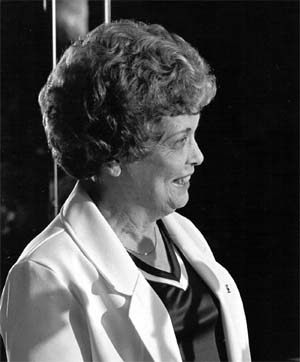
Photo: hoopedia.nba.com

Margaret Wade’s legacy will always be as the “mother of modern women’s college basketball.”1 The title is not the least bit hyperbolic. After all, she contributed to the sport of basketball in almost every capacity, and without her, women’s basketball would not enjoy the recognition it does today.
Although Margaret Wade was a skilled college and professional player, she is best remembered for contributions to the sport of basketball as a coach. She created a dynasty at Delta State University, leading the Lady Statesmen to three consecutive Association for Intercollegiate Athletics for Women (AIAW) National Championships and racking up a .789 winning percentage, a percentage that few coaches—men’s or women’s—have matched.2
Former players have described Wade as relentless in her demands of her players. Sue King, a standout player at Delta State, described the intensity of the calisthenics regimen Wade dictated with one simple statement: “She all but killed us.”3 King’s teammates and, in fact, everyone who ever played under Wade, would most likely echo similar sentiments. When every last bit of mental and physical energy was exhausted, Wade would find a way to get her players to reach deeply within themselves and somehow find even more.
While all would agree that her high performance expectations were integral to her teams’ successes, her ability to personally inspire each player was, perhaps, even more significant.4 Pat Summitt, the winningest coach in basketball history stated, “Anyone who knew Margaret was touched by her life. She had a passion for teaching and a desire to win that was hard to quench.”5
Her accomplishments are even more impressive given the obstacles Wade faced. When she started coaching at Delta State in 1972, women were still fighting for equality in sports. In fact, 1972 was the first year Delta State had even fielded a women’s basketball team since 1931—ironically, a team that Wade was a member of while a junior at Delta State. The next year Delta State cut women’s basketball, depriving Wade of the opportunity to play her senior year. Declaring that the sport was “too tough” on women in the 1932 statement defending its decision, Delta State officials stated that an intercollegiate basketball program for women “could not be defended on sound grounds.”6
Decades later, when Wade was asked to lead the reinstated program, she quickly turned attention away from any lingering stereotypes about women and made an instant impact. Aformer Delta State sports information director described her first year as “one of the most amazing accomplishments in sports history.”7 This successful first year turned out to be only a precursor to many more triumphant seasons.
Through coaching, Wade was able to finally accomplish many of the goals she was unable to attain as a player since the star forward’s career was suddenly cut short at the start of Wade’s senior year. Basketball had been the focus of Wade’s life since her youth, and she described this time as “especially tough.” Filled with anger and despair, Wade and her teammates burned their college uniforms as a form of protest again the administration’s sexist decision.
Several years later, Wade had another opportunity to play basketball. She played two seasons with a semi-pro team, the Tupelo Red Wings. Unfortunately, her career was cut short again, this time with a knee injury.
Nevertheless, Wade was determined to find another way to be involved with the game she loved so much. Coaching became her way to stay connected. She enjoyed a successful reign as the coach for the Cleveland (Mississippi) High School girls basketball team. When Wade stepped down from this position in 1954, she had led her team to the North Mississippi tournament 14 out of 15 seasons.
Before accepting the coaching job with Delta State, Wade served as the director of women’s physical education for the school. This job, along with her success at the high school level, made her the obvious prime candidate for head women’s basketball coach when the program was reinstated in 1973. Wade was eager about this opportunity. It brought back the great memories of her college career and also served as a way for her to bring emotional closure to the pain of her terminated 1932 senior season.
The current administration at Delta State stills credits Wade for putting the small college in Cleveland, Mississippi, on the map. Margaret Wade impacted the school not only as a coach, but also as a player and administrator. The current women’s basketball coach at Delta State, Sandra Rushing, credits Wade with making her job easier. “Her legacy of winning, and the way she went about it, will never be forgotten on this campus.”8 Rushing says that giving her recruits and players the opportunity to wear the same immortal green and white and to play in the same venerable facility that Margaret Wade made famous has made coaching basketball at Delta that much easier.
Margaret Wade passed away in 1995 but not before being recognized for her achievements. She became the first woman, coach or player, ever to be inducted into the National Basketball Hall of Fame. She was also enshrined in both the Delta State University and Mississippi Sports Halls of Fame.
The memory of Margaret Wade retains a prominent place in the world of college athletics. Each year, the best female player in National Collegiate Athletic Association (NCAA) Division I Basketball is awarded the Margaret Wade Trophy. The trophy is not only the oldest and most prestigious award in women’s basketball, but its annual presentation serves as a way to assure that the greatest players of today and tomorrow will never forget this great pioneer. With the establishment of the trophy in 1978, Margaret Wade’s name has already been associated with the some of the greatest names in college basketball, including Rebecca Lobo and Diana Taurisi. This connection only seems appropriate. She is, after all, a major reason why these women had the opportunity to play and excel in college basketball.
Prior to her death, Margaret Wade commented on the honor of this trophy: “My last will and testament to the ‘Margaret Wade Trophy’ will be the satisfaction that prospects of the award will create and stimulate desires in young women athletes throughout the country which will propel them to their greatest achievements in athletics; if their athletic accomplishments can be recognized by the award, then my life has been worthwhile.”9
Notes
1. 2004–05 Lady Statesmen Media Guide, “Lily Margaret Wade.” Delta State University, http://www.gostatesmen.com/sports/wbasketball/WBB-PDFs/Section7-WBB-0607-MargaretWade40to41.pdf.
2. Ibid.
3. “Margaret Wade, 82, basketball Coach,” New York Times, http://query.nytimes.com/gst/fullpage.html?res=990CE5DA1138F934A25751C0A963958260.
4. Ibid.
5. “Lily Margaret Wade.” Delta.
6. Ibid.
7. Ibid.
8. Ibid.
9. Ibid.
This excerpt was written by Sara Jane Baker.
IN SEASON:
Tue, Oct 1 at 12:03pm
Fri, Sep 6 at 9:32am
Fri, Nov 8 at 9:29pm
Fri, Nov 1 at 4:39pm
Today at 9:09am
Today at 9:04am
Sun, Nov 10 at 6:59pm
Thu, Nov 7 at 9:08pm
LATEST ARTICLES & POSTS
posted by Swish Appeal
Mon at 9:13am
posted by Swish Appeal
Mon at 9:11am
posted by All White Kit
Sun at 6:42pm

-
The body of this profile is an excerpt from 100 Trailblazers: Great Women Athletes Who Opened Doors for Future Generations.
This book is available on Amazon.com:
This book was written by Dr. Richard Lapchick, chair of the renowned DeVos Sport Business Management Program at the University of Central Florida, along with several of his students in the renowned program:
- Sara Jane Baker
- Jessica Bartter
- Catherine Lahey
- Stacy Martin-Tenney
- Horacio Ruiz
- Ryan Sleeper

The DeVos program offers students the opportunity to earn their Masters in Sports Business Management and a Masters in Business Administration. Focusing on ethics, diversity, leadership, and community service, the DeVos Program attracts some of the brightest and most committed students from across the country and across the globe.
-
This profile was built by:

Elizabeth Schulz
Orlando, FL
About Elizabeth:
Originally from Little Falls, MN Elizabeth is currently pursuing her MBA and Master's in Sport Business Management at the University of Central Florida. At UCF she is a graduate assistant for The Institute for Diversity and Ethics in Sport. Elizabeth is currently working with the Orlando Magic and has experience working for the Fargo Force and Alexandria Blizzard.