




Margie Wright: Softball
American Star of the Women’s International Sports Hall of Fame
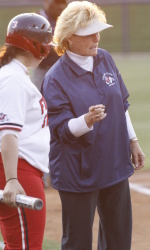
Photo: gobulldogs.com

Like so many other women in sports, Margie Wright’s first experiences with athletics were marked by disappointment. As a 10-yearold in Illinois, Wright was banned from playing Little League because of her gender. After she had been crying inconsolably for days, Wright’s father finally convinced her to play for him on an allgirls team.1 Although Wright was the one immediately saddened, it was the Little League Association that should have been crying. Through the dedication of her parents, the little girl the Association turned away became one of the most talented athletes the area had ever seen. Today, Wright is thankful for the opportunities that came of her initial denial, saying, “My experiences as a player and coach in the sport of softball have been phenomenal. Not only did I have the opportunity as a young girl to play at the highest level available because of my mom and dad, but that led me to a career that has allowed me to accomplish every possible goal a player or coach would ever dream to accomplish.”2 Despite, or perhaps because of, the adversity she faced, Wright dedicated her life to the promotion of athletic and professional opportunities for young women.
Contributing to this personal calling were Wright’s experiences as a college athlete. Even though facilities and amenities for female athletes were often scarce, Wright cherished her time as a student-athlete at Illinois State University. She graduated with 11 varsity letters spread across the sports of basketball, softball, and field hockey and, more important, a defined purpose for her life. Inspired by her interactions with a former coach, Wright decided that she too would coach female athletes in order to help provide them with hope, direction, and the best opportunities possible.3
Wright immediately became head softball, basketball, volleyball, track, and bowling coach at Metamora High School in Illinois, mentoring a number of young women. Soon, she returned to collegiate athletics as a volleyball and softball coach at Eastern Illinois University. Wright found her way back to her alma mater in 1980, taking the reins of the Redbird softball program and quickly leading them to the 1981 Association for Intercollegiate Athletics for Women (AIAW) Softball College World Series. In six years as head coach at Illinois State, Wright amassed 163 wins, a .638 winning percentage, and two conference titles, just a glimpse of the great success to come.
Wright brought her winning ways to California’s Fresno State University for the 1986 season when she was chosen from 74 applicants to become the Bulldogs’ next head coach.4 Upon her arrival, Wright began to mold Fresno State into a successful and disciplined fastpitch program. Not only were Wright’s athletes expected to perform on the diamond, they were also pushed to excel in the classroom. As stated on Fresno State’s softball website, the philosophy of the Bulldogs’ program is simply to be “the very best you can be, both as a softball player and as a person.”5 From the beginning of her tenure, Coach Wright set the bar high for her student-athletes.
Now in her 24th season at the helm of Bulldog softball, Wright is the winningest coach in National Collegiate Athletic Association (NCAA) softball. She is one of two coaches in any collegiate sport to have ever won over 1,300 games and was the only coach at Fresno State to have brought home a National Championship (1998) until the men’s team won the 2008 College World Series. In softball, Wright is a coaching legend, respected at every level of the game. She has coached some of the most talented and intelligent athletes to ever play the sport, including: 53 All-Americans, 16 Academic All-Americans, 15 Olympians, and four NCAA Postgraduate Scholarship Award winners, just to name a few distinctions. During her tenure, the Bulldogs have averaged 50 wins a season and are among the leaders in Women’s College World Series trips with 10 appearances, including three third-place and three runner-up finishes in addition to its national title.
Along with all of the team success, Wright has also been honored numerous times for her personal contributions to the game and to women’s athletics. She has twice been inducted into the Hall of Fame at her alma mater (once as a player and once as the member of a specific team) and is a member of the Fresno Athletic Hall of Fame. Wright is a five-time winner of Western Athletic Conference Coach of the Year and seven-time winner of West Region Coach of the Year and was named 1998 National Coach of the Year for softball. Additionally, she has been inducted into the Illinois Amateur Softball Association (ASA) and National Fastpitch Coaches Association (NFCA) Halls of Fame. Wright has also acted as a coach in the United States Olympic System, serving as a U.S. National Team coach for the 1996 Quadrinium, a period that included her time as an assistant during the team’s 1996 Olympic gold medal victory in Atlanta. In 2005, Wright was inducted into the International Women’s Sports Hall of Fame for her contributions to women and women’s athletics, an honor that she considers very meaningful.
Although she has dedicated her life to achievement and expects excellence, it is not awards, public recognition, or wins that motivate Wright. For Wright, the true goal of coaching is to lead young women to expect the individual best from themselves while always promoting the continued improvement of the climate of women’s athletics. In 2006, one of Wright’s “kids” (she considers her team to be a family) was diagnosed with cancer.6 The young woman is now in remission, but the diagnosis and ensuing battle reminded Wright that her coaching philosophy is the right one. Winning in collegiate softball is important, but winning at life is the true quest.
When asked to consider the entirety of her dynamic career as a player and a coach, Wright commented, “The support of my parents and family made all of the difference in the world and the fact that I had to put myself through college on a bank loan, has driven me to fight for Title IX and the future for young women in athletics. My 34-year playing career allowed me to play with and against some of the best female athletes ever and my 34-year coaching career has given me the opportunity to coach some of the best athletes ever in my sport. Representing my country in the Olympics and all areas of international competition, winning a gold medal, and winning an NCAA National Championship is more than I could have imagined. And bigger than that, having a positive effect on the growth and development of so many athletes, my life as a coach has been very rewarding. I truly owe it all to my parents, family, and all those athletes I have had the opportunity to be around.”7
Coach Wright might be surprised to find out how many of those current and former female athletes feel that they owe it all to her.
Notes
1. Sheila Mulrooney Eldred, “For Wright, Some of Best Coaching Moves Made Off Field,” Sports, The Fresno Bee, April 3, 2004.
2. Margie Wright, email interview with Catherine Lahey, May 27, 2008.
3. Sheila Mulrooney Eldred, “For Wright, Some of Best Coaching Moves Made Off Field,” Sports, The Fresno Bee, April 3, 2004.
4. Jeff Davis, “Wright Gets Her Day—and It’s by Proclamation,” Sports, The Fresno Bee, May 15, 2005.
5. Margie Wright, “A Message From Coach Wright,” Softball, Fresno State Bulldogs Website, http://gobulldogs.cstv.com/sports/w-softbl/spec-rel/011701aab.html.
6. Karrin Luce, “A Day in the Life of a Coach,” The Yelp, Fresno County Women’s Chamber of Commerce, April 2007.
7. Margie Wright, email interview with Catherine Lahey, May 27, 2008.
This excerpt was written by Catherine Lahey.
IN SEASON:
Tue, Oct 1 at 12:03pm
Fri, Sep 6 at 9:32am
Fri, Nov 8 at 9:29pm
Fri, Nov 1 at 4:39pm
Today at 9:09am
Today at 9:04am
Sun, Nov 10 at 6:59pm
Thu, Nov 7 at 9:08pm
LATEST ARTICLES & POSTS
posted by Swish Appeal
Mon at 9:13am
posted by Swish Appeal
Mon at 9:11am
posted by All White Kit
Sun at 6:42pm

-
The body of this profile is an excerpt from 100 Trailblazers: Great Women Athletes Who Opened Doors for Future Generations.
This book is available on Amazon.com: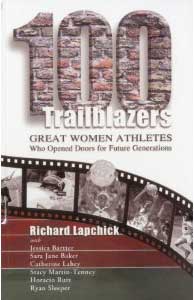
This book was written by Dr. Richard Lapchick, chair of the renowned DeVos Sport Business Management Program at the University of Central Florida, along with several of his students in the renowned program:
- Sara Jane Baker
- Jessica Bartter
- Catherine Lahey
- Stacy Martin-Tenney
- Horacio Ruiz
- Ryan Sleeper

The DeVos program offers students the opportunity to earn their Masters in Sports Business Management and a Masters in Business Administration. Focusing on ethics, diversity, leadership, and community service, the DeVos Program attracts some of the brightest and most committed students from across the country and across the globe.
-
This profile was built by:
Elizabeth Schulz
Orlando, FL
About Elizabeth:
Originally from Little Falls, MN Elizabeth is currently pursuing her MBA and Master's in Sport Business Management at the University of Central Florida. At UCF she is a graduate assistant for The Institute for Diversity and Ethics in Sport. Elizabeth is currently working with the Orlando Magic and has experience working for the Fargo Force and Alexandria Blizzard.