




Anita DeFrantz:
National Reform Leader—Olympic Sport
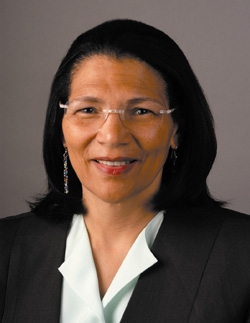
Website: http://anitadefrantz.net/


Anita DeFrantz has lived a life defying the odds. She did not play sports as a child despite the fact that she grew up in Hoosier basketball territory in Indiana. She rowed in college despite the fact that she was on an academic scholarship. She won an Olympic medal in rowing despite the fact that she had been introduced to the sport just five years prior. She defied President Jimmy Carter’s 1980 Moscow Olympic boycott despite the fact that the United States Olympic Committee (USOC) had not previously contradicted any president’s orders and sent Olympians into competition. She was elected vice president of the International Olympic Committee despite the fact that no female before her held that position. And that was just during the first 50 years of her life.
DeFrantz was born in Philadelphia but grew up in Indianapolis, where she learned a great deal of compassion and strength from her parents. Both her mother, who was a teacher, and her father, who ran an organization called Community Action Against Poverty, displayed commitments to youth, community, and education, and encouraged their daughter to do the same. In 1970, DeFrantz enrolled at Connecticut College on an academic scholarship with no athletic intentions, but, as a sophomore, discovered the sport of rowing. While walking on campus one day, DeFrantz stopped to ask a man about the long, thin object he was carrying. The man, Bart Gulong, turned out to be the rowing coach and the object he was carrying was a rowing shell. DeFrantz’s interest and 5-foot-11-inch build caused him to encourage her to participate in the new sport at Connecticut College. Though DeFrantz had never tried the sport before, she knew most of the girls who went out for the team would also be beginners; so she gave it a shot. Gulong had been right in predicting DeFrantz’s athleticism and shortly thereafter, he suggested she consider training for the Olympics. At the time, DeFrantz was not even aware that rowing was an Olympic sport for women because it had just been chosen to make its debut in the next Olympics.
DeFrantz graduated with honors in 1974 with a bachelor’s degree in political philosophy after competing at the collegiate level for three years. Her excellence in the rowing shell earned her a spot on the national team every year from 1975 until 1980. Coach Gulong’s suggestion came to fruition as DeFrantz traveled to Montreal for the 1976 Olympic Games. Just five years after learning the sport, De-Frantz, and the rest of the American team, came in third place behind the East Germans and Soviet Union in the Olympic debut of women’s rowing. In the midst of Olympic training, DeFrantz applied to and enrolled in law school at the University of Pennsylvania. After graduating in 1977 and passing the bar exam, DeFrantz began practicing law representing children.
In October 1977, DeFrantz participated in her first of many changes involving the Olympic Committee. She and three other Olympians were summoned to testify regarding the rights of athletes. Their testimony helped produce the Amateur Sports Act of 1978, which restructured the way Olympic sports are governed in the United States.
While a bronze medal in the Olympics is nothing short of an amazing accomplishment, DeFrantz hoped to return to the 1980 Olympics and capture the gold. Her participation with the national team kept her in tiptop shape while she was simultaneously fulfilling her professional career as a lawyer. DeFrantz worked for a public interest law firm in Philadelphia that protected children before taking a year off in 1979 to focus on what would be her last Olympic opportunity. To DeFrantz’s dismay, then-President Jimmy Carter announced in January 1980 that the United States planned to boycott the 1980 Olympics in Moscow because of the Soviet invasion of Afghanistan.
As a lawyer, DeFrantz immediately knew she and her teammates had rights as athletes. She did not want to stand by and watch President Carter strip away the athletes’ Olympic dreams. DeFrantz believed the Olympics were pure of political confrontations between countries and that a boycott represented the exact opposite of the Olympic ideology. DeFrantz had been a member of the USOC’s Athletes Advisory Council since her Olympic debut in 1976. She and other members pleaded with the USOC to defy President Carter’s order and eventually filed suit to allow them the opportunity to compete. DeFrantz knew the USOC could enter a team regardless of President Carter’s suggestions. Despite this, the Carter administration’s threat to ruin the USOC’s funding was taken seriously enough that DeFrantz, her teammates, and every other 1980 Olympic hopeful would have to wait another four more years.
Until the boycott decision was official in April 1980, DeFrantz continued to train, hoping for the best. She had become the face and name connected with the opposition to Carter’s position and the associated unpatriotic accusations left her very unpopular, making her the recipient of disturbing hate mail. Though the suit was lost, DeFrantz’s fight for athletes’ rights was just beginning.
While the opposition DeFrantz presented made her disliked by many, she certainly attracted notice, not all of which was negative. In 1981, Peter Ueberroth hired her on the management team of the 1984 Summer Olympic Games scheduled to take place in Los Angeles. Ueberroth asked her to serve the Los Angeles Olympic Organizing Committee as liaison with the African nations and as chief administrator of the Olympic Village. DeFrantz is credited with helping to save the 1984 Summer Games by preventing African nations from boycotting because South African runner Zola Budd was allowed to run for Great Britain. She had the credibility because she had actively opposed apartheid and had worked with Richard Lapchick and the American Coordinating Committee for Equality in Sport and Society (ACCESS) to keep South Africa out of international sports contests. Lapchick, who became a lifelong friend, calls Anita “one of sport’s greatest leaders and heroes. She always stands up for justice.” She has had many opportunities to do so.
DeFrantz was named vice president for the newly created Amateur Athletic Foundation (AAF) of Los Angeles, which was established from $93 million of the $230 million profit the Games produced. In 1987, she became president of the AAF, which has since changed its name to The LA84 Foundation. During the previous year, the International Olympic Committee (IOC) was looking to fulfill a lifetime position and found 34-year-old DeFrantz. Her appointment makes her a voting member of the IOC until the age of 80, when the position will become honorary in 2032. DeFrantz is one of two Americans to represent the United States and was the first woman and the first African-American to do so. DeFrantz finally gained the platform necessary to make her case for athletes’ rights.
In 1988, DeFrantz spoke out against the injustice she witnessed at the Olympic Games. Canadian Ben Johnson tested positive for performance-enhancing drugs after running the 100-meter dash in 9.79 seconds. DeFrantz refused to shy away from the controversy and spoke out publicly to fight for pure, drug-free Olympic competitions. Eight years and two Olympic Games later, DeFrantz continued to fight for clean sports by preventing the Atlanta Committee for the Olympic Games from using less expensive and not as concise drug testing methods for the 1996 Atlanta Games.
As a member of the IOC, DeFrantz made an impact fighting for athletes’ rights and the purity of the Games. Yet, her commitment and intelligence made her worthy of a position with the IOC that exhibits more power. From 1992 until 2001, DeFrantz sat on the executive board and in 1997 she accomplished a feat no female had successfully done in the past. DeFrantz was named one of the four vice presidents of the IOC, serving a four-year term. In the history of the IOC, which dates back to1894, a woman had never held such a prestigious position.
DeFrantz, whose high school did not offer team sports for girls, has worked tirelessly to provide opportunities for underprivileged youth, ensuring opportunities exist for males and females alike. The LA84 Foundation is committed to the eight counties of Southern California but focuses mainly on Los Angeles. And while no child is turned away, special emphasis is placed on girls, ethnic minorities, the physically challenged and developmentally disabled, and other underserved community members. DeFrantz knows sports can change one’s life and bring so much opportunity to a child, socially and physically. Nonetheless, she is realistic with the children, informing them of their slim chances in becoming professional athletes and encouraging them to focus on their education as well. De-Frantz believes this message should also be carried by the coaches and has committed the LA84 to a special coaching education program since 1985. In its first 20 years of existence, DeFrantz has led the LA84 in its endeavors that have provided nearly $50 million in grants to youth programs and has trained over 50,000 coaches.
DeFrantz is active in several youth, sport, and legal organizations, including Kids in Sports, the NCAA Leadership Advisory Board, the Juvenile Law Center, The Knight Foundation Commission on Intercollegiate Athletics, the Institute for International Sport, and FISA (the International Rowing Federation). DeFrantz also sits on several different Olympic committees, utilizing her historic position to the fullest.
In 2004, the First Lady of California, Maria Shriver, created The Minerva Awards in an effort to honor women for their humanity and commitment to service. Shriver chose four special women whose stories she believed would inspire others in the community, state, and nation. Fittingly, DeFrantz was a 2005 recipient of The Minerva Awards. Shriver named the Awards after the Roman goddess portrayed on the California State Seal who represents both a warrior and a peacemaker.
The great-great-granddaughter of a Louisiana plantation owner and one of his slaves, Anita DeFrantz has proven herself to be a true leader. She has achieved many firsts, both for her family and for our nation. This internationally known figure has put so many before her selflessly and persistently. She truly is a warrior and a peacemaker.
This excerpt was written by Jessica Bartter
Anita DeFrantz Trial By Fire: Challenging the 1980 Olympic Boycott:
IN SEASON:
Tue, Oct 1 at 12:03pm
Fri, Sep 6 at 9:32am
Fri, Nov 8 at 9:29pm
Fri, Nov 1 at 4:39pm
Today at 9:09am
Today at 9:04am
Sun, Nov 10 at 6:59pm
Thu, Nov 7 at 9:08pm
LATEST ARTICLES & POSTS
posted by Swish Appeal
Mon at 9:13am
posted by Swish Appeal
Mon at 9:11am
posted by All White Kit
Sun at 6:42pm

-
The body of this profile is an excerpt from 100 Trailblazers: Great Women Athletes Who Opened Doors for Future Generations.
This book is available on Amazon.com:
This book was written by Dr. Richard Lapchick, chair of the renowned DeVos Sport Business Management Program at the University of Central Florida, along with several of his students in the renowned program:
- Sara Jane Baker
- Jessica Bartter
- Catherine Lahey
- Stacy Martin-Tenney
- Horacio Ruiz
- Ryan Sleeper

The DeVos program offers students the opportunity to earn their Masters in Sports Business Management and a Masters in Business Administration. Focusing on ethics, diversity, leadership, and community service, the DeVos Program attracts some of the brightest and most committed students from across the country and across the globe.
-
This profile was built by:

Anna Florzak
http://tenniesandtutus.tumblr.com/
@eleanorflorzak
Kansas City, Mo & Orlando, Fla