




Anne "Sandy" Barbour:
Leader at the NCAA Division I-A Level
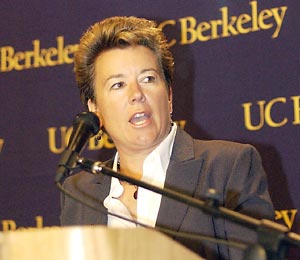
Photo: http://berkeley.edu/news/media/releases/2004/09/16_barbour.shtml
Life in a military family is typically characterized by discipline, structure, and constant relocation. The Barbour family, headed by Henry, a Navy pilot who was shot down twice over Korea, was no exception. The Barbours spent time both on U.S. soil and abroad during their children’s formative years. Sandy, the youngest of three girls, later recalled that life as a Barbour was militaristically “ ‘Yes, Sir,’ ‘No, Sir,’ or ‘I’ll find out, Sir.’” She once complained about being kicked out of basketball practice for mouthing off to the coach, and her father stood her up in front of the hall mirror and pointed out, in no uncertain terms, that such behavior was unacceptable.1 Needless to say, expectations were high in the Barbour household.
Although strict, Henry had a deep love of sports that he instilled in his youngest daughter. In her youth, Sandy was banned from playing Little League baseball based on her gender, even though her skills were on par with those of her male counterparts. A consummate champion for his children, Henry fought for her inclusion, but ultimate ly was unsuccessful. Despite the disappointment, Sandy’s love for sports grew as she and her father attended innumerable Navy and Baltimore Colts football games. For Sandy Barbour, a childhood passion quickly turned into a successful professional career.
Barbour attended Wake Forest University, where her superior athletic skills garnered her four varsity letters as captain of the field hockey team and two more as a varsity basketball player. After graduating with a degree in physical education, Barbour continued her
education at the University of Massachusetts, earning a master’s degree in sports management while working as an assistant coach for both the field hockey and lacrosse teams. She then moved into athletic administration at Northwestern University, eventually holding the position of assistant athletic director for intercollegiate programs for six years, as well as earning an MBA from Northwestern’s Kellogg School of Management. Post-graduation, Barbour spent a short
time working in programming and production for FOX Sports Net in Chicago before returning to college athletics.
In 1991, Barbour was recruited to join the administration team at Tulane University as an associate athletic director. Upon the departure of athletic director and mentor Kevin White, Barbour took the helm of Green Wave athletics. Over her three year tenure as athletic director, she led Tulane to an unprecedented 12 conference championships, including an undefeated season and a national ranking in football with Coach Tommy Bowden. After leaving Tulane, White had been appointed athletic director at Notre Dame and Barbour eventually joined him there as an associate athletic director before being promoted to the role of senior athletic administrator.2 Remembering the commitment to excellence that her father had instilled in her, Barbour raised the bar in each of these positions,drawing attention from the collegiate athletic community.
Her hard work paid dividends in 2004, when Barbour was offered a job that she called “a dream come true, both personally and professionally”—director of athletics at the University of California, Berkeley (Cal).3 Although some likened the difficulty of her task to
“being sent straight to the mound in the bottom of the ninth,” Barbour accepted the honor and the challenge with open arms.4 On the academic front, nearly half of Cal’s student-athletes maintain a cumulative GPA of 3.0 or higher, and 14 of Cal’s 27 programs earned cumulative GPAs higher than their historical average. Barbour has also worked diligently to upgrade facilities, improve relationships with Cal supporters, and champion community involvement for student-athletes.
Though Barbour often seems like superwoman, delicately balancing a mind-boggling number of critical tasks, she can sum up her plan for Cal athletics in three short words—“athletics done right.” For Barbour, this mantra entails focusing on four specific areas (athletics, academics, community, and fiscal responsibility) in order to build a healthy, model collegiate athletics program.5 She gives careful attention to each area, setting benchmarks and goals in order to
help define achievement. Each day may present new challenges, but Barbour’s map to success is clearly focused on the big picture.
Even so many years later, it is still the lessons of her father
Henry that make Barbour a perfect fit at Cal. His commitment to integrity and education are at the heart of the University of California, Berkeley, and Sandy Barbour alike. In a 2007 statement regarding Title IX compliance, Barbour stressed that even in greatness “we can always strive to be better.”6 It is this acute ability to always endeavor for more that sets Sandy Barbour apart from the crowd and makes her truly excellent.
Notes
1. Jake Curtis, “The Time Is Now,” Profile: Sandy Barbour, San Francisco
Chronicle, November 1, 2004.
2. “Sandy Barbour,” Athletic Director, CAL Athletics, http://calbears.cstv.com/
genrel/barbour_sandy00.html.
3. “UC Berkley Announces New Athletic Director, Notre Dame’s Sandy Barbour,”
Press Release, UC Berkeley News, http://berkeley.edu/news/media/releases/
2004/09/15_Barbour.shtml.
4. Curtis, “The Time Is Now.”
5. Sandy Barbour, interview by Chris Avery, The Bear Insider. August 22, 2007.
6. Sandy Barbour. “Athletic Director Sandy Barbour’s statement on women’s athletics
at Cal,” UC Berkeley Web Feature, August 24, 2007, http://berkeley.edu/news/
media/releases/2007/08/24_title9-barbour.shtml.
The exerpt above was written by by Catherine Lahey
IN SEASON:
Tue, Oct 1 at 12:03pm
Fri, Sep 6 at 9:32am
Fri, Nov 8 at 9:29pm
Fri, Nov 1 at 4:39pm
Today at 9:09am
Today at 9:04am
Sun, Nov 10 at 6:59pm
Thu, Nov 7 at 9:08pm
LATEST ARTICLES & POSTS
posted by Swish Appeal
Mon at 9:13am
posted by Swish Appeal
Mon at 9:11am
posted by All White Kit
Sun at 6:42pm

-
The body of this profile is an excerpt from 100 Trailblazers: Great Women Athletes Who Opened Doors for Future Generations.
This book is available on Amazon.com:
This book was written by Dr. Richard Lapchick, chair of the renowned DeVos Sport Business Management Program at the University of Central Florida, along with several of his students in the renowned program:
- Sara Jane Baker
- Jessica Bartter
- Catherine Lahey
- Stacy Martin-Tenney
- Horacio Ruiz
- Ryan Sleeper
The DeVos program offers students the opportunity to earn their Masters in Sports Business Management and a Masters in Business Administration. Focusing on ethics, diversity, leadership, and community service, the DeVos Program attracts some of the brightest and most committed students from across the country and across the globe.
-
This profile was built by:
Anna Florzak
http://tenniesandtutus.tumblr.com/
@eleanorflorzak
Kansas City, Mo & Orlando, Fla