




Barbara Jacket: Track & Field
American Star of the Women’s International Sports Hall of Fame
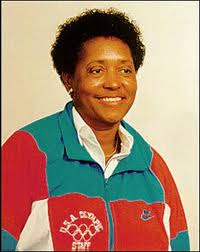
Photo: http://www.ehbcsports.com/index_files/Page1006.html
U.S. Track & Field and Cross Country Coaches Association (USTFCC)
Prairie View A&M; University Sports Hall Of Fame
Live life to the fullest. Be grateful for what you have. Nothing is promised to you. These are the principles by which Barbara Jacket has lived.1 These principles, along with her naturally competitive nature, have shaped one of the most successful, influential, and famous coaches in track and field history. More important, the thousands of students and athletes under her influence have come to share Jacket’s philosophy of living and her competitive nature.
From the beginning, Jacket was a competitor. Growing up in an era when a girl competing in athletics was frowned upon, she remembers playing “shirts and skins” with the boys in the neighborhood. But whether competing against girls or boys, Jacket was sure to win. Growing up in a single-parent household in the small Texas town of Port Arthur, Barbara, her brother, and her mother all shared a single-room house. In fitting with her grateful nature, Jacket never viewed her childhood poverty as a hardship. “When I was a kid, I didn’t know that we were poor because we always had something to eat.”2 In fact, Jacket credits these experiences for making her the amazing competitor she still is today.
Not your average tomboy, Jacket was fearless and did not hesitate to stand up to anyone, including her 200-pound brother. Growing up, she remembers seeking out fights. “I’d fight for my sister. I’d fight for my cousin, I’d fight for everybody,”3 Jacket admits. Fortunately, sports became a more appropriate outlet for her competitive and aggressive nature. At only 10 years old, Jacket started on the area high school softball team.
Like other African-American women of her time, Jacket faced obstacles that were more ominous than childhood poverty. Jacket remembers mischievously drinking out of the “whites only” water fountain to see how it differed from the “colored” water fountain.4 Attending a segregated school, Jacket’s basketball team had to receive special permission to play against the white high schools. In addition, the sexist attitudes of the era discouraged her from playing sports. Since there were limited girl’s teams to play on, Jacket often ended up as the only female on the boys teams. These obstacles, rooted in two things she had no control over, her race and her gender, would not soon disappear.
Nevertheless, sports became her ticket to college. “If it hadn’t been for sports, I could not have gone to college because my mama had no money to send me,”5 Jacket remembers. She attended the Tuskegee Institute in Alabama. Because Jacket had always been so focused on athletics, most people who knew her assumed she would struggle academically. Jacket persevered with the same drive and determination she exhibited in her sporting career. Despite her accomplishments
in athletics, graduating from college in 1958 remains one of Jacket’s greatest lifetime achievements. Her degree in physical education provided the foundation for her life’s work.
When Jacket took her first coaching job at Prairie View A&M in 1964, it was clear that women had made little progress in gender equity as Title IX had yet to be passed. Furthermore, African-Americans were still experiencing racism as many of the major conferences, like the Southeastern Conference (SEC), still did not allow black athletes to participate. Female athletes were also not given scholarships, they played in poor facilities, and they had limited opportunities. For many people, the mere thought that women should even participate in sports was still being questioned. Jacket explains, “When they built the gym [at Prairie View A&M] in 1964, they didn’t include dressing facilities for women.”6 Additionally, African-Americans were still not allowed to eat at some cafes and restaurants. “We had to tell them what we wanted at the back, even though they
had a black cook,” Jacket remembers. “The cook fixed your hamburger and you got it to go.”7
Ignoring these obstacles, Jacket started as a swim coach in 1964. Two years later, she organized the first track and field team but was still unable to get any funding from the school. As a coach, she was demanding, always pushing her athletes to reach their full potential and capabilities. “I raised hell with them; I pushed them to do what they were capable of.”8 This strategy paid off for Jacket—in a big way. In her 25-year reign as head coach, Jacket led her teams to more
than 20 national championships. She coached 57 All-Americans and five future Olympians. Jacket’s greatest athletic lifetime achievement came in 1974, when she led her very first team to a national championship. This accomplishment set the tone for the rest of Jacket’s successful career.
All of Jacket’s accolades caught the attention of the United States Olympic Committee. In 1992, she was named the head coach for the U.S. Olympic women’s track and field team, an honor only previously held by one other African-American woman. This highpressure experience turned out to be the best experience she would never want to do again. Working with professional athletes gave Jacket a new appreciation for the purity of college athletics. “Coaching elite athletes becomes a business . . . That cold business aspect makes high-level coaching much less fun than coaching your own team and seeing it develop.”9 Nevertheless, Jacket continued her
pattern of success when she led her team to four gold medals, four silver medals, and two bronze medals.
Although coaching became Jacket’s legacy, few know that teaching was her true passion. In fact, teaching is the reason she has remained at Prairie View so long. “I never wanted my job to depend on how well my students could jump or throw, or how fast they could run.”10 Jacket’s role as a teacher extends far beyond academics. She attempts to teach them life lessons to better prepare them for the real world. As a child who came from nothing and overcame hardships along the way, Jacket can easily relate to her students. “I let them know that the world doesn’t owe them anything—that they have to go out there and get it for themselves, but that they shouldn’t
be afraid to ask for help.”11
In 1990, Jacket expanded her role at Prairie View A&M. She was named athletic director, making her the only woman in the Southwestern Athletic Conference (SWAC) with this title. She remains in this position today. She also serves on the Division I Men’s and Women’s National Collegiate Athletic Association (NCAA) Track and Field Committee. Jacket is showing no sign of slowing down. She exercises daily and hopes to continue helping Prairie View’s track team when she retires.
Throughout her career, Barbara Jacket never strayed far from her Texas roots. Through her loyalty and dedication as a coach, teacher, and mentor, Jacket is responsible for putting the small town of Prairie View, Texas, on the map. Jacket’s numerous honors, awards, and championships are simply an afterthought to her most significant accomplishment: influencing and developing the lives of so many young people.
Notes
1 P. J. Pierce, Texas Wisewomen Speak: Let Me Tell You What I’ve Learned (Austin:
University of Texas Press, 2002), 134.
2. Ibid., 129.
3. Ibid.
4. Ibid.
5. Ibid.
6. Ibid., 131.
7. Ibid., 130.
8. Ibid., 131.
9. Ibid., 133.
10. Ibid., 132.
11. Ibid., 132.
The exerpt above was written by Sara Jane Baker
IN SEASON:
Tue, Oct 1 at 12:03pm
Fri, Sep 6 at 9:32am
Fri, Nov 8 at 9:29pm
Fri, Nov 1 at 4:39pm
Today at 9:09am
Today at 9:04am
Sun, Nov 10 at 6:59pm
Thu, Nov 7 at 9:08pm
LATEST ARTICLES & POSTS
posted by Swish Appeal
Mon at 9:13am
posted by Swish Appeal
Mon at 9:11am
posted by All White Kit
Sun at 6:42pm

-
The body of this profile is an excerpt from 100 Trailblazers: Great Women Athletes Who Opened Doors for Future Generations.
This book is available on Amazon.com: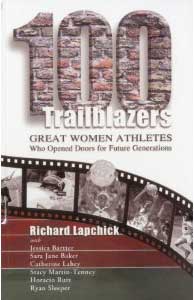
This book was written by Dr. Richard Lapchick, chair of the renowned DeVos Sport Business Management Program at the University of Central Florida, along with several of his students in the renowned program:
- Sara Jane Baker
- Jessica Bartter
- Catherine Lahey
- Stacy Martin-Tenney
- Horacio Ruiz
- Ryan Sleeper

The DeVos program offers students the opportunity to earn their Masters in Sports Business Management and a Masters in Business Administration. Focusing on ethics, diversity, leadership, and community service, the DeVos Program attracts some of the brightest and most committed students from across the country and across the globe.
-
This profile was built by:
Anna Florzak
http://tenniesandtutus.tumblr.com/
@eleanorflorzak
Kansas City, Mo & Orlando, Fla