




Beverly Kearney: Track & Field
American Star of the Women's International Sports Hall of Fame
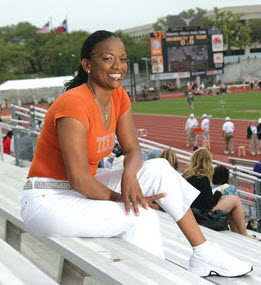
Photo: http://www.blackenterprise.com
University of Texas: Track & Field
Black Enterprise: Outrunning Fate
Meet Beverly Kearney, University of Texas Track & Field Coach
After she slowly made her way up the steps and across the stage, each foot carefully placed in front of the next with the help of a cane on either side, she finally arrived at the podium. She leaned over to the microphone and said, “I want you all to know that I have two canes, but I really only need one . . . deep down inside I’m a diva and I couldn’t wear my sneakers so I had to kind of compromise a little in order to wear my dress shoes.”1 The 450 guests, each on edge as they watched the star of the evening struggle to the stage to accept her award, roared with laughter. It wasn’t just Beverly Kearney’s gorgeous smile that warmed their hearts, but the resiliency that resounded as soon as she spoke to them. A tear rolled down my smiling face as I sat in the very back of the banquet hall, enthralled by the emotion a perfect stranger could bring to me.
A perfect stranger is perhaps a bit of an exaggeration. For the previous 10 months I had repeatedly read Kearney’s story and watched the heart-wrenching television specials that introduced her to me. Kearney was the recipient of the National Consortium for Academics and Sports’ Coach Award in honor of National Student- Athlete Day in 2005. As one of the event coordinators, the anticipation of meeting her was overwhelming and to my great pleasure and emotion, she did not disappoint my expectations.
The preeminent coach hails from Bradenton, Florida. While life for Kearney didn’t come easy, even as a child, she has made the most of every situation, capitalizing on expecting nothing but the best from herself. Though carefree she wasn’t. Kearney was the sixth of seven children her mother had with five different men. As the situation would suggest, her father was not a big contributor in her childhood. However, Kearney refused to let her absent father, alcoholic mother, and surroundings of drugs and prostitution determine her fate. Instead, Kearney blazed her own path—and quickly!
In high school, the track and field athlete was recruited to the basketball team for her speed. Girl’s basketball began in 1974 at her high school and by 1975, Kearney was a member of the team. Her high school basketball coach said the guard’s speed gave her the ability to steal the ball and make easy lay-ups but her shooting skills left something to be desired.
During her senior year, Kearney had to deal with the sudden death of her mother. She turned to Joan Falsone, a former assistant athletic director for county schools, who encouraged Kearney to enroll at Florida’s Hillsborough Community College in 1977. The National Junior College track and field All-American talent was then welcomed at Auburn University. As an Auburn Tiger, she earned two Association for Intercollegiate Athletics for Women (AIAW) All-American honors, Auburn Athlete of the Year, and team MVP. In 1980, she qualified for the U.S. Olympic trials in the 200-meter.
Upon earning her bachelor’s degree in social work, Kearney sought work as a social worker until Falsone suggested the coaching field. Kearney’s athletic talent was unquestionable, but her coaching success was only a vision of Falsone’s. Kearney’s later coaching success would prove Falsone to be a visionary.
Kearney put in the time to learn the in’s and out’s of the coaching profession while she earned her master’s degree in adapted physical education at Indiana State University, where she served the track team as a graduate assistant. She then did a two-year stint at the University of Toledo, where she held her first head coach title. From Toledo, Kearney accepted the top assistant coach title at the University of Tennessee because the track powerhouse was irresistible, despite the step backward in job titles. Tennessee was just a steppingstone to the powerhouse Kearney would later build at the University of Texas, after she made another stop as the University of Florida’s (UF) head coach. Again Kearney did not waste any time in reaching her goal, and in just her fifth year at the helm of UF, the Gators won the 1992 National Collegiate Athletic Association (NCAA) Division I Indoor title. Kearney became the first black female track and field head coach to win a NCAA Division I National Championship and just the third black head coach ever to win any NCAA title, following John Thompson’s 1984 basketball title with Georgetown University and Tina Sloan Green’s 1984 women’s lacrosse title with Temple University.
The University of Texas couldn’t help but take notice of the thriving coach and quickly wooed Kearney to join the Longhorns. The relationship has proved prosperous for both since her first season of 1993. When Kearney started her 16th season at UT in 2007–8, she already had led the Longhorns to six NCAA National Championships and 19 conference titles. Twenty-four current UT records have been set under Kearney’s tutelage. Several of her student-athletes have gone on to win nine Olympic medals since 1992; the 2008 Beijing Olympics were represented by more Longhorn talent and Kearney protégés.
While 2008 marks a big birthday for Bev, as she is endearingly called, it was not age that kept her from quickly entering the stage that evening in 2005. The 50-year-old, who could easily pass for someone in her 30s, was critically injured in a car crash that left her one of three survivors in a five-person, single-car crash. While headed to Disneyworld on December 26, 2002, the vehicle
Kearney was riding in crossed the median of Interstate 10 before rolling several times. Alcohol was not involved. Kearney, who was not wearing a seatbelt, was thrown from the vehicle. She suffered a critical back injury and underwent five hours of surgery to repair her vertebrae. Nonetheless, Kearney was lucky to be alive. She was traveling with two friends, Ilrey Sparks and Michelle Freeman, Freeman’s mother Muriel Wallace, and Sparks’s two-year-old daughter
Imani. Sadly, Ilrey Sparks and Muriel Wallace did not survive the accident. The accident left Kearney with paralyzing injuries and a huge responsibility; Bev became the legal guardian and caregiver for Imani Sparks. They both live with fellow survivor Michelle Freeman.
After two more surgeries in a month’s time, Kearney coached from her hospital bed, watching tapes, and writing notes and orders for her assistant coaches to pass along to the team.
Like everything else in which she participates, Kearney gave 100 percent to her physical therapy and has steadily improved since early 2003. She joined the team on the field in a wheelchair just three months after the accident. Her character and leadership was already inspiring to her young student-athletes, but without words, her presence inspired them immeasurably more. Though doctors worried Kearney would never use her legs again, she boldly stood on April 5, 2003, to the amazement and joy of the 20,000 athletes and spectators of the Texas Relays. After steadying herself with one arm, she flashed that gorgeous Bev smile and raised the other arm with a classic Longhorn hand signal. Marcus Sedberry, a University of Nebraska sprinter who was competing that day, delayed his warm-up in anticipation of what she promised she would do three months prior. The sight of her standing nearly brought Sedberry to tears. “The 2003 Texas Relays was a remarkable event,” he remembers. “The competition was great as usual, but the competition was overshadowed by the anticipation of Coach Bev standing for the first time since her accident. When she stood up, it sent a deafening roar across the entire Mike A. Myers Stadium. Regardless of what school you were affiliated with or cheering for, you were on your feet cheering and applauding the courage and determination Coach Bev showed at that moment.”2
Kearney steadily progressed from the wheelchair to a walker, then two canes, until she was down to just one cane in 2005, a feat that encouraged her to give away her wheelchair. While her balance is still not what it used to be, Kearney finds it easiest to get around in her scooter for long hauls. She credits Michelle Freeman, fellow survivor and the driver of the car that crashed, for her on-going care and support. In addition to living with Kearney and Sparks, Freeman is a volunteer coach with UT and has been a constant caregiver to Kearney since 2002.
While Kearney’s coaching accomplishments are stand-alone amazing, the personal tragedy she has faced makes her success even more astounding. Most important, Kearney has hundreds more student- athletes to influence and titles to win in her years to come. Two goals remain unconquered on Kearney’s list: professionally, to win the triple crown (winning an indoor and outdoor track and field title and the cross country title in a single year) and, personally, to wiggle her toes. Something tells me, when she does wiggle her toes for the first time in years, her student-athletes will be so inspired, they will easily bring home the triple crown. Or perhaps, it will happen the other way around. Either way, Beverly Kearney has already proven she can accomplish anything she puts her mind, heart, and faith into.
Notes
1. Beverly Kearney, Acceptance Speech, The National Consortium for Academics and Sports' 7th Annual Giant Steps Awards Banquet and Hall of Fame Induction Ceremony, Orlando, Florida, February 21, 2005.
2. Marcus Sedberry, interview with author, April 30, 2008.
This excerpt was written by Jessica Bartter
Articles Tagged with "Beverly Kearney" on WomenTalkSports.com:
IN SEASON:
Tue, Oct 1 at 12:03pm
Fri, Sep 6 at 9:32am
Fri, Nov 8 at 9:29pm
Fri, Nov 1 at 4:39pm
Today at 9:09am
Today at 9:04am
Sun, Nov 10 at 6:59pm
Thu, Nov 7 at 9:08pm
LATEST ARTICLES & POSTS
posted by Swish Appeal
Mon at 9:13am
posted by Swish Appeal
Mon at 9:11am
posted by All White Kit
Sun at 6:42pm

-
The body of this profile is an excerpt from 100 Trailblazers: Great Women Athletes Who Opened Doors for Future Generations.
This book is available on Amazon.com:
This book was written by Dr. Richard Lapchick, chair of the renowned DeVos Sport Business Management Program at the University of Central Florida, along with several of his students in the renowned program:
- Sara Jane Baker
- Jessica Bartter
- Catherine Lahey
- Stacy Martin-Tenney
- Horacio Ruiz
- Ryan Sleeper

The DeVos program offers students the opportunity to earn their Masters in Sports Business Management and a Masters in Business Administration. Focusing on ethics, diversity, leadership, and community service, the DeVos Program attracts some of the brightest and most committed students from across the country and across the globe.
-
This profile was built by:
Anna Florzak
http://tenniesandtutus.tumblr.com/
@eleanorflorzak
Kansas City, Mo & Orlando, Fla