




Meyer Debbie: Swimming
American Star of the Women’s International Sports Hall of Fame
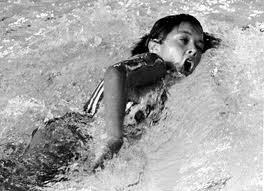
Photo: Voices From the Past
When Debbie Meyer was 12 years old in 1965, her father moved the family 3,000 miles from New Jersey to Sacramento, California, because of a job transfer. For Meyer, the move across
the United States was a traumatizing experience. She had to make new friends and adjust to a different city. Even more so, she left a YMCA program, where she swam three times a
week during the summer, to a swim program at the Arden Hills Swim and Tennis Club in Sacramento that swam six times a week for an entire year. Her father had been in touch with
swim coach Sherm Chavoor before moving to California and arranged for Meyer to begin swim classes once she arrived. She was at her new home on a Saturday and was at her first swimming class two days later.
At her first swim practice, Meyer swam four laps and got out of the pool in frustration. She was not as fast as the other swimmers and was embarrassed because she was not used to swimming as long or for as many days as her counterparts. Chavoor asked where she was going, and she replied she did not think she belonged in the swim program. But before she left, Chavoor told Meyer that he would be at the swimming pool the next day and at the same exact time. Meyer went back the next day, determined to be as good as the other swimmers and to finish the 5,000-yard practices. It would take her three months to get there.
“My dad was a Marine and you’ve got those qualities in you whether you want to or not,” Meyer said. “He’s not a lifer Marine, but he’s still a Marine at heart. We just didn’t give up at that time.”1 Meyer also credits her mom, a physical education teacher, for encouraging her. All of which led to her becoming one of the greatest swimmers in the world, but she was never really aware of where her swimming abilities could take her. “I didn’t know about the Olympic Games until 1966,” she said. “I swam because I loved the water. I loved the challenge of swimming faster times. I wasn’t swimming to make the Olympic team. The winter of 1967 I really had the concept of, ‘Wow, you really have a chance to make it to the Olympics.’” At the 1967 Pan American Games in Winnipeg, she set world records in the 400-meter and 800-meter freestyle events. In 1968, the U.S. swim team was the best in the world. Even a 16-year-old Meyer knew that by qualifying for the U.S. National Team, as she did, that she would come away with a stash of Olympic medals. But Meyer did more than haul a stash—she became the first swimmer to win three individual gold medals at one Olympics. She also was suffering from “Montezuma’s Revenge”—another name for diarrhea in Mexico. But her focus in practice was such that it did not affect her performances at the Olympics.
“I was very focused when I was in the water,” Meyer said. “[NBC Sports chairman] Dick Ebersol said to me, ‘You know Debbie, I recall you telling me that you never got nervous before a meet. Do you know why that happened?’ Because I knew I worked hard, and I knew what I could do. Maybe I didn’t know any better. I was anxious to swim because I wanted to know how fast I could go. I wasn’t worried about somebody beating me. I just wanted to see how fast I could go.”
Meyer would continue swimming until January 1972, when only months before the Munich Olympics, she retired from competitive swimming. The sport was no longer fun for her, even as she was still setting world records after her fabulous 1968 Olympics.
“I just kind of wanted to get on with my life,” Meyer said. “I knew being in the pool for four and a half hours a day was not part of my plan. I have no regrets whatsoever about quitting when I did. I had a wonderful life in the swimming pool.” Meyer credits swimming with giving her the opportunity to make many friends and to travel extensively around the world. Soon after her retirement, she worked for Speedo in public relations, where she would travel across the West Coast of the United States, up to Canada, and as far east as the Mississippi River. The career switch had an impact on Meyer, who was painfully shy up to when she retired from swimming. The new job forced her out of her shell, where she had to make sales presentations
and conduct cold phone calls to promote the Speedo brand. At the 2008 U.S. Swimming Olympic Trials, where the 1968 U.S. swim team held a reunion for its 40th anniversary, Meyer’s former
teammates could not believe how extroverted she had become. “I just wouldn’t stop talking,” she said. Meyer also enjoyed endorsement deals as a spokeswoman for M&M’s and Mars bar. Meyer
went back to her swimming roots and took up coaching jobs with Stanford and Cal-Berkeley. In 1992, Meyer was head coach of both the men’s and women’s swim programs at California State University, Sacramento, when the school cut the program. In addition to losing her job, in a four-week period Meyer was divorced, her grandmother passed away, and her former coach, Sherm Chavoor, also passed away. “It really was devastating,” she said.
Meyer moved back home with her parents to recover. Soon, she found a place where she could start a swim school. Meyer received a loan from a bank and also from a number of friends and family to put a down payment for the facility in 1993. She vowed to repay everyone back in five years, but she was able to do so in only two and a half years. The swim school also has a special place in her heart because two weeks after opening up the Debbie Meyer Swim School, she met her second husband, Bill Weber. Meyer currently specializes in teaching children with disabilities to swim. The conditions vary and include cerebral palsy, autism, spina bifida, and paraplegic and quadriplegic conditions. “It can be a challenge but they will learn and they can learn,” she said. “That’s what keeps me going. You have to learn their personality. You have to learn what their disability is. You have to put yourself in that situation and try to figure out how you’re going to make it work.”
Up to her retirement in 1972, Meyer set 15 world records and 27 American records, and was named World Swimmer of the Year from 1967 to 1969. In 1968, on the cusp of her Olympic triumph, she was awarded the 1968 Sullivan Award as the top amateur athlete. In 1987, she was inducted into the U.S. Olympic Hall of Fame, and in 1997, she was inducted into the International Swimming Hall of Fame. In 2004, Meyer was inducted into the National High School Hall of Fame. Looking back on her career, each induction and recognition has its own place in Meyer’s heart. “Each one came at a different stage in my career and my life so they’re each highlights,” she said. “Every time I get something it’s at a different point in my life and it means just as much.”
Meyer has thoughts of opening another swim school in Truckee, California, where she holds residence. For the 1972 Munich Olympics, instead of swimming, Meyer worked with the AP, and she still has aspirations of visiting Greece, the birthplace of the Olympic Games. “Some people say they can read people’s minds and psychics can speak to the dead, well, water is my sixth sense,” Meyer said. “I’m not afraid of it but I respect the heck out of it. There was a purpose for me in this world, and I think it was for me to teach kids to understand and respect the water. The Olympics were part of my journey to get to where I am right now. It taught me a work ethic. It taught me that I can overcome adversity. I got sicker than a dog down there [Mexico City] with ‘Montezuma’s Revenge,’ but I learned to work through pain and become a better person because of it.”
Note
1. All of the quotes in this article are by Debbie Meyer, from an interview with the
author on July 14, 2008.
100Tblzrs_Text.qxp 3/11/09 3:50 PM Page 236
The exerpt above was written by Horacio Ruiz
IN SEASON:
Tue, Oct 1 at 12:03pm
Fri, Sep 6 at 9:32am
Fri, Nov 8 at 9:29pm
Fri, Nov 1 at 4:39pm
Today at 9:09am
Today at 9:04am
Sun, Nov 10 at 6:59pm
Thu, Nov 7 at 9:08pm
LATEST ARTICLES & POSTS
posted by Swish Appeal
Mon at 9:13am
posted by Swish Appeal
Mon at 9:11am
posted by All White Kit
Sun at 6:42pm

-
The body of this profile is an excerpt from 100 Trailblazers: Great Women Athletes Who Opened Doors for Future Generations.
This book is available on Amazon.com:
This book was written by Dr. Richard Lapchick, chair of the renowned DeVos Sport Business Management Program at the University of Central Florida, along with several of his students in the renowned program:
- Sara Jane Baker
- Jessica Bartter
- Catherine Lahey
- Stacy Martin-Tenney
- Horacio Ruiz
- Ryan Sleeper

The DeVos program offers students the opportunity to earn their Masters in Sports Business Management and a Masters in Business Administration. Focusing on ethics, diversity, leadership, and community service, the DeVos Program attracts some of the brightest and most committed students from across the country and across the globe.
-
This profile was built by:
Anna Florzak
http://tenniesandtutus.tumblr.com/
@eleanorflorzak
Kansas City, Mo & Orlando, Fla