




Billie Jean King: Tennis
American Star of the Women’s International Sports Hall of Fame
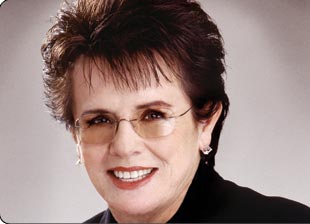
Photo: hickofsports.com
Women's Sports Foundation Founder: Billie Jean King
Amazon: Pressure is a Privilege


Billie Jean King was an early teacher for me on the issue of Women’s Rights. She used the world of sport to help educate many young girls and women, boys and men, about the inequitable and sexist world in which she competed. I have been lucky to know Billie Jean King since the mid-1980s. I have been around her as a fan, as a fellow committee member for various organizations, as an advocate for the Women’s Sports Foundation (WSF), which she founded, and in organizations dedicated to improving the situation of people of color in America. She is beyond any question an iconic hero in my lifetime. When I mention her name to other people, I know that it is hardly unique, as she stands tall for so many others.
Although she has so many great victories, including six Wimbledon singles championships and four U.S. Opens, she may be best remembered for a single match played against a 55-year-old man when she was at the top of her game. Bobby Riggs was a cocky, arrogant Wimbledon champion himself, circa 1939. He was somebody who used his braggadocio about the dominance of men over women to raise the ire of women’s organizations, and possibly, to get more attention for himself. It worked. In 1973, he defeated the great but fading star, Margaret Court.
This propelled Billie Jean King to accept a match against Bobby Riggs. She knew she had to win because on her shoulders were riding the hopes of so many young girls and women. The match became known as the "Battle of the Sexes." On September 20, 1973, in the Houston Astro Dome, Billie Jean King dismantled Riggs, 6-4, 6-3, 6-3. The New York Times Neil Amdur wrote, "Most important, perhaps, for women everywhere, she convinced skeptics that a female can survive pressure-felt situations and that men are as susceptible to nerves as women." Fifty million people watched that tennis match, which has been hailed ever since as the greatest step forward for women’s equality in sports. Billie Jean King showed every woman that it was okay to be an athlete at a time when many men were trying to persuade young girls and women not to compete sports because it was "not feminine." When LIFE Magazine named its 100 most important Americans of the 21st century, there were only four sports figures on the list and only one female athlete—Babe Ruth, Jackie Robinson, Muhammad Ali, and Billie Jean King.
Born into a family that produced two professional athletes (her brother was the Major League Baseball player Randy Moffitt), King started her journey when she was born on November 22, 1943. She grew up in Long Beach, California. Her father, Bill, worked for the Long Beach Fire Department and her mother, Betty, was a homemaker. She had told her mom at age five that "I am going to do something great with my life."
She knew after her first tennis lesson that she was going to be a tennis player. At age 11, Billie told her mom, "I am going to be No. 1 in the world."
By the time she was 17, she had won the doubles championship at Wimbledon with Karen Hantze. She would eventually win a total of 20 titles at Wimbledon, including ten doubles and four mixed, along with six singles championships. She gained the No. 1 ranking in 1966 after her first Wimbledon Singles Championship. The next year she won again at Wimbledon and also captured her first U.S. Championship.
She started when there were no women’s tennis professionals and by the end of her playing career had won close to $2 million in prize money. She became a strong advocate for women to gain equal pay with men for tournaments that they competed in. Billie Jean King helped launch the Virginia Slims Tour, which broke away from the regular tour. She signed a $1 contract to play in the Virginia Slims tennis tournament, which became the first professional tour for women, in 1970. She helped launch the first women’s players union, the Women’s Tennis Association. She told the U.S. Open officials in 1972 that if men’s and women’s champions did not receive the same prize that she and other women would not compete. In 1973, the U.S. Open became the first major tournament to offer equal prize money. Wimbledon didn’t comply until 2007!
She was off and running. Within a year, she had founded the WSF and Women’s Sports Magazine and then World Team Tennis (WTT). The WSF became the leading advocacy group for girls and women in sport and has remained so for more than three decades.
King's personal life became a lightning rod of controversy when her sexual orientation became public after a palimony suit by her assistant. Although King won the suit, she felt that she lost, perhaps, hundreds of thousands of dollars in endorsements because of the controversy caused by her becoming known as a bisexual player, and her husband were divorced shortly after.
But she was hardly stopped. She became a leader in the fight for equality and recognition in the Gay, Lesbian, Bisexual and Transgender (GLBT) community, and has been honored by many of the leading GLBT organizations.
Among the firsts that King achieved was the first woman commissioner in professional sports history (World Team Tennis, 1984); the first woman to coach a co-ed team in professional sports (Philadelphia Freedoms, WTT, 1974); the first female athlete in any sport to earn more than $100,000 in a single season ($117,000, 1971); and the first woman to have a major sports venue named in her honor (USTA Billie Jean King National Tennis Center—2006) In 2008, the Sports Museum of America opened in New York, where the Billie Jean King International Women’s Sports Center will be the nation’s first permanent women’s sports hall of fame and exhibit.
In a 2008 interview with Cokie Roberts of USA Today Weekend, King was asked, "Over time, have you seen a tangible difference for women in sports?" Her response was direct, "Oh, we’re shockingly off. Just for example, we get 8 percent of the sports page. We have about $1 billion in sponsorship worldwide—men have more than $25 billion. And that’s just the beginning. We have so far to go in the sports world. And yet, sports are a microcosm of society. If you know where we are in sports, you kind of know where the world is."
On the importance of female role models for girls, she told Roberts, "You have to see it to be it. If a girl sees a woman succeed at something new, the sky truly is the limit." King has been that role model and "shero" for generations and there is no sign of her slowing down. Elton John wrote his song, "Philadelphia Freedom," for Billie Jean. Like her, it became No. 1. She has been a freedom fighter. Still active after all these years and in great demand, Billie Jean King, at age 65 as of this writing, remains young at heart and in the hearts of women and girls around the country. She has also helped men, like me, gain a greater appreciation of how important sports are to women and girls.
This excerpt was written by Richard Lapchick.
Articles Tagged with "Billie Jean King" on WomenTalkSports.com:
- Battle of the Sexes Puzzler: Throw the match to pay a debt? If Riggs had won, he would have gotten $100K in prize money
- Sports History Files: Billie Jean King in the arena, Part 2
- Sports History Files: Billie Jean King in the arena, Part 1
- Women at Wimbledon through the ages
- Today in History: Billie Jean King and The Battle of The Sexes
- Equal pay in tennis called into question
- Billie Jean King for Huffington Post: Looking Back, Looking Forward: 40 Years of Title IX
- Christine Brennan: Ugly words can be agent of change
IN SEASON:
Tue, Oct 1 at 12:03pm
Fri, Sep 6 at 9:32am
Fri, Nov 8 at 9:29pm
Fri, Nov 1 at 4:39pm
Today at 9:09am
Today at 9:04am
Sun, Nov 10 at 6:59pm
Thu, Nov 7 at 9:08pm
LATEST ARTICLES & POSTS
posted by Swish Appeal
Mon at 9:13am
posted by Swish Appeal
Mon at 9:11am
posted by All White Kit
Sun at 6:42pm

-
The body of this profile is an excerpt from 100 Trailblazers: Great Women Athletes Who Opened Doors for Future Generations.
This book is available on Amazon.com:
This book was written by Dr. Richard Lapchick, chair of the renowned DeVos Sport Business Management Program at the University of Central Florida, along with several of his students in the renowned program:
- Sara Jane Baker
- Jessica Bartter
- Catherine Lahey
- Stacy Martin-Tenney
- Horacio Ruiz
- Ryan Sleeper

The DeVos program offers students the opportunity to earn their Masters in Sports Business Management and a Masters in Business Administration. Focusing on ethics, diversity, leadership, and community service, the DeVos Program attracts some of the brightest and most committed students from across the country and across the globe.
-
This profile was built by:

Anna Florzak
http://tenniesandtutus.tumblr.com/
@eleanorflorzak
Kansas City, Mo & Orlando, Fla