




Bonnie Blair: Skating
American Star of the Women’s International Sports Hall of Fame
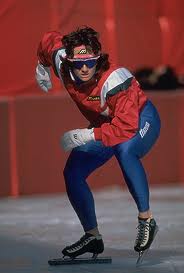
Photo: ESPN

Bonnie Blair’s accomplishments as an athlete are incredible. Blair, a speed skater, is the most decorated American woman in winter Olympic history. Her performance in the 500-meter event earned her gold medals in three consecutive Olympic Winter Games (1988, 1992, and 1994). In those same games she garnered a bronze and two gold medals in the 1,000-meter distance. Blair was the first woman to break the 39 second barrier in the 500 meter, speed skating’s version of the four minute mile. On her 31st birthday, Blair blazed an American record and a personal best in the 1,000 meters.1 She retired a champion, still at the peak of her game.
Her accomplishments have led to some of the greatest honors in sports. In 1992, Blair was named the winner of the James E. Sullivan Award, an honor reserved for America’s top amateur athlete. She was only the second American to win Norway’s Oscar, an award recognizing the world’s best speed skater. ESPN counts her as the 69th greatest athlete of the 20th century. She’s been named athlete or sportswoman of the year by Sports Illustrated, the AP, ABC Sports, CBS, the Women’s Sports Foundation, and the United States Olympic Committee. In 2002, she was inducted into the United States Olympic Hall of Fame as America’s most decorated winter Olympian. Bonnie Blair’s status as a legend is unquestionable.
Although Blair’s athletic achievements make her appear superhuman, it is her humanity—her normalcy—that makes her truly inspiring. Blair is the kind of athlete that young people of every race, region, and athletic ability can attempt to emulate. Undersized by traditional speed skating standards, Blair crafted her technique to maximize every ounce of effort. Former U.S. Olympic coach Peter Mueller once called her “the best technician in the world over the sprint distance, man or woman.”2 On the ice, in the heat of competition, Blair was all power, grace, and fluidity—consummately prepared and simply stunning. Beyond the spotlight, she toiled alone in freezing rinks across the globe, missing innumerable family holidays and pushing herself for the love of the sport and the thrill of competition.
Much of her passion and drive seems to be drawn from the Blair family itself. As the youngest of six children, Blair grew up in a house virtually obsessed with the pursuit of speed on ice. In fact, her father and all five siblings were participating in a speed skating meet when Eleanor Blair gave birth to Bonnie. The family was informed of the birth over the rink’s loudspeaker, marking the first of many public address announcements about Bonnie Blair. By age two, Blair was gliding across the ice, her feet so small that she wore a pair of shoes inside the smallest pair of hand-me-down skates the Blair family owned.
As the years passed, the Blair children, most of them champions at the national level of competitive speed skating, slowly began to move beyond the sport, leaving Bonnie to make a choice. And so she chose, said her sister Mary, “She dedicated her life to it.” Blair spent her high school years training and competing on the speed skating circuit, determined to turn her talent into success. With the financial backing of the Champaign (Illinois) Policemen’s Benevolent Association, she moved to Europe to train full-time and learn the intimate nuances of the sport. At 19, only a few short years after making the pivotal decision to fully dedicate herself to speed skating, Blair competed in her first Olympic Games, finishing eighth in the 500 meters.3
Through Bonnie, the Blair family recommitted themselves to speed skating. Together with family friends, they formed the Blair Bunch, a group dedicated to supporting Bonnie at all of her major
events. They became to Blair what the Cameron Crazies are to Duke basketball. The Blair Bunch strengthened and inspired her, fueling her pursuit of greatness. Perhaps best of all, they shared fully in her joys—after all, no family understands the pure exhilaration of speed on ice better than the Blairs.
While Bonnie drew inspiration from her supporters, one of them, her brother Rob, drew strength and motivation from her. Stricken with an inoperable brain tumor, Rob frequently experienced seizures that left him continually learning how to reuse the right side of his body. When others might despair, the Blairs turn to each other. “I watch what Bonnie does and that just feeds into me,” said Rob in a 1991 Sports Illustrated interview. “She has said that I’ve inspired
her and that’s nice of her to say. But I’ve gotten a lot more from her example than the other way around.”4 This attitude is the epitome of the connection the Blair clan shares. Their familial inspiration is not a straight line; it’s a circle.
Now, in her retirement, Blair has more time to dedicate to her family, which includes husband and fellow Olympic speed skater David Cruikshank. Though she is one of the winningest female athletes in American history, Blair has never let the shine of a gold medal blind her to the truly important things in life. “Winning doesn’t always mean being first,” says Blair. “Winning means you’re doing better than you’ve ever done before.”5
Notes
1. Larry Schwartz, “Blair is special . . . but she doesn’t know it,” ESPN.com,
March 18, 2005. http://sports.espn.go.com/espn/classic/bio/news/story?page=Blair
_Bonnie.
2. Schwartz, “Blair is special.”
3. Steve Rushin, “Child of Innocence,” Sports Illustrated, December 19, 1994.
4. Ibid.
5. Bonnie Blair, “Personal Growth,” A Gift of Inspiration, http://www.agiftofin
spiration.com.au/quotes/personalgrowth.shtml.
This excerpt was written by Catherine Lahey
IN SEASON:
Tue, Oct 1 at 12:03pm
Fri, Sep 6 at 9:32am
Fri, Nov 8 at 9:29pm
Fri, Nov 1 at 4:39pm
Today at 9:09am
Today at 9:04am
Sun, Nov 10 at 6:59pm
Thu, Nov 7 at 9:08pm
LATEST ARTICLES & POSTS
posted by Swish Appeal
Mon at 9:13am
posted by Swish Appeal
Mon at 9:11am
posted by All White Kit
Sun at 6:42pm

-
The body of this profile is an excerpt from 100 Trailblazers: Great Women Athletes Who Opened Doors for Future Generations.
This book is available on Amazon.com: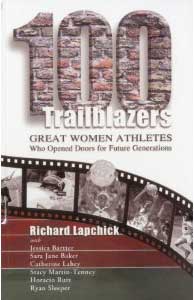
This book was written by Dr. Richard Lapchick, chair of the renowned DeVos Sport Business Management Program at the University of Central Florida, along with several of his students in the renowned program:
- Sara Jane Baker
- Jessica Bartter
- Catherine Lahey
- Stacy Martin-Tenney
- Horacio Ruiz
- Ryan Sleeper

The DeVos program offers students the opportunity to earn their Masters in Sports Business Management and a Masters in Business Administration. Focusing on ethics, diversity, leadership, and community service, the DeVos Program attracts some of the brightest and most committed students from across the country and across the globe.
-
This profile was built by:
Anna Florzak
http://tenniesandtutus.tumblr.com/
@eleanorflorzak
Kansas City, Mo & Orlando, Fla