




C. Vivian Stringer:
American Star of the Women’s International Sports Hall of Fame
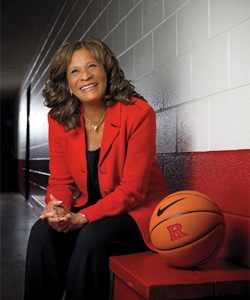
Photo: Rutgers University


Coach Vivian Stringer has proven she can overcome any obstacle she encounters. With adversity from personal struggles, family crises, and negative media attention, she has conquered each one with dignity and class. Despite all this adversity, C. Vivian Stringer is one of the most successful coaches in the history of college basketball. She has also been a role model, mentor, and inspiration to many.
When Coach Stringer took over the Rutgers women’s basketball team in 1995, she knew it was going to be a road paved with challenges. Stringer inherited a struggling team that had not experienced a 20-plus win season in four years. For some, this may seem like an overwhelming task, but for Stringer, it was just another opportunity for success. Despite these odds, Coach Stringer was completely confident in the potential of her team. Two recruiting classes later, her team won the Big East Championship and made an appearance in the National Collegiate Athletic Association (NCAA) tournament, eventually making it to the Sweet Sixteen. In the next eight seasons, Stringer led her team to seven NCAA tournament appearances. In 2007, Stringer’s team advanced to the national championship game in Cleveland, Ohio. Although the Scarlet Knights were defeated by perennial powerhouse, Tennessee, Stringer proved that hard work, persistence, and a little optimism will eventually pay off.1
Stringer’s success should not come as a surprise given her past credentials. By the time Coach Stringer joined Rutgers, she had established herself as a coach who turned struggling teams into national powerhouses. In 1971, Coach Stringer made her coaching debut at Cheyney State, a historically all-black college. She started her career in the early 1970s, when women’s sports were still struggling to take off. However, Stringer and her team played in front of large crowds and qualified for the first-ever NCAA women’s basketball national championship. Despite losing to Louisiana Tech in the national championship game, Stringer had proven herself as a coach. After 11 seasons at Cheyney State, Stringer went to the University of Iowa. Her success continued as she led her team to nine NCAA tournament appearances and established Iowa as a dominant women’s basketball team. Stringer’s Iowa team had the first-ever advanced sellout of a women’s basketball team, proving that women’s basketball had the potential to be as successful as men’s basketball.
All her success did not go unnoticed. One of her proudest honors is being voted National Coach of the Year by her peers three times. She has also been named Coach of the Year by Sports Illustrated, USA Today, The LA Times, and the Black Coaches and Administrators (formerly the Black Coaches Association). Sports Illustrated named her one of the “101 Most Influential Minorities in Sports” in 2003. On top of countless honors, she has rewritten the coaching history books. She is the first basketball coach, male or female, to bring three different teams to the NCAA tournament. Among Division I women’s basketball coaches, she ranks third in wins. In 2001, she was inducted into the Women’s Basketball Hall of Fame.
These statistics, awards, and honors are enough to impress anyone. However, her success is even more amazing given the obstacles and struggles she had to overcome along the way. Very few know the details of her personal and family struggles. The adversity for Stringer started at a very young age. Stringer, one of five children, was born in the small town of Edenborn, Pennsylvania. Her parents instilled the values of hard work, perseverance, and a strong work ethic. She was required to do various chores around the house on a daily basis while her father supported the family by working in the coal mines. With all of the financial constraints, Stringer never heard her father complain. Even after both of his legs were amputated due to gangrene, he continued to do his best to support the family./In high school, there were very few opportunities for women in sports, especially for an African-American woman. There was a cheerleading squad at her high school, but there were no other girls’ sports team at her high school. Stringer tried out for the cheerleading squad, and although she was the most talented, she was cut from the team because of her race. With the help of an NAACP leader, Stringer fought this ruling and later became the first black cheerleader at her high school. This struggle had a huge impact on her life, and she could have never known how much it would help her overcome the adversities she would later face.2
Stringer saw true strength in her mother when her father passed away during her childhood. Instead of dwelling on the loss, her mother immediately took over the family responsibilities, found a job, and supported the family.
The strong family values that Stringer learned in her upbringing helped her with her own family. Vivian married William D. Stringer and they had three children. However, once again, Vivian faced another challenge. After her middle child, Janine, suffered from meningitis, she was left with special needs. Stringer and her husband strived to give their daughter the best medical attention available and, once again, she thrived in the face of adversity. During this time, Stringer was coaching at Iowa, and it was clear that she did not let this challenge affect her coaching duties as she guided her team to the Final Four.3
Then on Thanksgiving Day 1992, another tragedy struck. Her husband unexpectedly died of a heart attack.4 This was arguably the most devastating event in her life. Despite struggling to raise her three children by herself, she demonstrated tremendous strength, much like her mother had when her own husband passed away. While some would be unable to recover from such a tragedy, Stringer picked up her family and moved to New Brunswick, New Jersey, to begin her incredible reign at Rutgers University.
With all the success Stringer was experiencing at Rutgers University, it finally seemed as if the adversity had stopped. After an impressive season, the Scarlet Knights upset the No. 1 seeded Duke and reached the NCAA Tournament Final Game. This accomplishment, however, was quickly overshadowed by negative comments from radio show host, Don Imus. Following the tournament, Imus, a nationally syndicated radio host, and his executive producer were discussing Rutger’s final game versus Tennessee. Rather than praising the accomplishments of both teams, the hosts made offensive and derogatory comments toward the Rutgers team, referring to them as “rough girls and nappy headed hoes.” Stringer called Imus’s remarks “racist and sexist . . . deplorable, despicable and unconscionable.” 5 She handled this obstacle just as she had the other ones, with dignity and class. With Coach Stringer’s leadership, the Rutgers team met with Don Imus and eventually accepted his apology.6With Essence Carson, Rutgers’s captain, as their spokesperson, Rutgers’s entire basketball team embodied all the traits of Stringer—courage, eloquence, and strength. They ensured that Rutgers basketball will not be remembered for Imus’s ignorant comments, but for their amazing accomplishments on and off the basketball court.
Recently, in early 2008, Vivian Stringer and her Rutgers basketball team received the first ever Eddie Robinson Leadership Award from the National Consortium for Academics and Sports. This award is presented to those who exemplify courage and stand up for justice. Under Stringer’s amazing leadership, the Scarlet Knights were able to make this negative situation into a positive learning experience. Coach Stringer is not only teaching these players basketball skills, she is also instilling in them important values and lessons that they will utilize for the rest of their lives.
Notes
1. Rutgers Women’s Basketball, “C. Vivian Stringer.” Scarlet Knights (accessed July 10, 2008).
2. Kelly Whiteside, “Rutgers Coach Has History of Standing Firm,” USA TODAY, April 11, 2007.
3. Kathy Crockett, “Sports Hero: C. Vivian Stringer” (accessed July 10, 2008).
4. Melanie Jackson, “Stringer’s Dream Come True,” January 9, 2006.
5. Maria Newman, “Rutgers Women to Meet with Imus over Remarks,” New York Times, April 10, 2007.
6. “Rutgers Team: We Accept Don Imus Apology,” AP, April 13, 2007.
The exerpt above was written by Sara Jane Baker.
Articles Tagged with "C. Vivian Stringer" on WomenTalkSports.com:
IN SEASON:
Tue, Oct 1 at 12:03pm
Fri, Sep 6 at 9:32am
Fri, Nov 8 at 9:29pm
Fri, Nov 1 at 4:39pm
Today at 9:09am
Today at 9:04am
Sun, Nov 10 at 6:59pm
Thu, Nov 7 at 9:08pm
LATEST ARTICLES & POSTS
posted by Swish Appeal
Mon at 9:13am
posted by Swish Appeal
Mon at 9:11am
posted by All White Kit
Sun at 6:42pm

-
The body of this profile is an excerpt from 100 Trailblazers: Great Women Athletes Who Opened Doors for Future Generations.
This book is available on Amazon.com:
This book was written by Dr. Richard Lapchick, chair of the renowned DeVos Sport Business Management Program at the University of Central Florida, along with several of his students in the renowned program:
- Sara Jane Baker
- Jessica Bartter
- Catherine Lahey
- Stacy Martin-Tenney
- Horacio Ruiz
- Ryan Sleeper

The DeVos program offers students the opportunity to earn their Masters in Sports Business Management and a Masters in Business Administration. Focusing on ethics, diversity, leadership, and community service, the DeVos Program attracts some of the brightest and most committed students from across the country and across the globe.
-
This profile was built by:

Anna Florzak
http://tenniesandtutus.tumblr.com/
@eleanorflorzak
Kansas City, Mo & Orlando, Fla