




Carol Gordon:
Trailblazer of the Association for Intercollegiate Athletics for Women (AIAW)
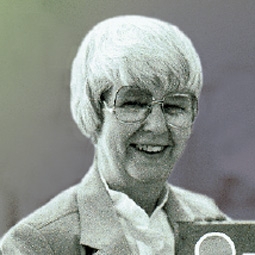
Photo: Washington State University
When Carol Gordon joined Washington State University’s (WSU) faculty in 1962, no one could have predicted her widespread influence and impact. Gordon was originally hired as a teacher; however, she quickly expanded her role to one of a mentor, coach, and administrator. At a time when opportunities for women and sport were disparate, Carol Gordon advanced women’s athletics and fought for many of the opportunities that are apparent today.
Despite the societal stereotypes that sports were “unladylike” and the limited opportunities for women in the 1930s, Gordon competed in numerous sports during her youth. A native of Goffstown, New Hampshire, she played basketball at Goffstown High while also serving as a “curtain raiser” for the men’s basketball team. Gordon then took her athletic talents to Oberlin College in Ohio. Although opportunities for women and sport were still limited at Oberlin, Gordon amazingly lettered in four sports: field hockey, tennis, basketball, and volleyball.
Gordon’s involvement in sport as an athlete influenced her decision to make coaching and teaching her life’s work. “I always was convinced of the importance of activity—both athletics and dance— and that it should be an important part of life.”1 Gordon accepted her first coaching and teaching job at the University of New Hampshire in 1948. Six years later, she took her career to the University of Utah. In addition to coaching and teaching at Utah, Gordon added to her educational resume. She received her master’s degree in psychology, as well as her doctorate in educational psychology. Gordon was twice honored with Utah’s Faculty Woman of the Year honors.
Psychology of sport became Gordon’s specialty, which eventually led her to WSU. In 1962, WSU hired Gordon to chair its department of physical education for women. She also coached the Cougar field hockey and tennis teams while teaching psychology of sport classes. Gordon’s impact at WSU was extensive. At a time when there was a large disparity between men’s and women’s sports, Gordon campaigned for women’s athletics at the state and national levels.
In addition to her teaching, coaching, and administrative roles at Washington State, Gordon found time to serve as the president of the Association for Intercollegiate Athletics for Women (AIAW) in 1973–74. The AIAW, founded in 1971, was the most important organization in the progression of women’s sports. The AIAW governed collegiate women’s athletics and administered national championships until 1982, when the National Collegiate Athletic Association (NCAA) finally adopted women’s sports. Gordon was also a member of the AIAW/NCAA Joint Committee and the NCAA Long Range Planning Committee.
After 21 years at Washington State, Carol Gordon retired in 1983. She continues to live in Pullman, Washington, while in retirement. Fortunately, her accomplishments as a pioneer for women’s athletics have been widely recognized. In 1988, she received a Lifetime Achievement Award from the National Association of Collegiate Women Athletic Administrators. Although this proved her widespread influence, Carol Gordon, perhaps, made the biggest impact at WSU. In fact, recently in 2004, Gordon was inducted into Washington State University’s Athletic Hall of Fame. Joining an elite group of former coaches, administrators, and athletes, her induction has ensured that her contributions to women’s athletics will never be forgotten.
Notes
1. Pat Caraher, “WSU Hall of Fame Adds 5 Who Excelled,” Washington State Magazine, 2004.
(accessed June 20, 2008).
The exerpt above was written by Sara Jane Baker
IN SEASON:
Tue, Oct 1 at 12:03pm
Fri, Sep 6 at 9:32am
Fri, Nov 8 at 9:29pm
Fri, Nov 1 at 4:39pm
Today at 9:09am
Today at 9:04am
Sun, Nov 10 at 6:59pm
Thu, Nov 7 at 9:08pm
LATEST ARTICLES & POSTS
posted by Swish Appeal
Mon at 9:13am
posted by Swish Appeal
Mon at 9:11am
posted by All White Kit
Sun at 6:42pm

-
The body of this profile is an excerpt from 100 Trailblazers: Great Women Athletes Who Opened Doors for Future Generations.
This book is available on Amazon.com: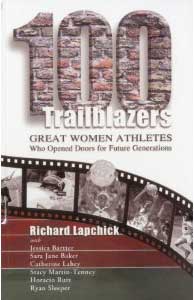
This book was written by Dr. Richard Lapchick, chair of the renowned DeVos Sport Business Management Program at the University of Central Florida, along with several of his students in the renowned program:
- Sara Jane Baker
- Jessica Bartter
- Catherine Lahey
- Stacy Martin-Tenney
- Horacio Ruiz
- Ryan Sleeper

The DeVos program offers students the opportunity to earn their Masters in Sports Business Management and a Masters in Business Administration. Focusing on ethics, diversity, leadership, and community service, the DeVos Program attracts some of the brightest and most committed students from across the country and across the globe.
-
This profile was built by:
Anna Florzak
http://tenniesandtutus.tumblr.com/
@eleanorflorzak
Kansas City, Mo & Orlando, Fla