




Chris Evert: Tennis
American Star of the Women’s International Sports Hall of Fame
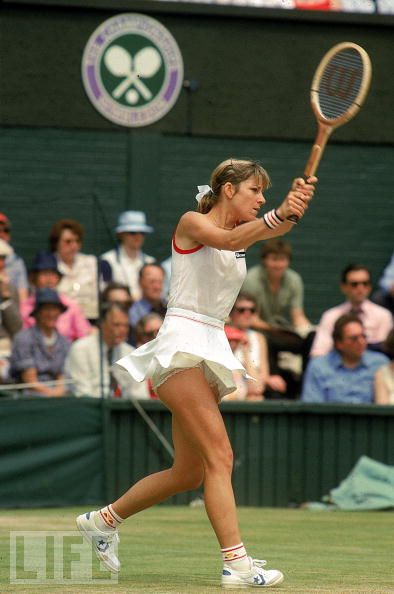
Photo: http://gototennis.com/2009/05/19/chris-evert-on-roger-federer-i-cry-every-time-he-loses/
Who's No. !? 16 Women in Tennis Who Held The Top Spot the Longest


The line between sports stardom and Hollywood celebrity has been blurred in the past few decades, leading sports fans to revel in the drama behind the scenes as much as the score on the field. Sports fans love winners, but even more so, they love the story leading up to the competition, they love the rivalry, they love watching the underdog succeed, and, perhaps most of all, they love the juicy details of the athletes’ personal lives. While the vast majority of us cannot relate to the perfection we see on the field or court, it is more likely that we were once the underdog or that a long-standing rivalry once brought out the best of us as competitors. In addition, it is the controversy in the locker room that is most relatable, bringing today’s celebrity-athlete out of the untouchable realm and down to earth with the rest of us, despite their seven-figure salaries. “Years before Anna Kournikova or Serena Williams arrived, [Chris] Evert was women’s sports first crossover star. People magazine covered her romances. Andy Warhol asked her to sit for a portrait. Saturday Night Live invited her to be the first female athlete to host the show.”1 Evert won stardom both on and off the tennis court, but the controversy surrounding the tennis-celeb Chris Evert’s career was that there was no controversy.
Chris Evert first entered the stage as a cute, naïve, humble 15- year-old just along for the ride when she upset the world’s No. 1 player, Margaret Court, in 1970. The high school sophomore was so unknown, the scoreboard mistakenly listed the amateur as “Everet,” but it wasn’t long before the tennis world learned her true name and bona fide talent. She quickly became a fan favorite, as there weren’t many teenage stars on the tennis circuit. At the time, the rules prohibited an individual from turning professional before turning 18 years old. Evert’s big upsets, subtle charm, and sweet demeanor won the hearts of tennis fans and sportswriters alike. She was nicknamed “Cinderella in Sneakers” by the New York Times and “Little Miss Sunshine” by New York’s Daily News. But her name was not always synonymous with good press. As she stoically progressed, and made a habit of consistently winning, the fan favorite lost her appeal by playing with an almost unprecedented level head. The British sportswriters re-nicknamed her “Ice Princess” in 1972 because of her outwardly cold appearance during matches. Some fans felt betrayed to see so much seemingly easy success come to an American woman who appeared emotionless and unimpressed by her own victories. But the fans’ assumptions could not have been further from the truth. Evert was filled with emotion on the inside, but externally portrayed the mental concentration that she had mastered, and that every competitor envied. Opponent Billie Jean King wrote, “Winning meant everything to Chris, the most competitive person I have known and one of the toughest competitors ever . . . unsmiling on the court . . . Chris had the ability to concentrate at all times. Her unwavering focus, combined with her great, natural coordination and her father’s
marvelous training, made Chris Evert one of the giants of the game.”2 While sportswriters everywhere praised Evert’s talent but bashed her emotionless façade, it is surely words like these from a respected peer that meant the most.
As King mentioned, Evert stuck to the poised play she learned from her greatest coach, her father, Jimmy Evert. You could say it flowed through the veins of his five children, the bloodline of a tennis- playing family, but more important than passing on his talent was the ability of Jimmy to spend time with his children while juggling his life as a tennis pro. What better way to succeed as a professional and a father than to be able to share the joys of both? Especially when Jimmy often spent 12 hours a day, seven days a week on the tennis courts. To mixed answers depending on who you ask (Chris or Jimmy), it seems Jimmy Evert dragged his five-and-a half- year-old daughter away from the swimming pool with friends and the weekend slumber parties to his tennis courts at the Holiday Park municipal facility, where he could pass along his honed racquet skills. Jimmy Evert had competed at Forest Hills (now known as the U.S. Open) five times and was ranked as high as 11th in the country
in 1943. His stellar amateur circuit earned him a tennis scholarship to the University of Notre Dame and a Canadian National Championship. While the dream of a college scholarship for each of his children would have been nice, Jimmy was just happy to have them on the court. He could never have expected each of his five children would go on to reach at least the final round of a national championship as junior players.
Perhaps even further from Jimmy’s mind was the two-handed backhand craze he and Chris would eventually start. As a young girl, Chris was not strong enough to handle the racket single-handedly on her backswing so her father and coach let her use two hands, hoping
that as she grew in strength and size, she would outgrow this technique. To his initial displeasure, Chris managed to master the two handed backhand and utilized it during her entire career. The success she had with her backhand led to tennis youth everywhere emulating her movements. Today, the two-handed backhand is a common weapon on the pro-tour, something almost nonexistent on the tour in the late 1960s and early 1970s.
After Evert’s initial show-stopping victory over Margaret Court just weeks after Court had won the 1970 Wimbledon, Evert really made a name for herself as she landed in the living rooms of tennis fans nationwide during the 1971 U.S. Open, where the unrenowned teen made it to the semifinals before she fell to Billie Jean King, who would eventually become that year’s champion. At the time, Evert was the youngest player ever to reach that stage at just 16 years, eight months, and 20 days old. Evert played in about five tournaments a year until she was 18 and could turn professional. Until then, her sparing tournament play allowed her to focus on graduating from high school and practicing tennis without burning out.
December 21, 1972 marked Chris Evert’s 18th birthday and the day she declared her professional status. She might as well have declared her unstoppable status as well. Evert’s skill first learned on the clay courts of Fort Lauderdale, Florida, led her to win 125 consecutive matches (24 tournaments) on clay between 1973 and 1979. This stretch still stands as the longest winning streak of any player on any single surface. After the single loss that broke the streak, Evert went on to win the next 72 matches on clay. Evert’s records would be hard to list, but another great streak includes the 55 straight matches that she won in 1974 on all surfaces. That record stood for more than 10 years. It is not surprising that Evert was the first player to win 1,000 singles matches; she retired in 1989 with a total of 1,309 match victories (out of 1,454) in her career. It was obvious that Evert did not expect anything less than a victory from herself. She reached the finals or the semifinals in 52 of her 56 Grand Slams, 18 of which she took home the title (three Wimbledons, seven French Opens, two Australian Opens, and six U.S. Opens). Evert’s Grand Slam total remains the third best in professional tennis history.
There is a widely-believed premise that good news never makes the news. Because sports fans gravitate toward the controversy, sportswriters are forced to seek the drama off the court, or in some cases, invent the controversy on their own. Chris Evert experienced this firsthand as she repeatedly faced Martina Navratilova. Sportswriters were desperate to paint the picture of an evil rivalry but the truth was far from ill will of either competitor. In fact, Evert and Navratilova could often be found in the locker room after a finals match where the winner would be consoling the crying loser with an arm around her shoulders. It was not a coach or a mother doing the consoling, but it was the very person who had just beat them, hardly a sign of hatred between the two women. The only debate was around who would be victorious as the winner and the loser seemed endlessly interchangeable. Their early meetings went favorably to Evert, who was 20-5 in their first 25 meetings. But with Evert in mind,
Navratilova changed her training regiment and began to gain more W’s against her. With Navratilova’s 1984 Wimbledon win over Evert, their draw was a clean 30-30.3 The latter 20 match-ups went 13-7 to the defected-Czechoslovakian. Their final tally from 1973 to
1988 was 43-37, with Navratilova slightly edging out Evert. Most important, though, was the friendship they groomed along the way. Both competitors credit each other for their lengthy careers, agreeing it was the other who gave them the strength and motivation to
keep training and competing. Navratilova and Evert even shared the same side of the net at times to compete together as a doubles team. The duo produced doubles championships in 1975 and 1976 at the French Open and Wimbledon, respectively. The friendship/rivalry produced such extensive hype and intrigue that a book was published
specifically about the two women 16 years after Evert’s retirement. In it, author Johnette Howard best describes their relationship:
They were two people who fervently wanted the same thing, found the other blocking the way, and ultimately forgave each other for it. They were bound by their athletic superiority. They were operating so far above everyone else on tour, needing to fear only each other, and they realized that they were the only two people who really, truly understood what the other was going through.4
Despite exchanging the No. 1 ranking 17 times, there was no one on tour who the other would rather cede it to. Before her 1989 retirement, Evert spent seven years of her two-decade-spanning career ranked No. 1 and remains there in the hearts and memories of many fans. Tennis prodigies seek Chris Evert’s advice at the Evert Academy in Boca Raton, Florida, where she instructs. She offers tips about their forehand, one- or two handed backswing, drop shot and lob, but most important offers the secret of her success; “the mental side was my strength . . . I was a really good athlete, but I wasn’t a great athlete.”5 While each of her competitors would almost certainly agree with her undeniable mental prowess, we would be hard pressed to find anyone who would agree that she wasn’t a great athlete, especially seeing as how she practically beat them all!
Note
1. Johnette Howard, The Rivals (New York: Broadway Books, 2005), 4.
2. Billie Jean King, We Have Come A Long Way (New York: McGraw-Hill, 1988),
135.
3. Howard, The Rivals, 6.
4. Ibid., 9.
5. The Oprah Winfrey Show, April 8, 2008.
The exerpt above was written by Sara Jane Baker
Articles Tagged with "Chris Evert" on WomenTalkSports.com:
IN SEASON:
Tue, Oct 1 at 12:03pm
Fri, Sep 6 at 9:32am
Fri, Nov 8 at 9:29pm
Fri, Nov 1 at 4:39pm
Today at 9:09am
Today at 9:04am
Sun, Nov 10 at 6:59pm
Thu, Nov 7 at 9:08pm
LATEST ARTICLES & POSTS
posted by Swish Appeal
Mon at 9:13am
posted by Swish Appeal
Mon at 9:11am
posted by All White Kit
Sun at 6:42pm

-
The body of this profile is an excerpt from 100 Trailblazers: Great Women Athletes Who Opened Doors for Future Generations.
This book is available on Amazon.com:
This book was written by Dr. Richard Lapchick, chair of the renowned DeVos Sport Business Management Program at the University of Central Florida, along with several of his students in the renowned program:
- Sara Jane Baker
- Jessica Bartter
- Catherine Lahey
- Stacy Martin-Tenney
- Horacio Ruiz
- Ryan Sleeper

The DeVos program offers students the opportunity to earn their Masters in Sports Business Management and a Masters in Business Administration. Focusing on ethics, diversity, leadership, and community service, the DeVos Program attracts some of the brightest and most committed students from across the country and across the globe.
-
This profile was built by:
Anna Florzak
http://tenniesandtutus.tumblr.com/
@eleanorflorzak
Kansas City, Mo & Orlando, Fla