




Christine Grant:
Trailblazer of the Association for Intercollegiate Athletics for Women (AIAW)
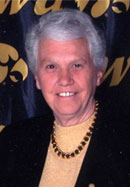
Photo: http://www.sportsmanagementresources.com/our-consultants/christine-grant
University of Iowa- Be Remarkable
Listening to Dr. Christine Grant over the phone, one can hear, in her gentle Scottish voice, that behind the pride she has for the Association for Intercollegiate Athletics for Women (AIAW), there is a trace of sadness that remains from its ultimate demise. Grant loved the AIAW. Looking back on a career full of accomplishments and hard fought battles, the former University of Iowa women’s athletic director and professor, and one of the nation’s leading proponents of Title IX legislation, fondly remembers the Association she believes was coming close to creating the perfect model for intercollegiate athletics. “There was tremendous respect for each person and it was just such an exciting time,” she said of the AIAW. “We were starting this organization from scratch.”1 As Grant speaks, it is barely a week after the 25th anniversary of the official dissolution of her beloved organization. She makes it a point to say that policies made during the AIAW’s 10 years of existence always kept the student-athlete in mind. “Every decision that we made we would ask ourselves, ‘Is this in the best interest of the student-athlete?’”
Grant was the acting president of the AIAW from 1979 to 1980, when it became clear the Association would be shut down. Members of the AIAW tried in vain to keep the Association alive, knowing it provided women with substantial leadership roles in significant administrative positions. As the National Collegiate Athletic Association (NCAA) took over women’s athletic departments because of Title IX financial and legal implications, women who previously held the highest posts in their departments were suddenly moved to less influential posts in departments directed by men. The AIAW and the NCAA differed in philosophies relating to athletics, not the least of which included financial aid for student-athletes, the sums of money dedicated to athletics, and the purposes for which the finances were used. The AIAW sued the NCAA in 1983, but the presiding judge ruled against the organization. “To this day, I do not know how we lost that lawsuit,” Grant said. Many women left intercollegiate athletics altogether, never to return because of the differences. Grant says she was blackballed by the NCAA, which was fine by her because she still was the athletic director of the women’s athletic department at the University of Iowa. It would take many years before Grant would again participate in NCAA committees.
Her fight for equality can be traced back to her native Scotland. Grant grew up surrounded by sports as a child, falling in love with field hockey because of the freedom she felt while running around an open field. For her, it was natural to include sports in her life. After receiving her diploma in physical education in 1956 from Dunfermline College in Aberdeen, Scotland, Grant was a high school teacher and coach in Graeme, Scotland, until 1961, when she moved to Canada. In Canada, she became heavily involved with field hockey, helping to organize pockets of field hockey clubs into a national field hockey association. In nine years in Canada, Grant would be chosen as the National Coach of the Canadian Women’s Field Hockey team, and she also organized national field hockey tournaments. In 1969, Grant pursued graduate studies in the United States and enrolled at Iowa. Grant did not want to spend more than one year at Iowa, but with the creation of a new women’s athletic department at the university, and with her international experience combined with her leadership skills, she was hired as women’s athletic director in 1973. Grant would go on to earn a bachelor’s degree in physical education and her master’s and doctoral degrees in sports administration.
“I could not believe the opportunities for men in this country,”she said. “There was nothing like a football Saturday in Iowa City, and on the other hand, I could not believe the opportunities for women because there were none.”
With her position independent of the men’s athletic department and with support from the University of Iowa, she was able to become an expert witness on Title IX legislation. Grant said that many of her colleagues who made the transition into working for a merged athletic department were afraid to speak on Title IX issues because they were afraid of the reprisals from the athletic director to whom they reported. “I was in a position to speak, so I felt an obligation to do what I could,” she said. Grant testified before Congress on numerous occasions regarding gender equity in sports. She also served as a consultant for the Civil Rights Title IX Task Force, becoming a key figure in drafting Title IX implementation. The University of Iowa has a collection of Christine Grant’s papers that she wrote throughout her career, including those she prepared for congressional testimonies, as well as her scholarly publications. During her time as women’s athletic director until her retirement in 2000, she grew the department to include 12 NCAA championship titles and 27 Big Ten Championships.
Teaching, Grant said, had always been her true love. Teaching came naturally to her as a former coach. Since 1975, Grant was associate professor of Health and Sport Studies. Even after retiring from her post as athletic director, she remained teaching in the graduate sport administration program at Iowa until 2006. By the late 1980s, Grant returned to work directly with the NCAA when she saw a change in leadership that embraced women’s athletics. She credits Dr. Myles Brand of the NCAA as one of the greatest proponents
of Title IX.
Grant has been instrumental as a consultant and chair in many of the NCAA’s most important committees regarding NCAA certification requirements, gender and equity issues, and
amateurism reform. “In the ’70s I was the biggest opponent of the NCAA,” she said. “Now I am one of the NCAA’s biggest supporters.” Grant has been inducted into the University of Iowa Athletics Hall of Fame and the Iowa Women’s Hall of Fame. In 2006, Grant was the recipient of the NCAA President’s Gerald R. Ford Award, which was awarded to her at the NCAA National Convention. The award honors individuals who have provided significant leadership in the areas of higher education and intercollegiate athletics throughout their careers. She was the first woman to receive the honor. That same year, she was named one of the 100 most influential educators
in the United States by the Institute of International Sport. “On behalf of the entire University of Iowa family, I’d like to congratulate Dr. Grant on this wonderful honor,” said Iowa athletic director Gary Barta when Grant was recognized by the Institute of International Sport. “People around the country are now finding out what we Iowans have known for a long time; Dr. Christine Grant was a wonderful teacher, coach, athletic administrator, and proponent of women’s athletics. There’s no question the status of women, in today’s athletic world, is in large part due to the ideals and efforts championed by Dr. Christine Grant.”2
Currently, Grant is an associate of the consulting firm Sports Management Resources (SMR) started by former CEO of the Women’s Sports Foundation Donna Lopiano. The firm works to consult athletic directors about policies in education and gender equity, and in the implementation and management of those policies. When she speaks about her career in sports and her involvement in creating opportunities for student-athletes, one can’t help but notice the passion in her voice. “To have had sports as a career has been delightful,” Grant said. “Sports have brought me so much joy and friendships that I wanted other young ladies to have the same opportunities I did.” During an interview a little more than one year after her retirement as women’s athletic director at Iowa, the interviewer asked, almost as if to extract an inspiring quote, why Grant had bothered to try and change the atmosphere of college athletics. The interviewer got just what he was looking for. “Because we in education have a responsibility to try to help society understand that in educational sport, winning is not the most important thing and losing is never failure,” Grant responded. “We can teach society that. I truly believe that, but we’ve got to believe it ourselves.”3
Notes
1. Unless noted otherwise, the quotes in this article are by Christine Grant, from
an interview with the author, July 8, 2008.
2. University of Iowa News Services. Christine Grant honored as one of 100 most
influential sports educators, October 17, 2007, http://www.news-releases.uiowa.edu/
2007/october/101707christine_grant_honor.html.
3. Ross Atkin, “A Voice in the Wilderness for Sports as Education,” The Christian
Science Monitor, November 30, 2001.
The exerpt above was written by Horacio Ruiz
IN SEASON:
Tue, Oct 1 at 12:03pm
Fri, Sep 6 at 9:32am
Fri, Nov 8 at 9:29pm
Fri, Nov 1 at 4:39pm
Today at 9:09am
Today at 9:04am
Sun, Nov 10 at 6:59pm
Thu, Nov 7 at 9:08pm
LATEST ARTICLES & POSTS
posted by Swish Appeal
Mon at 9:13am
posted by Swish Appeal
Mon at 9:11am
posted by All White Kit
Sun at 6:42pm

-
The body of this profile is an excerpt from 100 Trailblazers: Great Women Athletes Who Opened Doors for Future Generations.
This book is available on Amazon.com: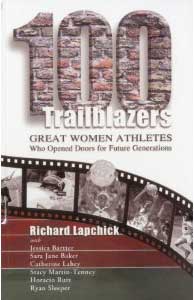
This book was written by Dr. Richard Lapchick, chair of the renowned DeVos Sport Business Management Program at the University of Central Florida, along with several of his students in the renowned program:
- Sara Jane Baker
- Jessica Bartter
- Catherine Lahey
- Stacy Martin-Tenney
- Horacio Ruiz
- Ryan Sleeper
The DeVos program offers students the opportunity to earn their Masters in Sports Business Management and a Masters in Business Administration. Focusing on ethics, diversity, leadership, and community service, the DeVos Program attracts some of the brightest and most committed students from across the country and across the globe.
-
This profile was built by:

Anna Florzak
http://tenniesandtutus.tumblr.com/
@eleanorflorzak
Kansas City, Mo & Orlando, Fla