

Donna de Varona: Swimming
American Star of the Women’s International Sports Hall of Fame
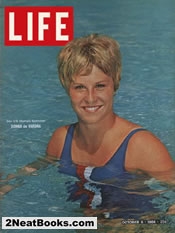
Photo: LIFE Magazine

For a few years in the mid-1960s, Donna de Varona was one of the most recognizable faces in the world. She first made headlines at age 13 as the youngest member of the U.S. Olympic team at the 1960 Rome Olympics. Four years later at the Tokyo Olympics, she captured a gold medal in Olympic record time in the 400-meter individual medley and a gold medal in world record time in the 4x100 free relay. Soon after the Tokyo Olympics, de Varona retired from competitive swimming with 37 national titles in the backstroke, butterfly, and freestyle and had broken 18 world records. In between her two Olympic appearances and shortly after her retirement, de Varona was the most photographed woman athlete, appearing on the covers of Life, Time, and twice on Sports Illustrated. For the International Swimming Hall of Fame’s first international meet in 1965, de Varona was recognized as the “Queen of Swimming.” But her success as a gold medalist in swimming is only a small prologue to the impact she would have in fighting for women’s rights on the professional side of sports as well as on the playing field.
As a 17-year-old, de Varona became the first woman sports broadcaster to appear on network television when she covered the 1965 men’s Amateur Athletic Union (AAU) swimming championships alongside Jim McKay. While she was typecast as a swimming expert early in her career, de Varona was able to move up the broadcasting ranks to eventually become an on-air analyst, commentator, host, writer, and producer. In 1991, she earned an Emmy Award for producing a feature on a Special Olympian and in 1998, she received an Emmy nomination for co-producing, writing, and hosting Keepers of the Flame, a television special on the Olympics. While de Varona pioneered the way for women in broadcasting, her impact has been felt just as strongly in her advocacy for creating and protecting opportunities for girls and women in sport.
de Varona was active in advisory positions as early as 1966, when she served on the President’s Council on Physical Fitness and Sport. By 1973, she was a co-founder of the Women’s Sports Foundation, the preeminent organization in the United States for the advancement of girls’ and women’s lives through sport and physical activity. She served as the Foundation’s first president from 1979 to 1984 and is currently an honorary trustee for the Foundation. “I felt that women needed an organization that represented just us,”1 de Varona said. Under de Varona’s leadership, the Foundation established an annual fundraising dinner and takes annual visits to Washington, D.C., to speak about the impact Title IX has had on providing opportunities for women in sport. Nearly 30 years after de Varona lobbied for the passage of Title IX, she served on the U.S. Secretary of Education’s Commission on Opportunity in Athletics. The Commission was formed to study the effect of Title IX on men and women. When the majority of the Commission had created proposals to change Title IX to preserve opportunities for men, de Varona and Julie Foudy, then-captain of the U.S. soccer team, objected in a minority rebuttal. While they staunchly supported both men’s and women’s sports, de Varona and Foudy felt that the new proposals would not have helped preserve any more men’s sports and would have damaged opportunities for women.
“I am disturbed by the Commission’s failure to ask for or consider any data on the impact of its proposals—such as the effect of the recommendations on participation opportunities and scholarships for female athletes,” de Varona wrote to the Opportunity in Athletics Commission. “In fact, the impact is likely to be devastating; one estimate calculates that under one of the proposals, women at a typical Division I-A school would lose 50,000 participation opportunities and $122 million in scholarships. This is simply unacceptable. Indeed, as a member of President Ford’s Commission on Olympic Sports, I had the privilege of participating in a procedure that was open, fair and comprehensive and I felt when the process was completed that I had been given the opportunity to fully examine the facts and the impact our recommendations would have on the Olympic community. Therefore, regretfully, because this report does not allow me to meet these responsibilities, I must decline to sign on to it and will be participating in the filing of a separate minority report.”2
As a result of both de Varona’s and Foudy’s minority report, Secretary of Education Rod Paige did not alter any of the Title IX legislation because a consensus was not reached by the task force, and in July 2003, the Bush administration announced that the law would remain unchanged. In 1996, de Varona was appointed as the chair of the 1999 Women’s World Cup, which would be hailed as the most successful women’s sporting event ever. “Soccer is the most popular sport around the world,” de Varona said during an interview following the World Cup. “And one of the tests that we’ve fought in trying to gain acceptance in supporting women’s sports is the test of can you fill stadiums, can you get the ratings? Well, we sold over 650,000 tickets. We had a rating of 13, which I guess translates into 40 million homes. And we met people on every standard. And it was a global celebration as well.”3
Her role as chair of the Women’s World Cup was so successful that she now serves on the board of the U.S. Soccer Foundation. Throughout her career, she has received several of the highest honors that can be bestowed to an individual from a number of organizations. In 2000, the International Olympic Committee awarded her with its highest distinction—the Olympic Order for contributing to the Olympic movement worldwide. In 2003, the National Collegiate Athletic Association (NCAA) honored her with its highest individual honor, the Theodore Roosevelt Award, which is awarded annually to “a distinguished citizen who is a former college student-athlete and who has exemplified the ideals and purposes of college athletics by demonstrating a continuing interest and concern for physical fitness and sport.” de Varona has been inducted into the U.S. Olympic Hall of Fame, the International Swimming Hall of Fame, and the Women’s Hall of Fame.
Dating back to her Olympic roots in 1960, when she first introduced herself as an upbeat teenager, the 2008 Beijing Olympic Games marked de Varona’s 18th coverage of the Summer and Winter Olympic Games as a broadcaster for both radio and television. True to both her Olympic spirit and continual fight for women’s sports, she is currently the co-chair of the Back Softball campaign to have the sport restored to the Olympics by 2016.
Notes
1 Carline Bennett, “Seven Who Changed Their World,” WeNews, December 23, 2003.
2 Donna de Varona, letter to Title IX Commission, February 20, 2003.
3 Donna de Varona, interview with Jim Lehrer, Online NewsHour, July 12, 1999. Retrieved from http://www.pbs.org/newshour/bb/sports/july-dec99/soccer_7-12.html.
This excerpt was written by Horacio Ruiz
IN SEASON:
Tue, Oct 1 at 12:03pm
Fri, Sep 6 at 9:32am
Fri, Nov 8 at 9:29pm
Fri, Nov 1 at 4:39pm
Today at 9:09am
Today at 9:04am
Sun, Nov 10 at 6:59pm
Thu, Nov 7 at 9:08pm
LATEST ARTICLES & POSTS
posted by Swish Appeal
Mon at 9:13am
posted by Swish Appeal
Mon at 9:11am
posted by All White Kit
Sun at 6:42pm

-
The body of this profile is an excerpt from 100 Trailblazers: Great Women Athletes Who Opened Doors for Future Generations.
This book is available on Amazon.com: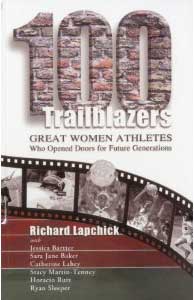
This book was written by Dr. Richard Lapchick, chair of the renowned DeVos Sport Business Management Program at the University of Central Florida, along with several of his students in the renowned program:
- Sara Jane Baker
- Jessica Bartter
- Catherine Lahey
- Stacy Martin-Tenney
- Horacio Ruiz
- Ryan Sleeper

The DeVos program offers students the opportunity to earn their Masters in Sports Business Management and a Masters in Business Administration. Focusing on ethics, diversity, leadership, and community service, the DeVos Program attracts some of the brightest and most committed students from across the country and across the globe.