




Wyomia Tyus: Olympics, Track & Field
American Star of the Women’s International Sports Hall of Fame
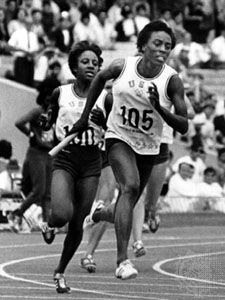
Wyomia Tyus was there to witness one of the most memorable events in Olympic history. She watched as Tommie Smith and John Carlos bowed their heads, raised their fists, and silently protested the country that had shown such incredible racial injustice.1 Tyus was so moved by these actions she dedicated the gold medals for which she had worked so hard to Smith and Carlos. “What I did . . . was win a track event. What they did lasted a lifetime, and life is bigger than sport.”2 Tommie Smith and John Carlos were not the only athletes to make history at these 1968 Olympics. Tyus became the first runner, male or female, to defend her title in the 100-meter dash.
The prestige and steep competition associated with the 100- meter dash has made it one of the most anticipated Olympic races. The winner goes home with not only a gold medal, but the title of “fastest woman in the world.” To accomplish this honor once was amazing, but to accomplish it twice was unheard of. However, with all the controversy surrounding these Olympics, Tyus’s triumph was overlooked. It would not be until decades later when she would finally be recognized.
In the time period leading up to these Olympic Games, Tyus faced adversity and challenges as many people questioned whether or not she still had the skills to remain competitive. “I was not encouraged to stay in the sport. There were people saying even before 1968 that I was too old to be running. That just goes to show the state of mind of people at the time.”3 Tyus, however, ignored this discouragement and continued with the sport, not because it brought her fame or money, but because she loved it. And what is even more impressive is the fact that not only did she compete in the Olympics, but she ran at record-breaking speed.
This state of mind needed to overcome adversity was nothing new to Tyus. From a young age, Tyus was battling race and gender issues surrounding her participation in sports. Not only did societal ideals tell her women should not play sports, but her own mother believed athletics were unladylike. Additionally, growing up in Griffin, Georgia, provided many other challenges rooted in racial prejudice. Tyus was forced to take a one-hour bus trip to school each morning because the school closest to her house was for white students only. Despite these obstacles, Tyus fell in love with sports, and she believed athletics was a means to break away from these inequalities.
One major reason for her growing passion in sports was due to her father’s influence. Much to the dismay of her mother, Tyus’s father encouraged his daughter to play sports. In fact, he forced Wyomia’s older brothers to include her in the neighborhood games of basketball and football.4 As a result of these interactions, Tyus’s first love became basketball. It was not until she attended a clinic in 1960 that she became interested in track and field. Ed Temple, the legendary coach from Tennessee State University (TSU), invited Tyus to their camp. Temple would not only become her coach, but he would take on a much more significant role when Tyus’s father passed away that same year. “Coach Ed Temple came into my life after my father died. A man of integrity, Coach Temple had many sayings to encourage us during the rough times.”5
With the special bond Coach Temple and Tyus shared, it was no surprise when she attended TSU on a track and field scholarship. TSU had a reputation of producing talented track and field athletes, as former Olympic medalists Wilma Rudolph and Mae Faggs preceded her on the team. Additionally, TSU was one of the few schools that offered athletic scholarships for women. Throughout college, Tyus continued to show improvement and was consistently winning races. This success earned her a spot on the 1964 Olympic team headed to Tokyo, Japan. Although Tyus was the underdog to her teammate, Edith McGuire, Tyus prevailed and took home the gold medal in the 100-meter race.
Leading up to the 1968 Olympics in Mexico City, the United States was at the peak of racial disorder. Many African-Americans encouraged Tyus to protest the Games because it seemed absurd that Tyus would support a country that was not supporting her. Despite these concerns, Tyus felt strongly about defending her 100-meter title. She would not only win the gold medal but in doing so, she set the world record with a time of 11.08 seconds. She earned a second gold medal in the 4 × 100-meter relay. In her own way, Tyus protested the lack of civil rights in the United States by wearing all black to her awards ceremony.
Upon returning to the United States, Tyus received little recognition for her accomplishments, which came as no surprise to Tyus. “Coach Temple always told us that we could break world records and win gold medals, but we probably still wouldn’t be recognized because we were women and we were black.”6 Ironically, this lack of recognition would be the motivation behind her life’s work after track.
In 1973, Tyus, tennis star Billie Jean King, and swimmer Donna de Varona became the founding members of the Women’s Sports Foundation. This nonprofit foundation’s mission is to “advance the lives of girls and women through sport and physical activity.” Since its establishment, the Women’s Sports Foundation has increased high school sports opportunities for girls by 847 percent and college sports opportunities by 411 percent. Additionally, the Foundation has inspired millions of women to become active by increasing physical education opportunities for over 400,000 girls in lower socio-economic areas.7
Tyus’s fight for equality in women’s sports does not stop there. Tyus has toured over 60 cities to speak and encourage athletics and physical fitness for women. She was a spokesperson for the Active and Ageless, which encouraged those over 50 years old to stay physically active. Tyus also played an integral part in the United States Olympic Committee’s Project Gold 2000. Project Gold, which stands for Guaranteed Olympic Leadership Development, attempted to place underrepresented groups, like women and minorities, in leadership roles in sports.8
Sadly, it would not be until 1988 when the world finally realized the magnitude of Tyus’s accomplishment. Carl Lewis successfully defended his title in the 100 meters at the Olympics in Seoul. Much of the world mistakenly thought he was the first to accomplish this feat only to learn it was actually Tyus, who 20 years earlier had done the same.
Wyomia Tyus is more than a tremendous athlete. She truly embodies humility and altruism as she has never expected praise for her accomplishments on or off the track. Although Wyomia Tyus has never received the attention she deserves, she has ensured that future women pioneers will.
Notes
1. “Wyomia Tyus,” The New Georgia Encyclopedia,” http://www.georgiaencyclopedia.org/nge/Article.jsp?id=h-836
2. “Wyomia Tyus—Olympic Success,” http://sports.jrank.org/pages/4987/Tyus-Wyomia.html.
3. Ibid.
4. “Wyomia Tyus—Early Training,” http://sports.jrank.org/pages/4987/Tyus-Wyomia.html.
5. “Wyomia Tyus—A Coach’s Influence,” http://sports.jrank.org/pages/4987/Tyus-Wyomia.html.
6. “Wyomia Tyus—Olympic Success.”
7. Women’s Sports Foundation, “About Us,” http://www.womenssportsfoundation.org/cgi-bin/iowa/about/more.html.
8. “Passing the torch: Women’s commission updates,” USATWomen’s Commission, http://www.smfsport.com/USATWomen/wcnews01.htm.
The previous excerpt was written Sara Jane Baker
IN SEASON:
Tue, Oct 1 at 12:03pm
Fri, Sep 6 at 9:32am
Fri, Nov 8 at 9:29pm
Fri, Nov 1 at 4:39pm
Today at 9:09am
Today at 9:04am
Sun, Nov 10 at 6:59pm
Thu, Nov 7 at 9:08pm
LATEST ARTICLES & POSTS
posted by Swish Appeal
Mon at 9:13am
posted by Swish Appeal
Mon at 9:11am
posted by All White Kit
Sun at 6:42pm

-
The body of this profile is an excerpt from 100 Trailblazers: Great Women Athletes Who Opened Doors for Future Generations.
This book is available on Amazon.com:
This book was written by Dr. Richard Lapchick, chair of the renowned DeVos Sport Business Management Program at the University of Central Florida, along with several of his students in the renowned program:
- Sara Jane Baker
- Jessica Bartter
- Catherine Lahey
- Stacy Martin-Tenney
- Horacio Ruiz
- Ryan Sleeper

The DeVos program offers students the opportunity to earn their Masters in Sports Business Management and a Masters in Business Administration. Focusing on ethics, diversity, leadership, and community service, the DeVos Program attracts some of the brightest and most committed students from across the country and across the globe.
-
This profile was built by:

Taunita Stephenson
About Taunita:
~*Member of the DeVos Sport Business Program (Top 4 Sport Business Programs in the Nation!), Class of 2012*~ ~*Class of 2009, Delaware State University Graduate-Making My Mark on the World!" ~*I am enthusiastic about equality and diversity and hope to begin a career in Player Development or Diversity Initiatives!*~ God, Family, Friends, Career Goals, Jay-Z, Lakers, Fashion-In that order! What I Live By: "Vision without action and a plan is an illusion"