

Dr. Peggy Burke:
Trailblazer of the Association for Intercollegiate Athletics for Women (AIAW)
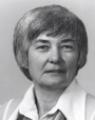
When asked what the climate of women’s sports was like when she first became interested in athletics, Dr. Peggy Burke laughs a little. “Really, there was no climate, because there were little to no formal opportunities for women. At least, that was the case where I grew up.”1 Though women’s teams didn’t exist in her area, in fact, there wasn’t even physical education in her high school, Burke had the fortune of being introduced to sports through playing with her brothers. Despite the absence of athletic opportunities during her own formative years, Burke would soon become one of the most influential voices in garnering increased opportunities in sport for women.
The community of women’s athletics narrowly missed losing Burke’s influence entirely. Upon entering college Burke declared a business major, completely unaware of the opportunity to study physical education. When she realized that the physical education major was open to women, she quickly made a switch, incurring a date with her own destiny. When asked why she elected to change majors, Burke says “It was purely my own desire—no one pushed me toward athletics.”2 From that point forward, Burke was fully dedicated to her field, becoming actively involved in women’s athletics administration at a number of levels.
Since 1977, Burke has been an active promoter of athletic opportunities for women. Much of her career was spent as an associate professor of sport, health, leisure, and physical studies at the University of Iowa. While there, she mentored numerous women while establishing collegiate athletic opportunities for women. One of the ways she did this was by participating as a founding member of the Association for Intercollegiate Athletics for Women (AIAW). Burke began as a representative at the state level in Iowa, helping to diffuse the boycott of Iowa Wesleyan University. From the state level, Burke became a member of the AIAW’s first delegate assembly in 1972 and eventually served as the organization’s president from 1976 to 1977.
During her presidential tenure, Burke tackled numerous issues in women’s athletics including Title IX interpretation, six-player girls’ basketball in Iowa, AIAW policy and structure, and the National Collegiate Athletic Association’s (NCAA) increasing interest in overseeing women’s championship play. “I’m very proud of the fact that we implemented a system of student-athlete representatives—that was something that took place during my presidency,”3 says Burke. An unselfish leader, Burke shortened her own tenure as president by implementing streamlined election practices, so that presidents were chosen at the delegation rather than by mail-in vote. Burke also took great pride in the work that AIAW did in promoting Title IX and addressing its correct interpretation.
The issue that Burke and many others within the organization felt most strongly about was the NCAA’s increasing encroachment on the governance of women’s intercollegiate athletics. Though the NCAA initially snubbed women’s sports, functionally prompting the formation of the AIAW, its apathy didn’t last long. As the AIAW built a strong base for women’s athletics and Title IX began to truly take effect, the NCAA began to develop an interest in uniting men’s and women’s sports governance under one organizational umbrella. Soon the NCAA began to actively pursue gaining oversight of women’s athletics from the AIAW. The issue was a volatile one, particularly for those like Burke who had worked so tirelessly to create an organization for women by women. “I was very opposed to the NCAA’s takeover of women’s sports governance. It came at a time when we [the AIAW] were gaining television contracts, a step that would have made the AIAW financially feasible into the future. I resented the takeover then and I resent it today.”4 These strong feelings were shared by many women who had dedicated their time and talent to providing opportunities to females—in student-athlete, coaching, officiating, and administrative roles—through the AIAW. In 1982, governance of women’s athletics was officially transferred to the NCAA and the AIAW, a truly innovative and empowering organization, closed its doors.
Regardless of the organization’s ultimate end, the AIAW and its leaders accomplished an incredible amount in creating opportunities for women through athletics and beyond. For her work with the organization and for women, Burke has been honored numerous times. A copy of one of her speeches was published in the 1979 edition of Vital Speeches of the Day, and she authored many journal articles and book chapters. Burke has been honored with the University of Iowa Distinguished Achievement Award and the Women’s Sports Foundation’s Pioneer in Women’s Sports Award. The National Association for Girls and Women in Sport (NAGWS) had lauded Burke twice, first with the Honor Fellow Award and then with the 1999 Pathfinder Award.5 Her passionate work with the AIAW set the foundation for increased opportunities for females through sports.
Today there is a place for women’s sports in American society, largely due to the work of Burke and her colleagues in the AIAW. When asked if she had any advice for the young women of today, Burke replied “Someone once said, ‘Women should raise more hell and fewer flowers.’ I still think that’s a good motto for today.”6 The quote, by James McNeill Whistler, is an excellent summation of the vigor with which Burke plowed through the obstacles that stood in the way of equality for women through sport. Burke is also quick to remind women that the fight is not over. The greatest honor that today’s female athletes can give her is to remember the past and work for a brighter future.
Notes
[1] Dr. N. Peggy Burke, telephone interview with Catherine Lahey, May 28, 2008.
2 Ibid.
3 Ibid.
4 Ibid.
5 Mary Geraghty, “Burke Wins Pathfinder Award for Promotion of Women in Sports,” The University of Iowa News Services, May 24, 1999.
6 Dr. N. Peggy Burke, telephone interview with Catherine Lahey, May 28, 2008.
This excerpt was written by Catherine Lahey.
IN SEASON:
Tue, Oct 1 at 12:03pm
Fri, Sep 6 at 9:32am
Fri, Nov 8 at 9:29pm
Fri, Nov 1 at 4:39pm
Today at 9:09am
Today at 9:04am
Sun, Nov 10 at 6:59pm
Thu, Nov 7 at 9:08pm
LATEST ARTICLES & POSTS
posted by Swish Appeal
Mon at 9:13am
posted by Swish Appeal
Mon at 9:11am
posted by All White Kit
Sun at 6:42pm

-
The body of this profile is an excerpt from 100 Trailblazers: Great Women Athletes Who Opened Doors for Future Generations.
This book is available on Amazon.com:
This book was written by Dr. Richard Lapchick, chair of the renowned DeVos Sport Business Management Program at the University of Central Florida, along with several of his students in the renowned program:
- Sara Jane Baker
- Jessica Bartter
- Catherine Lahey
- Stacy Martin-Tenney
- Horacio Ruiz
- Ryan Sleeper

The DeVos program offers students the opportunity to earn their Masters in Sports Business Management and a Masters in Business Administration. Focusing on ethics, diversity, leadership, and community service, the DeVos Program attracts some of the brightest and most committed students from across the country and across the globe.