
Effa Manley: Baseball, Softball
A Racial and Gender Pioneer
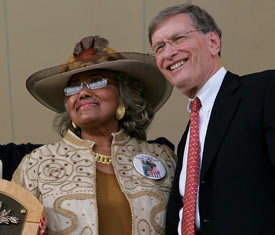
The accomplishments of Effa Manley would be noteworthy regardless of the enterprise in which she worked. The fact that she worked in the business of sport in the 1930s and 1940s, which at the time was almost exclusively a male endeavor, is remarkable—and given she was a woman in an interracial marriage to an African-American entrepreneur whose biggest interests were gambling and baseball makes her story that much more intriguing and inspirational.
Effa Manley and her husband Abe, the owners of the Brooklyn Eagles (which would later gain fame as the Newark Eagles), joined the Negro National League (NNL) in 1935. Abe spent most of his time recruiting and acquiring players for the team, which meant Effa was left running the business of the baseball club—an area in which she would excel. As Effa learned more and more about the business of baseball, she became an outspoken advocate and defender of black baseball. The Eagles moved to Newark for the 1936 season, thus beginning an intriguing relationship between black baseball, the city of Newark (which had a much larger black population than Brooklyn), and the marketing and management skills of Effa Manley.
While always chasing the perennial champion Homestead Grays, the Newark Eagles fielded a winning team almost every year and had some of the most high-profile players in the NNL. Players like Monte Irvin, Ray Dandridge, Willie Wells, George “Mule” Suttles, Larry Doby, and Don Newcombe helped the Eagles attract large crowds of up to 10,000 spectators, causing a writer to remark that the Eagles were to (black) Newark what the Dodgers were to Brooklyn. Effa Manley was one of the first owners to understand the link between popularity on the field and popularity in the community. While Abe built a solid foundation on the field, it was Manley who developed the complementary relationship in which Newark helped the Eagles and the Eagles helped Newark. She made sure that the team had an image of upholding the black community’s best standards—and was heavily involved in using the Eagles as a platform for cause marketing initiatives for the NAACP, career opportunities for blacks in medicine, social organizations such as the Black Elks lodges, and fundraisers for various local schools and other community-based organizations.
Effa Manley, like contemporary Cleveland Indians Owner Bill Veeck, also realized the value of a ticket and the importance of price integrity—neither was interested in giving away free tickets—but both promoted the idea of selling tickets (and in turn, having people from the benefiting organization sell the tickets) and donating a portion of the proceeds to some type of cause marketing initiative. One of the more interesting examples of this type of endeavor occurred in 1941, when Manley and the Eagles were enlisted to help raise funds for the local Jewish community center by playing an exhibition game against the well-known white barnstorming team, House of David.
The one thing that set Manley apart from many of her contemporaries was her ability to see the value of long-term marketing initiatives—those initiatives with more of a future impact on financial fortunes rather than an immediate return. Sponsoring youth baseball teams in order to teach young people about the game and to create an ongoing relationship between the youth and the game was a viable long-term growth strategy—growing and developing a market to ensure the long-term stability of the team. Perhaps if more people would have thought like Effa Manley, there would be more African-Americans playing and watching baseball in 2008 than the current levels, which have been dropping annually.
Manley’s role could best be described as the team’s business manager—which essentially put her in charge of nearly everything concerning the Eagles that occurred in Newark except for the actual playing of the games. This meant that Manley was responsible for the schedule, travel, publicity, advertising, purchasing, concessions, negotiating player contracts, ballpark operations, marketing and ticket sales, as well as the aforementioned community relations programs. There are few, if any women, in 2008 with responsibilities of this magnitude with any sport franchise—so imagine how unique this was when it occurred more than 60 years ago.
As Effa was met with more and more success, Abe Manley began turning more and more of the operations of the Eagles over to her until it grew to the point that she had final say in everything—including hiring managers and ultimately overseeing the sale of players to the now integrated major leagues. As the NNL and the Eagles were disbanding, Manley battled with the likes of Branch Rickey over the fate of Monte Irvin and she made her point and was able to sell Irvin to the New York Giants. How ironic is it that the widely anticipated integration of Major League Baseball in 1947 would lead to the ultimate devastation of one of the most visible black enterprises in the United States, the Negro baseball leagues?
The demise of the NNL and the Newark Eagles meant that she did not have any day-to-day baseball responsibilities—but Manley’s baseball related work was not complete. She worked tirelessly, until her death in 1981, to gain recognition for great Negro League players like Satchel Paige, Josh Gibson, Biz Mackey, and many others by the Baseball Hall of Fame. Manley was also involved in oral baseball histories and film documentaries about the Negro Leagues such as Craig Davidson’s film The Sun was Always Shining Someplace. Manley’s dream would become a reality in 1971—and she would have been even more pleased in 2008, when all of the surviving Negro league players were “drafted” by major league teams as a gesture to compensate for overlooking these players and excluding them from the mainstream version of the game they loved.
Effa Manley was a driven force where she found challenges and satisfaction in the management of a men’s game. Sadly, there are few women pioneers who worked in the sports industry at the levels and with the accomplishments of Effa Manley—but more than 60 years later she is still a source of pride, accomplishment, and aspiration for the women of today.
This excerpt was written by William A. Sutton.
IN SEASON:
Tue, Oct 1 at 12:03pm
Fri, Sep 6 at 9:32am
Fri, Nov 8 at 9:29pm
Fri, Nov 1 at 4:39pm
Today at 9:09am
Today at 9:04am
Sun, Nov 10 at 6:59pm
Thu, Nov 7 at 9:08pm
LATEST ARTICLES & POSTS
posted by Swish Appeal
Mon at 9:13am
posted by Swish Appeal
Mon at 9:11am
posted by All White Kit
Sun at 6:42pm

-
The body of this profile is an excerpt from 100 Trailblazers: Great Women Athletes Who Opened Doors for Future Generations.
This book is available on Amazon.com: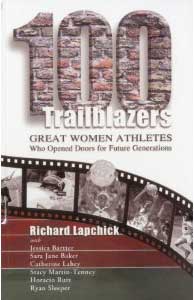
This book was written by Dr. Richard Lapchick, chair of the renowned DeVos Sport Business Management Program at the University of Central Florida, along with several of his students in the renowned program:
- Sara Jane Baker
- Jessica Bartter
- Catherine Lahey
- Stacy Martin-Tenney
- Horacio Ruiz
- Ryan Sleeper
The DeVos program offers students the opportunity to earn their Masters in Sports Business Management and a Masters in Business Administration. Focusing on ethics, diversity, leadership, and community service, the DeVos Program attracts some of the brightest and most committed students from across the country and across the globe.