
Evelyn Ashford: Track & Field
American Star of the Women’s International Sports Hall of Fame
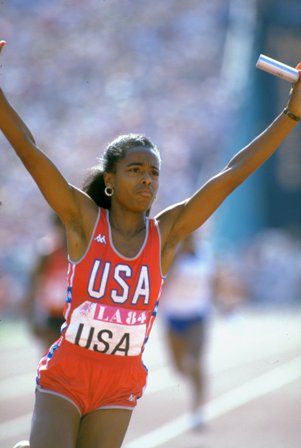
Photo: Steve Powell
Evelyn Ashford was the first woman to run the 100-meter dash under 11 seconds when she set a world record of 10.79 seconds in 1983. Her storied career began years before when the young Evelyn found herself leading a group of boys in a foot race. She is the daughter of U.S. Air Force Sergeant Samuel Ashford and wife Vietta and in typical military fashion, the family was never able to plant their feet for long in one city because duty called. By Evelyn’s sophomore year of high school, her family had moved to Roseville, California. She had proven her swift-footed skills in Alabama the previous year on the track, but once they arrived in California there was no girls’ track and field team for her to compete in. Not bound by society’s divergence of gender for the sport, she turned heads as she raced with the high school boys’ track team. Pure athletic talent usually opens doors, and her stunning speed certainly opened the door for her to run with the boys.
Evelyn Ashford matured competitively and became respected by her peers, and those young, high school boys honored her by naming her captain during her senior year. She garnered so much attention that she was offered an athletic scholarship by Coach Pat Connolly at UCLA that year. From her lightning start the first day of practice, she impressed Connolly and he quickly began planning a golden future for Ashford. After only a year of consistent training and coaching, Ashford qualified for the 1976 Olympic Games in Montreal at 19 years old. Placing fifth in the 100-meter dash final, she registered a time that was faster than that of many seasoned veterans of the sport. The tide was turning in women’s track and field, and another great era was approaching with Evelyn Ashford stepping onto the track.
With just a taste of international competition, Ashford returned to dominate the women’s collegiate competition. In both the 1977 and 1978 seasons, she accomplished the illustrious double-double national championship for a sprinter—a win in the 100-meter dash and in the 200-meter dash. The following year, she returned to the international scene, competing for the World Championship in 1979, and won the 100-meter with ease. Everything was starting to align for the young sprinter and she was favored to win the gold in the 100-meter during the upcoming 1980 Olympic Games in Moscow. Her childhood dream of winning a gold medal for her country, like her hero Wilma Rudolph, was so close that she could taste the victory. However, like so many U.S. athletes, she faced almost unbearable disappointment when her Olympic dreams were crushed due to the U.S. boycott of the 1980 Olympic Games. President Jimmy Carter decided to boycott the Moscow Games in protest of the Soviet Union’s invasion of Afghanistan. Ashford then found herself at a crossroads in her career when she injured her hamstring in a race later that summer. As a result, she chose to take a year off to evaluate her goals in track and in life.
She could have let the disappointment conquer her golden dreams, but instead she returned to the track with a renewed sense of purpose and vigor. Her speed improved as the hamstring recovered, and the fleeted-foot Ashford returned to the sport to prove her talent to the world’s competition. She earned the notable double-double just out of her starting blocks at the 1981 World Cup. During the peak of her career, Ashford collected 20 of the 23 fastest times in the women’s 100-meter. Ashford had become the face and the hope of her country in the battle on the track between her native United States and the competitive East German sprinting regime. Her rival in this epic sprinting duel was Marlies Gohr of East Germany, and the two phenoms traded wins in the 100-meter. Gohr defeated Ashford at a Los Angeles meet in 1983, but just one week later Ashford delivered a tremendous performance at the Sports Festival in Colorado with a world-record 10.79 seconds. That same year, Ashford repeated her remarkable double-double performance at the World Cup. As she prepared for the 1983 World Championships in Helsinki, she was focused on beating Gohr in the final. After breezing by the competition in the quarter- and semifinals, her previous hamstring injury resurfaced in the final, crushing her dreams of beating her old foe. Gohr won the battle.
Ashford had faced this same kind of adversity before, but this time she would have to push harder to return from the injury because the 1984 Los Angeles Olympic Games were only months away. And push she did, as she ran away from the field with her coveted Olympic gold medal in the women’s 100-meter dash while setting the Olympic record. Ashford delivered a second gleaming performance in the 4x100 relay and brought home a second gold medal. The victory left a bittersweet taste in her mouth as the games concluded because Gohr, the East Germans, and Soviet Union had boycotted these Games as a result of President Carter’s boycott in 1980. Later that summer, she caught up with Gohr in Zurich and overcame her rival in a stunning world-record performance of 10.76 seconds. Ashford was pregnant at the time of the race and took the next 17 months off to have her baby, a daughter she named Raina.
Speculation and doubt circled her return to the sport, as many wondered if this world-class sprinter would return to a competitive level, let alone regain her championship reign. Ashford faced her critics by persevering and her competition and the media quickly recanted their hesitation as Ashford proceeded to win all but two races in 1986. She continued her pursuit of excellence and made her fourth Olympic team in 1988. Ashford immediately made her mark on the 1988 Seoul Olympics, as she was selected by the U.S. team captains to carry the U.S. flag in the opening ceremonies. In nearly 100 years of the Olympic Games, Ashford was only the third woman and second African-American to carry the country’s flag in the Olympic parade. It was an honor bestowed on a well-respected athlete by the nation’s best to recognize the impact she has had on her sport and the nation. A seasoned competitor, Ashford made the 100-meter final but knew that her teammate, the youthful Florence Griffith-Joyner, would be difficult to beat for the gold. Youth passed experience by 0.29 seconds that day on the track and Ashford was awarded a silver medal in the 100-meter dash. She quickly dug deep into her experience and heart, and came back in the 4x100 relay to deliver a come-from-behind victory as the anchor leg for the U.S. team. Experience and perseverance was victorious.
Ashford defied the odds yet again, making her fifth and final Olympic team for the 1992 Olympic Games in Barcelona, Spain. The last was similar to the first with wide eyes and breathing the atmosphere in with every breath, but the fifth time poise replaced nervousness. Ashford ran the lead leg on the 4x100-meter and as she stood on the podium holding her final gold medal, she took her final breath of Olympic air. Ashford told Flip Bondy of the New York Times in 1992, “I think maybe I’m a pioneer . . . When I started, the Eastern European women had a stranglehold on sprinting. I wanted to prove that Evelyn Ashford could run fast and win a gold medal. Maybe I contributed something good.”1 Ashford was honored for doing something good for track and field in 2006 with her induction into the U.S. Olympic Hall of Fame. She was also awarded the Flo Hyman Award by the Women’s Sports Foundation. Ashford has worked for General Motors as an Olympic advisor, made appearances for the U.S. Olympic Committee, commentates for track and field occasionally, but mostly she is the proud mother of her two children and wife of Ray Washington.
Note
1 Flip Bondy, “BARCELONA: TRACK & FIELD; Ashford Hands Off And Then Signs Off,” New York Times, August 9, 1992. (accessed January 20, 2008, at http://query.nytimes.com/gst/fullpage.html?res=9E0CEFDA1E3FF93AA3575BC0A964958260)
This excerpt was written by Stacy Martin-Tenney.
Articles Tagged with "Evelyn Ashford" on WomenTalkSports.com:
IN SEASON:
Tue, Oct 1 at 12:03pm
Fri, Sep 6 at 9:32am
Fri, Nov 8 at 9:29pm
Fri, Nov 1 at 4:39pm
Today at 9:09am
Today at 9:04am
Sun, Nov 10 at 6:59pm
Thu, Nov 7 at 9:08pm
LATEST ARTICLES & POSTS
posted by Swish Appeal
Mon at 9:13am
posted by Swish Appeal
Mon at 9:11am
posted by All White Kit
Sun at 6:42pm

-
The body of this profile is an excerpt from 100 Trailblazers: Great Women Athletes Who Opened Doors for Future Generations.
This book is available on Amazon.com: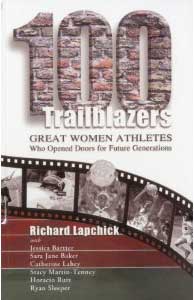
This book was written by Dr. Richard Lapchick, chair of the renowned DeVos Sport Business Management Program at the University of Central Florida, along with several of his students in the renowned program:
- Sara Jane Baker
- Jessica Bartter
- Catherine Lahey
- Stacy Martin-Tenney
- Horacio Ruiz
- Ryan Sleeper

The DeVos program offers students the opportunity to earn their Masters in Sports Business Management and a Masters in Business Administration. Focusing on ethics, diversity, leadership, and community service, the DeVos Program attracts some of the brightest and most committed students from across the country and across the globe.