

Evonne Goolagong: Tennis
International Star of the Women’s International Sports Hall of Fame

Evonne Goolagong’s talent stood out right away. Mrs. Martin, one of Evonne’s first instructors, said, “The first thing we noticed was the way Evonne moved. She was a natural athlete.” But it was more than her talent that drew eyes on the tennis court. She also stood out for her appearance, recalled Mrs. Martin, because she was “darker than the rest of the kids.”1 The Goolagong family are Australian Aboriginals, something Evonne equated to “aliens” in her memoir, Evonne! On the Move. “Now we are aliens in our own country. Another civilization has taken over, and we are second-class citizens. Aborigines. We left our mark across the continent, and I’ve left mine across the world, but I grew up as a bushie—a country girl—in Barellan, Narrandera Shire, New South Wales, Australia.”2 Australian Aborigines were the first inhabitants of the continent. They were tribal people who hunted on foot using spears, traps, and boomerangs. They moved often, following the abundance of food and good weather. A “bushie” by birth, Evonne left the countryside, not for superior weather or plentiful crops, but to globetrot from court to court, trampling many international competitors along the way.
Evonne Goolagong was playing with tennis balls before she was walking or talking. When she was just 12 months, her parents discovered how much tennis balls and chewing gum could entertain their daughter. It was almost like a free babysitter and an important form of entertainment since Evonne was the third of eight Goolagong children. Eventually, at two years old, when she did learn to walk, she could often be seen carrying her tennis ball around the neighborhood. But before Goolagong learned what to do with that tennis ball, she was outside playing rugby, cricket, and soccer with her brothers and other neighborhood boys. These games taught her to run and forced her to do so quickly. Her tennis game later became known for the way she moved, as is suggested from the title of her memoir. Goolagong said “Speed has been a prime factor in my tennis . . . Running makes me feel good and free; it’s the best part of any sport.”3
Though her mother was worried about her walking late, she quickly caught up and by the age of nine, her running on the court attracted the attention of Australian teaching pro Vic Edwards. Goolagong was fortunate that while growing up in Barellan, she was welcomed on the War Memorial Tennis Club courts next to her home. By age 13, she had moved to Sydney to train and live with the Edwards family. Sydney was about 400 miles northeast of Barellan and strikingly different in population. Barellan was a wheat-farming town with just 900 inhabitants (down to 359 in 2001). It was in the fast-paced, densely-populated Sydney that Goolagong was first made to feel different for being an Aboriginal.
Goolagong quickly made headlines by surprising competitors and winning tournaments, but the headlines often read “colored this or Aboriginal that.”4 Goolagong’s success in Australia’s tennis circuit drew attention as she was the first Aboriginal to reach such a pinnacle, not necessarily because she was the best, but because unlike those before her, Goolagong was able to overcome the discrimination Australians reserved for Aboriginals. Goolagong’s success helped educate her country and the world about Aboriginals. She dismissed many of the stereotypes, including the assumption that she was practically professional at the Aboriginal custom of throwing a boomerang, something she had actually never even tried.
By the time Goolagong was 16, she’d won all of the Australian national junior titles. In 1970, at age 18, she made her international debut. Her first match at Wimbledon quickly made her a fan favorite. She always “walked onto the court with a smile on her face,” says Billie Jean King, “and it was apparent to all that, win or lose, tennis was a sheer joy for her.”5 By January 1971, Goolagong made it to the finals of the Australian Open, where she nearly beat fellow countrywoman Margaret Court. Court and Goolagong teamed up to win the women’s doubles of the 1971 Australian Open. Goolagong soon revenged her singles loss by beating Court in the 1971 Wimbledon despite being seeded third. Goolagong completed her triumphant year with the French Open title as well.
The 19-year-old Wimbledon and French Open champion did not realize the significance of her success. In fact, Goolagong shied away from the attention because she never thought tennis was, nor wanted tennis to be, her life. Rather, Goolagong found joy in what her victories provided her with the ability to do: “The best present I ever bought anybody, a huge refrigerator, Mum’s first . . . You should have seen her the afternoon the men from the appliance store in Griffith knocked on the door and began carrying in this fridge. I’m sure she enjoyed that more than my winning Wimbledon. And so did I.”6
Goolagong took her game seriously but never allowed it to control her life or emotions. Even in the middle of a match, she often let anything but tennis roam her thoughts. She suffered a long mental lapse in one match while trying to remember the words to a song. Once they came to her, the “Goolagong fog” lifted and she seemed to flip a switch before going on to win the match easily after a loss appeared imminent. She joked in her memoir that she cried more over sappy movies than the loss of any championship game and was often distracted in a match if her opponents didn’t push her to run after each ball. After her 1974 loss to Billie Jean King at the U.S. Open, Goolagong said, “It will probably take me until tomorrow to forget it,”7 as if that was an unusually long time to dwell on a huge tournament loss.
Perhaps Goolagong wasn’t gravely fazed by her losses because they were so greatly outnumbered by wins (704-165 career). Goolagong won the Australian Open in 1974 and 1975 before marrying British tennis player Roger Cawley. At 25 and pregnant, she gladly put tennis aside to welcome her new role of motherhood. She continued to compete until she was four months along and then continued playing recreationally until she was seven months pregnant. Her eldest daughter, Kelly, was born in 1977 and Goolagong had no trouble returning to professional tennis several months later. In 1980, she was the Wimbledon Champion again and was the first mother to achieve such a feat since Dorothea Lambert Chambers did the same in 1914. Goolagong had her son Morgan in 1981 but did not officially retire until 1983.
Goolagong’s career ended with 43 singles titles and nine doubles titles, including 14 Grand Slam titles (seven in singles, six in women’s doubles, and one in mixed doubles). The calmness of Evonne’s play coincidently matched the translation of her surname Goolagong which “is an Aboriginal word meaning tall trees by still water.”8 Though “still” is not a word often used to describe her, her calm and serene approach to tennis is perhaps what made her the successful player she is known as today.
Notes
1 Evonne Goolagong, Evonne! On the Move (New York: E. P. Dutton & Co., Inc., 1975), 48-49.
2 Ibid., 29.
3 Ibid., 38.
4 Ibid., 67.
5 Billie Jean King, We Have Come a Long Way (New York: McGraw-Hill, 1988), 131.
6 Goolagong, Evonne! 146.
7 Ibid, 25.
8 Ibid, 64.
This excerpt was written by Jessica Bartter.
Articles Tagged with "Evonne Goolagong" on WomenTalkSports.com:
IN SEASON:
Tue, Oct 1 at 12:03pm
Fri, Sep 6 at 9:32am
Fri, Nov 8 at 9:29pm
Fri, Nov 1 at 4:39pm
Today at 9:09am
Today at 9:04am
Sun, Nov 10 at 6:59pm
Thu, Nov 7 at 9:08pm
LATEST ARTICLES & POSTS
posted by Swish Appeal
Mon at 9:13am
posted by Swish Appeal
Mon at 9:11am
posted by All White Kit
Sun at 6:42pm

-
The body of this profile is an excerpt from 100 Trailblazers: Great Women Athletes Who Opened Doors for Future Generations.
This book is available on Amazon.com: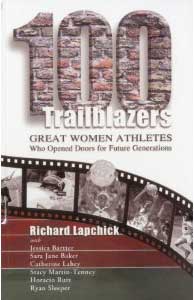
This book was written by Dr. Richard Lapchick, chair of the renowned DeVos Sport Business Management Program at the University of Central Florida, along with several of his students in the renowned program:
- Sara Jane Baker
- Jessica Bartter
- Catherine Lahey
- Stacy Martin-Tenney
- Horacio Ruiz
- Ryan Sleeper

The DeVos program offers students the opportunity to earn their Masters in Sports Business Management and a Masters in Business Administration. Focusing on ethics, diversity, leadership, and community service, the DeVos Program attracts some of the brightest and most committed students from across the country and across the globe.