
Hazel Wightman: Tennis
American Star of the Women’s International Sports Hall of Fame
“Queen Mother of Tennis” is one of the many nicknames Hazel Wightman has donned. It was one of many, not because people changed their minds about her during her 45-year-long career, but because she had a hand in almost every aspect of the game of tennis. Wightman was a talented player, a well-respected teacher, a mentor to many aspiring players, an advocate for a women’s playing platform, and, obviously, a motherly-figure to other female tennis players. Through it all, Wightman was an amateur, never receiving a dime for the 45 tennis titles she earned during her lengthy playing career.
Born as Hazel Hotchkiss on December 20, 1886, in Healdsburg, California, Wightman was not introduced to tennis until she was 16 years old. Her interest was sparked after watching fellow Californian May Sutton battle one of her sisters. The five Sutton sisters dominated Southern California’s tennis territory, winning every singles title in the region’s championships between 1899 and 1915. Wightman’s interest went from a spark to a full-fledged flame after watching the more rapid pace of a men’s doubles game packed with power and volleying.
Volleying would become a key ingredient of Wightman’s game. She practiced tennis around and against her house with her four older brothers, but because of the dirt and gravel ground, they were forced to hit the ball before it bounced or simply volley back and forth. Wightman honed her game on the only court near her home in Berkeley, California. The lone court at the University of California, Berkeley, restricted female players from using the court after 8:00 a.m. Therefore, Wightman showed up at 6:00 a.m. every day.
It did not take long before Wightman was known as the best tennis player in Northern California. And therefore, it was inevitable that she would face her Southern California counterpart and inspiration, May Sutton. In 1909, the 22-year-old traveled to the Philadelphia Cricket Club for the U.S. Championships. Despite learning on clay and never having played on grass before, Wightman won the grass tournament with her net-attacking style and dominant volley. With a single tournament, Wightman introduced a new style of play to women’s tennis. Wightman also won the women’s doubles and mixed doubles titles in 1909. She defended all three titles in 1910 and 1911. As could have been predicted, Wightman faced May Sutton in the 1911 finals, where she went on to win the close match 8-10, 6-4, 9-7.
In 1912, Hazel Hotchkiss married George Wightman of Boston, Massachusetts, and took a retreat from tennis to start a family. The true competitor inside her jumped back into tennis after a simply-stated challenge from her father. Mr. Hotchkiss pointed out that no American women had ever won a singles title after giving birth to a child. Though easier said than done, Wightman was up for the challenge. In 1919, at the age of 32, she won her fourth (and last) singles title, again at the U.S. Championships. She went on to win the women’s doubles title at the same tournament and continued prolonged success in doubles tournaments until 1954, when she won her 45th and final title at age 68.
While juggling motherhood with her tennis career, proving to be up to her father’s challenge, Wightman also focused on equality for women’s tennis. In 1919, she urged tennis officials to offer an international team tournament for women similar to the men’s Davis Cup. The Davis Cup began in 1900 as a competition between the United States and Great Britain, but has now expanded to 127 entering countries. Wightman wanted the women’s version to “include Great Britain, the United States, France, and all other nations with prominent women players.” Wightman went so far as to spend $300 of her own money on a trophy that she presented to United States Lawn Tennis Association (USLTA) with her idea. The tall, slender, silver cup sat on their shelves for four years before Wightman’s dream was realized. In 1923, the West Side Tennis Club in Forest Hills, New York, opened a new tennis stadium and decided the “Ladies International Lawn Tennis Challenge” would be the perfect event to celebrate its opening. The tournament continued until 1989, but was always known by its unofficial name, the Wightman Cup.1
The Wightman Cup was alternately played in the United States and Great Britain each year. In England, it was generally played before Wimbledon and “helped generate tremendous interest in the women’s game.”2
Wightman remembered 1924 as the prime of her tennis career. She traveled to England with Helen Wills to win the women’s doubles title at Wimbledon, which she described as nothing less than “a big thrill.”3 She then traveled to Paris, France, for the 1924 Olympic Games, where she won two gold medals, one each in the women’s doubles and mixed doubles.
In 1940, the mother of five divorced George Wightman, but remained living in Massachusetts. She moved to Chestnut Hill near the Longwood Cricket Club, where she instructed tennis clinics and coordinated many tournaments. The now single woman opened up her three-story home to young aspiring female tennis players from every stretch of the globe. She was known for motherly yet rigid hospitality:
[BLOCK QUOTE]
Guests slept everywhere, from the basement to the solarium, coexisting peacefully with Mrs. Wightie’s cats, which came and went as they pleased through the open windows.
Mrs. Wightie rose at dawn. She would whip up batches of brownies and chocolate-chip cookies for her guests and to satisfy her own sweet tooth. Then she headed for the washing machine. “She did all the laundry for us,” recalled Doris Hart, a Wimbledon and United States champion in the 1950s. “She didn’t want us to mess with her machine. It wasn’t like the machines today. It had one of those ringers. It was always going.”
Shirley Fry, another champion, recalled that Mrs. Wightman washed the dishes herself, too, “because during the war she had learned to save soap, and no one else could do it right.” She shook out just the necessary amount of flakes from a little basket.
Following an evening meal at a large table, Hazel played bridge or poker with her guests. Women who went out for the evening signed out and in on a blackboard. There was no curfew, but Hazel watched over her girls with the eye of a hawk, or perhaps the eye of a mother hen. “Shirley!” she would say, narrowing in on a too-casual teenager, “Stand up straight!”4
Wightman’s career lasted long enough for her to compete in doubles tournaments with her pupils. She taught many of the best, including Helen Wills (with whom she won Wimbledon and the Olympics) and Sarah Palfrey. She was ranked in the U.S.’s top 10 in 1915, 1918, and 1919, when she was the nation’s top-ranked player. In 1973, the California native was named an honorary Commander of the British Empire by Queen Elizabeth II. In 1999, the Boston Globe named her 85th on its list of the Top 100 New England sports figures of the 20th century. Wightman’s sports figure fame extended far beyond her win-loss record or long-standing doubles reign. Wightman’s volley-changing style of play, outspokenness for female tennis players, endless teaching, and maternal care for the game of tennis made her stature far from short, despite being a meager five feet tall. Billie Jean King once wrote that “Hazel Wightman’s name is woven into the tapestry of women’s tennis like a shining golden thread that stretched from the 1900s through the 1920s, 1930s, 1940s, 1950s, and 1960s. Champion, patron, coach …she devoted her life to teaching, encouraging, sheltering, and enlightening aspiring young tennis stars. In a statistic not recognized by the record books, ‘Mrs. Wightie’ will be remembered as the most beloved tennis figure of all time.”5
Notes
1.) Billie Jean King, We Have Come a Long Way (New York: McGraw-Hill Book Company, 1988), 20-22.
2.) King, We Have Come a Long Way, 21.
3.) Barbara Matson, “She Was Queen of Court: Wightman Had Regal Reign in Women’s Tennis,” The Boston Globe, October 8, 1999.
4.) King, We Have Come a Long Way, 21-22.
5.) King, We Have Come a Long Way, 20.
This excerpt was written by Jessica Bartter.
IN SEASON:
Tue, Oct 1 at 12:03pm
Fri, Sep 6 at 9:32am
Fri, Nov 8 at 9:29pm
Fri, Nov 1 at 4:39pm
Today at 9:09am
Today at 9:04am
Sun, Nov 10 at 6:59pm
Thu, Nov 7 at 9:08pm
LATEST ARTICLES & POSTS
posted by Swish Appeal
Mon at 9:13am
posted by Swish Appeal
Mon at 9:11am
posted by All White Kit
Sun at 6:42pm

-
The body of this profile is an excerpt from 100 Trailblazers: Great Women Athletes Who Opened Doors for Future Generations.
This book is available on Amazon.com: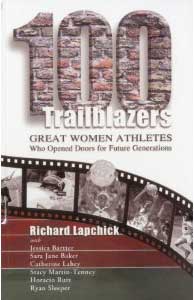
This book was written by Dr. Richard Lapchick, chair of the renowned DeVos Sport Business Management Program at the University of Central Florida, along with several of his students in the renowned program:
- Sara Jane Baker
- Jessica Bartter
- Catherine Lahey
- Stacy Martin-Tenney
- Horacio Ruiz
- Ryan Sleeper

The DeVos program offers students the opportunity to earn their Masters in Sports Business Management and a Masters in Business Administration. Focusing on ethics, diversity, leadership, and community service, the DeVos Program attracts some of the brightest and most committed students from across the country and across the globe.