

Helen Stephens: Track & Field
American Star of the Women’s International Sports Hall of Fame
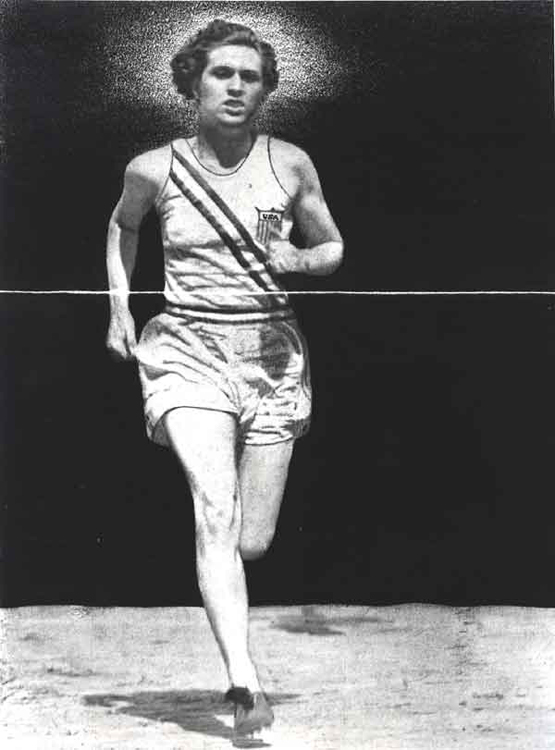
As time passes, the inequality between men’s and women’s sports is slowly closing. We currently live in an era of Title IX, the Women’s National Basketball Association (WNBA), and other women’s professional sports leagues, but it was not so long ago that women had to fight for athletic opportunities. Many of the opportunities that exist now for women were unimaginable dreams for woman pioneers like Helen Stephens. She was not only one of the greatest American athletes of her time, but she played a big role in paving the way for women’s equality in sports.
Although Stephens saw success in almost every aspect of her life, the path she followed was not an easy road. Born in 1918, a time marked by the women’s suffrage movement, Stephens grew up in a society with very few opportunities for women and virtually no opportunities for women in athletics. Additionally, women were constantly fighting gender stereotypes. Any woman involved in athletics was looked down upon and seen as unladylike. Stephens was no exception. She grew up on a farm in the small town of Fulton, Missouri. Although Stephens’s mother wanted her to play the piano, she was a true tomboy and enjoyed helping out around the farm. Little did she know this farm work would be great training for her future in track and field. She idolized the great Babe Didrikson and at the age of eight, Stephens dreamed of becoming the fastest woman in the world.1 Not only was this a big dream for a young girl, but it was seemingly unrealistic given the lack of facilities, athletic teams, and opportunities for women during this time. At Stephens’s school, girls were required to take physical education, but they did not participate in high school sports. However, Stephens’s six-foot frame and blazing speed quickly caught the eye of her high school gym teacher, Coach W. Burton Moore. Coincidentally, Coach Moore was knowledgeable about the sport of track and field and was eager to explore the depths of her talent.2
Coach Moore immediately knew that Stephens was special. At practice one day, Coach Moore clocked her at 5.8 seconds in the 50-meter dash, which would have tied the world record if Stephens was competing in an official track meet. He clocked her again just to make sure her time was accurate. When he confirmed that indeed it was, he immediately began cultivating her talent. Just one year later, Coach Moore took Stephens to her first track meet in St. Louis. The meet would give her the opportunity to run against the reigning Olympic gold medalist, Stella Walsh. Not only did Stephens beat the reigning champ, she set the world record in the 50-meter dash. The press quickly heard about Stephens’s success and gave her a new nickname, “The Fulton Flash.”3
The Fulton Flash now had her sights set on the 1936 Olympics in Berlin, Germany. However, with the rise of Adolf Hitler, many Americans urged her not to compete in protest of the Nazis. Although Stephens sympathized with this cause, she also felt strongly about representing her country in the Olympics and fulfilling her childhood dream of being the fastest woman in the world. On July 15, 1936, Stephens and 382 other U.S. Olympic athletes boarded the SS Manhattan to Berlin. Stephens would again be meeting her rival, Stella Walsh, in a much anticipated rematch. Despite her minor shin-splints and the poor weather conditions, Stephens defeated the Polish star and broke the world record. She earned another gold medal when she anchored the 400-meter relay. Everyone took notice of the young Stephens, including Adolf Hitler. After seeing Stephens compete, Hitler assumed she must be a pure Aryan with her fair hair, blue eyes, and strong build and he immediately requested to meet her. Helen Stephens was the only American athlete to have a private meeting with Adolf Hitler.4
When Stephens returned to the United States, she was a celebrity. Her hometown of Fulton celebrated her homecoming and everyone wanted to meet the fastest woman in the world. Unfortunately, her popularity also brought negative attention. Look magazine printed a picture of Stephens running with a caption that read “Is this a man or a woman?” Stephens was so hurt and angered by this cover that she sued the magazine and was awarded $5,500. In order to maintain her amateur status, Stephens worked odd jobs to make money. However, a turning point in her professional life occurred when a picture of Stephens as a cocktail waitress surfaced, resulting in harsh criticism by prohibitionists. Shortly thereafter, Stephens hung up her amateur status and finally signed a professional contract for financial reasons. She would later question this decision, as she would never be allowed to compete in another Olympic Games.5
Her passion for sports extended beyond track and field, as she tried her hand in caging, now commonly known as professional basketball. Using the remaining amount of her settlement money, Stephens, with the help of her friend, Issy, launched the first female basketball team. Stephens’s team, The Helen Stephens Olympic Co-Eds Basketball Team, would play against all-men’s teams using all-men’s rules. She assembled a talented team, including a ski star, a female wrestler, and a baseball star. Stephens would play until she retired in 1941.6
The passage of Brown v. Board of Education in 1954, calling for racial equality in the educational system, motivated Stephens to become increasingly active in politics. Stephens realized how few opportunities there were for women in general, but more specifically in competitive sports.7 Sports had played such a large role in Stephens’s life that she wanted to ensure that men and women across the country would have equal opportunities. However, Stephens was still fighting gender stereotypes. Many believed that women should not play competitive sports and some even believed that women athletes became infertile. Stephens also recognized the lack of coaching and training in female sports. Once again, Stephens took action and began coaching. She elicited the help of area coaches and began holding track clinics and setting up training-teams. She hoped to generate excitement about the sport of track and field, while developing potential Olympic hopefuls.8
Into her adult years, Stephens continued to be recognized and honored for her achievements as an Olympic athlete. She was inducted into the Track and Field Hall of Fame and the National Women’s Hall of Fame. By 1984, she had been inducted into six different halls of fame. She continued to be active in track and proved she still had talent, as she continued to be the top performer in her age bracket during various track meets. Stephens refused to let her age slow her down. She participated in women-in-sports conferences and spoke at numerous engagements. In December 1993, the BBC filmed Stephens for a documentary titled The People’s Century: Sporting Fever. Tragically, she would not live to see it. On January 17, 1994, Stephens passed away shortly after undergoing surgery for blocked carotid arteries.9
Although the world lost an amazing athlete and pioneer, Helen Stephens had accomplished so much in her lifetime. She lived through the women’s suffrage movement, World War II, the civil rights movement, and the passage of Title IX. Her athletic accomplishments were simply an afterthought to the incredible gains she made for women’s athletics. She defied gender stereotypes and refused to give into societal ideals for women. Helen Stephens’s courage will not soon be forgotten. In fact, it is seen every day as opportunities for women in athletics continue to increase.
Notes
1 Sharon Kinney Hanson, The Life of Helen Stephens: The Fulton Flash (Carbondale: Southern Illinois University Press), 6.
2 Ibid., 21.
3 Ibid., 22-25.
4 Ibid., 61-92.
5 Ibid., 117-36.
6 Ibid., 156-65.
7 Ibid., 187.
8 Iibd., 191-94.
9 Ibid., 243-44.
This excerpt was written by Sara Jane Baker.
IN SEASON:
Tue, Oct 1 at 12:03pm
Fri, Sep 6 at 9:32am
Fri, Nov 8 at 9:29pm
Fri, Nov 1 at 4:39pm
Today at 9:09am
Today at 9:04am
Sun, Nov 10 at 6:59pm
Thu, Nov 7 at 9:08pm
LATEST ARTICLES & POSTS
posted by Swish Appeal
Mon at 9:13am
posted by Swish Appeal
Mon at 9:11am
posted by All White Kit
Sun at 6:42pm

-
The body of this profile is an excerpt from 100 Trailblazers: Great Women Athletes Who Opened Doors for Future Generations.
This book is available on Amazon.com:
This book was written by Dr. Richard Lapchick, chair of the renowned DeVos Sport Business Management Program at the University of Central Florida, along with several of his students in the renowned program:
- Sara Jane Baker
- Jessica Bartter
- Catherine Lahey
- Stacy Martin-Tenney
- Horacio Ruiz
- Ryan Sleeper

The DeVos program offers students the opportunity to earn their Masters in Sports Business Management and a Masters in Business Administration. Focusing on ethics, diversity, leadership, and community service, the DeVos Program attracts some of the brightest and most committed students from across the country and across the globe.