
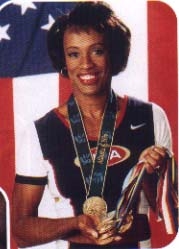
Jackie Joyner-Kersee: Track & Field
American Star of the Women’s International Sports Hall of Fame
Website: http://www.jackiejoynerkerseeonline.com/


Jackie Joyner-Kersee has always had “a kind of grace” as an athlete because while she is a tough competitor she has always demonstrated poise and charm on and off the track. Her race in life has been filled with obstacle after obstacle, but she breezed past each one with her head held high as if each was just another hurdle on the track. Her maternal grandmother, Evelyn Joyner, named her Jacqueline after former First Lady of the United States, Jacqueline Kennedy Onassis, a woman known for her elegance. Evelyn knew that Joyner-Kersee would also be a first lady.
Joyner-Kersee quickly secured the title of “Greatest Woman Athlete of the Twentieth Century,” assuring her place as the first lady of track and field for quite some time. She competed in the heptathlon, a two-day event comprised of the 100-meter hurdles, high jump, shot put, and 200-meter on the first day, and the long jump, javelin, and 800-meter on the second day. Her place in history would not be secured simply because she was the first female to become so decorated in track and field, for as time passes her records will be surpassed future generations of runners. Rather, Joyner-Kersee will remain in our memories because of the way she conducted herself with such class.
Joyner-Kersee grew up in East St. Louis, Illinois, and spent most of her time at the Mary Brown Community Center, which offered sports to young people as well as story time and painting. Joyner-Kersee’s neighborhood was plagued with violence and drug abuse, so the community center was as much a safe haven as it was an opportunity for personal growth. Al and Mary, Joyner-Kersee’s parents, had married young and were barely out of childhood themselves when Jackie was born. Mary Joyner was extremely conscientious about her daughter’s future and so she pushed her in the classroom and on the athletic fields to break the cycle of babies having babies that seems so compelling in a poor community. Her daughter was to know greatness, not poverty. Joyner-Kersee’s trek to the top would start when she joined the track club at age nine without any financial resources. She sold candles to her elementary classmates to raise money for track meet travel expenses. She ran in a pair of shoes until the rubber wore out or they fell off. Joyner-Kersee had it all from a young age—she steadily ran past her competition on the track and excelled in the classroom.
Evelyn Joyner doted on Joyner-Kersee by playing dress up with her and painting her tiny fingernails so they would match her own. Joyner-Kersee felt like the first lady when her grandmother was around. She was the adult who always made her feel special as a child. Evelyn planned a trip from Chicago to visit her darling granddaughter, and Joyner-Kersee could rarely contain her excitement any time her grandmother planned a visit. The trip was only a few days away when the family received a call that Evelyn would be visiting the angels instead. Joyner-Kersee’s step-grandfather was a destructive alcoholic. He had come home drunk from the bar and shot Evelyn with a 12-gauge shotgun while she was sleeping. Joyner-Kersee had it all, except her loving grandmother. She never drank or used any recreational drugs because she saw how their use often leads to violence. She is proud of the fact that her family never became victims of violence because they continued to expect great things from one another and encouraged one another’s hopes and dreams, just as Evelyn encouraged Joyner-Kersee to be the first lady of whatever her heart desired.
Joyner-Kersee became a talented high school athlete in track and field and basketball. She was so successful that she was offered a scholarship to UCLA, consistently one of the top track and field programs in the country. She was so talented that she is one of the few athletes who could handle the demands of two sports and her coursework. Her mother asked her to come home for Christmas her freshman year, but she declined and promised to come home in the spring. Unfortunately, she would return home sooner than she intended. Joyner-Kersee’s mother died suddenly from meningitis just a short time after the Christmas invitation she had declined. Joyner-Kersee went home to attend her mother’s funeral. Her three siblings were terribly grief stricken. As the eldest child, Jackie Joyner-Kersee had to remain strong. She held her head high above the abyss of emotion drowning everyone else. Returning to school, she remained strong for nearly a year but the wave of grief found her in Los Angeles the next Christmas when Joyner-Kersee realized that she wouldn’t be getting a call to come home that year. The tears flowed and she momentarily lost the resilience that she so elegantly displayed on the athletic fields. Her indestructible façade may have cracked, but it would not crumble. She endured the almost insurmountable pain and did not veer from the path that her mother had set for her all those years ago. She continued her education to set an example for her family, showing them life would go on and they would not become victims of tragedy.
It is often said that when a door closes, there is an open window. However, one can get seriously scraped climbing through. Joyner-Kersee saw her open window as an open lane on the track, but in 1982 she developed a condition known as exercise-induced asthma. As a woman who characterized herself as invincible, she was shaken to the core when told that she had limitations. Jackie Joyner-Kersee denied that she had a disease, but today she admits that she was simply too scared to acknowledge it. She went so far as to hide her inhaler from people, even when her breath escaped her and she needed to use it. Eventually, she couldn’t deny its existence any longer; she didn’t take her inhaler with her to practice one day and ended up in an emergency room feeling suffocated and losing control. When she woke up, she awakened with an awareness of her disease and realized that her medication was life-sustaining. She then altered her routines and workouts, acknowledging that she would not become weak and vulnerable to the disease.
Once again, doors seemed to be closing on her and her escape from life’s anxiety seemed to be slipping away. Someone special stepped in and helped her manage her disease as well as her track and field career. Bob Kersee, the assistant coach at UCLA, had experienced the loss of his mother and he offered his support to Joyner-Kersee and then helped her gain control of her asthma. He encouraged her to continue in track and field as the same fierce competitor that she had always been, and helped her realize that the asthma was not a limitation, just another competitor. His compassion and reinforcement were invaluable to Joyner-Kersee and a friendship began to blossom. Four years later, this friendship was solidified when they became husband and wife. Bob has the same fire in him that Joyner-Kersee does when it comes to competition. He is her biggest critic and her biggest fan on the track. He will scream at her on the track and cook her dinner the same evening. They truly complement each other and their relationship has proven successful in life and in sport.
Joyner-Kersee became a household name because of her remarkable athletic achievements. Her willpower to compete with asthma enhanced her prestige. Her collegiate athletic career started her on the path to success when she set the National Collegiate Athletic Association (NCAA) record for the heptathlon twice. She also continued to play basketball for UCLA and was recognized as the UCLA All-University Athlete for three years. In 1984, Joyner-Kersee won the silver medal in the heptathlon at the Olympics and finished fifth in the long jump. She would go on to win numerous heptathlon titles at the World Championships and Goodwill Games. She graduated from college, married Bob, and then in 1988, struck gold. She set the world record in the heptathlon at the U.S. Olympic Trials and won the long jump. She traveled to the Olympics and won a gold medal for both the heptathlon and the long jump events, beating her own world record in the heptathlon and setting an Olympic record in the long jump. In 1992, she won gold once more in the Olympic heptathlon and stole silver in the long jump. Four years later, Joyner-Kersee won a bronze medal in the long jump after she had pulled a muscle and had to withdraw from the heptathlon. In fact, she did not lose a heptathlon in over 12 years from 1984 until the 1996 Olympic Trials.
Her success in track and field built the pedestal on which she so gracefully speaks from today. She was a star female athlete during a time when girls who competed in sports were commonly referred to as tomboys. She challenged that perception by exuding what she calls “a kind of grace.” She describes her definition of grace in her autobiography, which appropriately is titled A Kind of Grace. She continues to promote women in athletics and encourages young girls to follow in her footsteps.
Her career came full circle around the track and finished at her starting line in East St. Louis. The community center that she enjoyed so much as a child had closed while she was traveling the world for track meets and publicity appearances. Wanting to give the children of East St. Louis the same opportunities that had placed her in such an advantageous position, she took a percentage of all of her endorsements and raised $40,000 to reopen the center. She wanted to give more and explored ways to finance a brand new 37-acre facility that boasts indoor and outdoor tracks, basketball courts, and state-of-the-art computer rooms. She is determined to create opportunities for children who are facing the same tough decisions and turbulent lifestyles that she did when she was their age. One such experience that she provided was a trip to New York City for the Macy’s Thanksgiving Day Parade for 100 children through her Jackie Joyner-Kersee Community Foundation. The inspiration that she received at the Mary Brown Center when she was nine was so profound that all of her efforts are focused on her Foundation today.
She also speaks out about asthma as her next great opponent. She says that she approaches fighting the disease as if it is one of her competitors and her treatment is the training she needs to be competitive. According to Letterlough of the Philadelphia Tribune, African-Americans “only represent 12 percent of our population, [but] they comprise 26 percent of the deaths related to asthma.” Joyner-Kersee was fortunate enough to have the proper medical treatment for her disease, but she realizes that not everyone is fortunate enough to receive sound medical care that is needed to manage the disease properly. She knows that African-Americans are more likely to simply attempt to live with asthma, and she wants to use her status to draw attention to how tragedy can happen without treatment and how one can live a full and complete life with it.
She also speaks about the importance of goal setting and violence prevention. She challenges her audience to think about what could happen at their school even though they have not experienced a violent act as of yet, and how they could prevent it. The loss of her grandmother had a profound influence on her life. She now wants to provide a positive influence for today’s youth. She had goals and dreams that carried her out of an impoverished neighborhood and that brought her back to that same town with a renewed purpose. She emphasizes that having goals is a real antidote to violence. Her audience may have come to hear Jackie Joyner-Kersee, the world’s greatest female athlete, but they left hearing a message that challenged them to be serious about their future.
Joyner-Kersee has experienced the power that sport can have, and she has done everything she can to utilize that power. She has even entered the business of sports, first and foremost through her endorsement money that she has funneled into the Jackie Joyner-Kersee Community Foundation. She ventured outside her sport to become certified as a sports agent with the National Football League Players Association from 1998 to 2001, a role that only five females had filled prior to that time. Her company, Elite International Sports Marketing Inc., is designed to help athletes prepare for a career in athletics as well as what they can do after their career is complete. She has been extraordinarily successful in the heptathlon in track and field, and she is becoming an exceptional leader in the heptathlon of life.
This excerpt was written by Stacy Martin-Tenney.
Articles Tagged with "Jackie Joyner-Kersee" on WomenTalkSports.com:
- Dual Meet Hall of Fame: Jackie Joyner (Kersee)
- Is Michael Phelps the greatest American athlete ever? This writer says, what about Jackie Joyner Kersee?
- Not Your Average Track Fan: Feed it, and it will Grow!
- Brittney Reese wins long jump at IAAF World Indoor Championships, breaks Jackie Joyner-Kersee's 18-year-old record
- Black History Month – Female Athletes Who Changed the World
- Brittney Reese walking in the footsteps of idol Joyner-Kersee
IN SEASON:
Tue, Oct 1 at 12:03pm
Fri, Sep 6 at 9:32am
Fri, Nov 8 at 9:29pm
Fri, Nov 1 at 4:39pm
Today at 9:09am
Today at 9:04am
Sun, Nov 10 at 6:59pm
Thu, Nov 7 at 9:08pm
LATEST ARTICLES & POSTS
posted by Swish Appeal
Mon at 9:13am
posted by Swish Appeal
Mon at 9:11am
posted by All White Kit
Sun at 6:42pm

-
The body of this profile is an excerpt from 100 Trailblazers: Great Women Athletes Who Opened Doors for Future Generations.
This book is available on Amazon.com: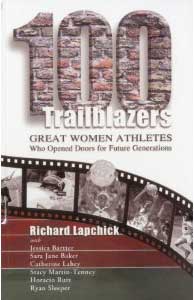
This book was written by Dr. Richard Lapchick, chair of the renowned DeVos Sport Business Management Program at the University of Central Florida, along with several of his students in the renowned program:
- Sara Jane Baker
- Jessica Bartter
- Catherine Lahey
- Stacy Martin-Tenney
- Horacio Ruiz
- Ryan Sleeper

The DeVos program offers students the opportunity to earn their Masters in Sports Business Management and a Masters in Business Administration. Focusing on ethics, diversity, leadership, and community service, the DeVos Program attracts some of the brightest and most committed students from across the country and across the globe.