

Janet Evans: Swimming
American Star of the Women’s International Sports Hall of Fame
Website: http://www.janetevans.com/

It is the opening ceremony of the 1996 Atlanta Summer Olympic Games, eight years removed from when Janet Evans first captured the world’s attention at the 1988 Seoul Olympic Games when she won three gold medals, two of them in world-record time. She stood on the track of Centennial Olympic Stadium as a torch bearer, waiting half-excitedly, half-anxiously, to have her torch lit by American boxer Evander Holyfield and Greek track runner Voula Patoulidou, and at the moment she received the Olympic flame, Evans jogged around the stadium waving at the people in the stands and at the athletes congregated in the infield. She ran up a ramp to where the unlit Olympic cauldron stood, and as she reached the top of the ramp, it was “The Greatest,” Muhammad Ali, who took the flame from Evans to light the Olympic cauldron. Evans stepped to the side and took the moment in.
“It was the neatest thing being up there, to see in [Ali’s] eyes how thrilled he was . . . I can’t speak for him, and I know he has done amazing things in his life, but this was probably pretty, pretty cool,” Evans said. “It has to rank right up there with all the great things he’s done. If you could have been up there and heard the crowd when he came out. They were cheering loudly when I was up there, but when he came out I thought the stadium was going to fall down.”1
Ali had received the flame from one of the greatest. Evans is considered to be the best long-distance swimmer in women’s history. She had earned the spot to stand next to Ali and share in his excitement. The Atlanta Games were a different kind for Evans, and though only 24 years old at the time, her athletic career had come full circle in Atlanta. She was no longer the bubbly teen in Seoul who would become the face of swimming after winning three individual gold medals, or the ultra-focused veteran at the 1992 Barcelona Olympics who had carried the pressures of defending two of her gold medals in the four years between Olympics. In Atlanta, when she ran up the ramp to stand next to Ali, even after all her records and titles, it was as if she had truly arrived.
At 5 feet, 4 inches, Evans carried her thin and petite frame to become the most dominant swimmer of her time. Her windmill stroke was unorthodox, but it gave the impression she was attacking the water. “It’s not a classic style you might expect a world-record holder to have,” said coach Bud McAllister. “But underwater, her technique is almost flawless. Above the water, when she’s going fast, her arms are almost straight. That’s because she has such tremendous acceleration that at the end of her stroke her arms come almost straight out of the water.”2
Evans was born to swim. She started when she was one year old, literally still in her diapers, when her grandmother thought Evans’s mother was wasting her money by putting baby Janet in swim classes. Her parents had a pool in the backyard, and they felt that all the kids in the house should be able to swim in case they fell into the pool. By the time she was three years old, Evans knew how to do all four swim strokes: the breast, butterfly, freestyle, and backstroke. At the age of 17, Evans was on her way to the Seoul Olympics as a senior in high school and the holder of three world records. At the 1988 Olympics, she would win her first gold medal in the 400-meter individual medley and would break her own world record while winning gold in the 400-meter freestyle. Her 400-meter freestyle record would stand for more than 17 years. Evans would later add another gold medal by capturing the 800-meter freestyle. Evans’s 800-meter freestyle record, later set in August 1989, was one of the longest-standing records in swimming history, standing 19 years until it was broken in the 2008 Beijing Olympics.
Her bubbly personality resonated through the sporting landscape and the world was in awe of how such a tiny girl could dominate her sport against physically imposing women who towered over little Janet. “The other night Janet was sitting between the two East German women she’d beaten on her way to a world record in the 400-meter freestyle,” wrote Tony Kornheiser in a piece on Evans shortly after the 1988 Olympics. “These women were big, and almost identical with their curled ringlets of blond hair, ice-cold blue eyes and broad shoulders. Silent and rather dour, they resembled great stone lions guarding a library. And between them, this little slip of a giggly thing with short brown hair that doesn’t even come over her ears, this little pixie.”3
The next four years would heighten the expectations of the young Olympian. People had begun buzzing in her ear, some suggesting she would have been better off retiring from swimming after her monumental showing at the 1988 Olympics to prosper in the endorsements that were flooding her way. Evans declined these suggestions and instead enrolled at Stanford University, where she would continue to train for the 1992 Olympics. Her body was also changing as she was making the transition from teenager to adult. Evans grew three inches and added on 15 pounds, making it difficult for her to duplicate her swimming feats from just a few years before. By the 1992 Olympics, when Evans was 20 years old, it became apparent that Evans the woman was not quite as fast as Evans the girl, but there was no mistaking she was still the fastest in the world. Evans had not lost a 400-meter race since 1986, and she was the favorite heading into both the 800-meter and 400-meter freestyle races. Evans raised the stakes on her own success. “Who’s going to remember whether you set a world record or not?” she said just days before competing in 1992. “They’ll just remember what you did at the Olympics.”4
At Barcelona, Evans would defend her gold medal in the 800-meter freestyle, but it would be her second-place finish in the 400-meter freestyle event that overshadowed her success. Her teary post-swim press conference magnified her disappointment, no matter how much she tried to hide it with her smile. After the race, she told reporters she was happy because she had tried her best and that was the only thing she could ask of herself, but no one doubted that she had given her best effort, it was just tough to believe that Evans was truly happy.
“There’s a lot of pressure placed on Americans,” a teary Evans said to the media after her second-place finish. “You all don’t understand the pressure placed on every athlete here, especially those expected to medal. But I think it will help me later in life to get through job interviews and things like that. You learn a lot about yourself. You overcome disappointment.”5
Evans decided to race in the Olympics once more, certain that the Atlanta Olympics would be the last of her career. It was her desire to represent the United States in Atlanta that spurred four more years of training. Evans’s desire to win still burned as wildly as ever, but she was different in Atlanta. This time around, the 24-year-old Evans was the underdog and she understood the importance of taking in all of the Olympic experience.
“Of course, I went to Atlanta wanting to win,” Evans wrote in an article looking back on her career. “Who doesn’t want to win? But I’d put a lot of miles on my shoulders by then. I just didn’t have it when I got there, for a variety of reasons. In Atlanta, I really learned it was okay not to win. It was okay to represent my country, do my best, and be satisfied with the results. And I was.”6
In her final Olympic race and in the same event where she was the world record holder for so long, the 800-meter freestyle, Evans came in sixth place and 11 seconds behind the winner. Evans walked away with a degree of disappointment, but she was ready for her life after athletics. “I’m happy but I’m sad,” Evans said after the race. “It’s been a great experience for me and I’m going to miss it. It wasn’t exactly a great way to go out, but I’m still happy to be me.”7
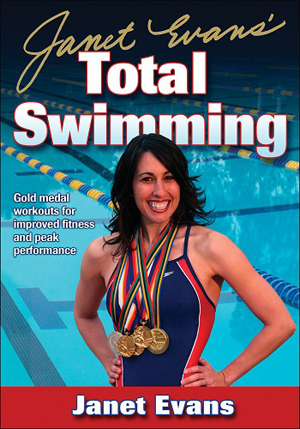
It has been good to be Evans. After her retirement, she became a highly requested public speaker for corporations, where she has worked for Olympic sponsors. She has stayed involved in swimming by conducting her own swim clinics and branding swim meets under the Janet Evans Invitational name. In 2007, she released her book, Janet Evans’ Total Swimming, as a guide with different training programs for swimmers at different levels. In 2001, she was inducted into both the International Swimming Hall of Fame and the International Women’s Sports Hall of Fame. In 2004, she was inducted into the U.S. Olympic Hall of Fame. In all, she won 45 U.S. National titles, set seven world records, and is the only woman to hold three world records concurrently. She has also served as the chairman of FINA’s (the worldwide governing body of swimming) Athlete’s Committee.
It is true that people remember what you do in the Olympics, as Evans once said, but as she came to realize, they also remember so much more than that.
Notes
1 Jon Wilner, “Evans to Ali—A Glowing Experience,” Daily News, July 23, 1996.
2 Christine Brennan, “Janet Evans Hits the Pool, Then the Books,” The Washington Post, September 16, 1988.
3 Tony Kornheiser, “To Beat Janet Evans, Get Up Early,” The Washington Post, September 24, 1988.
4 John Powers, “Janet Evans Finds Herself Free at Last,” The Boston Globe, July 24, 1992.
5 Dan Shaugnessy, “Evans’ Silver a Crying Shame, The Boston Globe, July 29, 1992.
6 Janet Evans. March 26, 2008. http://www.america.gov/st/sports-english/2008/March/20080326163241cmretrop0.6073986.html.
7 Sam McManis, “Janet Evans Goes Out with Head Held High,” Knight-Ridder Newspapers, July 25, 1996.
This excerpt was written by Horacio Ruiz.
Articles Tagged with "Janet Evans" on WomenTalkSports.com:
IN SEASON:
Tue, Oct 1 at 12:03pm
Fri, Sep 6 at 9:32am
Fri, Nov 8 at 9:29pm
Fri, Nov 1 at 4:39pm
Today at 9:09am
Today at 9:04am
Sun, Nov 10 at 6:59pm
Thu, Nov 7 at 9:08pm
LATEST ARTICLES & POSTS
posted by Swish Appeal
Mon at 9:13am
posted by Swish Appeal
Mon at 9:11am
posted by All White Kit
Sun at 6:42pm

-
The body of this profile is an excerpt from 100 Trailblazers: Great Women Athletes Who Opened Doors for Future Generations.
This book is available on Amazon.com:
This book was written by Dr. Richard Lapchick, chair of the renowned DeVos Sport Business Management Program at the University of Central Florida, along with several of his students in the renowned program:
- Sara Jane Baker
- Jessica Bartter
- Catherine Lahey
- Stacy Martin-Tenney
- Horacio Ruiz
- Ryan Sleeper

The DeVos program offers students the opportunity to earn their Masters in Sports Business Management and a Masters in Business Administration. Focusing on ethics, diversity, leadership, and community service, the DeVos Program attracts some of the brightest and most committed students from across the country and across the globe.