
JoAnne Carner: Golf
American Star of the Women’s International Sports Hall of Fame
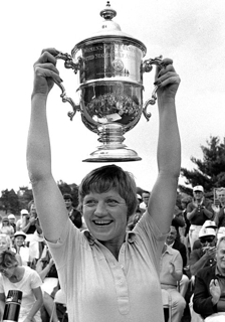
JoAnne Carner was born April 4, 1939, in Kirkland, Washington. She was the youngest of five Gunderson (her maiden name) children. She had three sisters, but it was her brother Bill, the second youngest, born just 13 months before JoAnne, who would help shape her life by introducing her to the game of golf. Bill worked at a nine-hole public course and JoAnne tagged along whenever possible. “We played after the customers went home, with old taped up clubs, wearing gloves ’til they fell apart,” JoAnne said.1 She also attributes these after-hour practices with developing her “feel” for the game, which so many Ladies Professional Golf Association (LPGA) players talk about as being so vital to their success. JoAnne reminisces, “We played in the moonlight, which is why I’m such a feel player.”2
This experience paid off and JoAnne Carner became a local celebrity after notching her first couple of victories as an amateur. After winning the Junior National title in 1956, the 17-year-old was rewarded with a ticker tape parade from Seattle to her hometown of Kirkland 12 miles away. “The Great Gundy,” as she would come to be known, became an absolute dominant force during her 14 years in the amateur ranks. In addition to her U.S. Girls Junior Championship in 1956, Carner won a total of five U.S. Amateur Championships (1958, 1960, 1962, 1966, and 1968), trailing only the lifelong amateur Glenna Collett-Vare, who won six. Carner also was a runner-up in the prestigious event two times to boot. She made four appearances in the Curtis Cup (1958, 1960, 1962, and 1964), an international competition held biennially that pits teams from the United States, England, Ireland, Northern Ireland, Scotland, and Wales. Then in 1969, a year before turning professional, Carner won the Burdine’s Invitational, and is still the last amateur to win an LPGA event.
Carner had become the best amateur golfer in the world. What is even more amazing about her accomplishments is that unlike most golfers who make a career in the game, Carner focused on more than just golf during her time as an amateur. She completed a four-year degree at Arizona State University in physical education, where her skills on the greens earned her one of the first athletic scholarships in golf for a woman. Upon graduating, Carner spent time at several jobs, including at an insurance company and an electronics store. Before turning professional, she also owned and operated a nine-hole golf course with her husband.
She thrived in the match play scenarios that the amateur competitions present. This style of play suited Carner because she worked hard to scout the competition on how they would handle certain circumstances and used her intimidation to propel her to victory after victory. Eventually, she turned professional because she had simply outgrown the challenge of competing as an amateur. “I had no desire to be a pro,” Carner recalls. “I loved amateur golf. Then I ran out of goals. My USGA record was something like 910 victories out of 1,000 matches.”3
So, in 1970, armed with a new nickname because “The Great Gundy” no longer suited her after she adopted the last name of her husband, Don Carner, JoAnne “Big Momma” Carner joined the LPGA Tour. “When I first came on tour, some of the lady pros didn’t care for me too much, probably because of my amateur success,” Carner remembers. “They tried some mental games on me. I thought it was poor sportsmanship.” This inhospitable welcome did not shake Carner’s confidence one bit, but success on the pro tour would come slower than she was accustomed to. “I expected to take over the tour immediately,” Carner said. “Sandra Haynie told me it would take four years, and I said baloney, but it did. I was used to match play and winning, not staying there and grinding it out for $500.”4 To help her get back to her winning ways, Carner began playing her own mind games with opponents. She would practice vigorously away from the tournament so that nobody ever saw her practice, then show up early the day of the competition to relax, smoke, and drink coffee in front of everybody. “It drove some of them crazy,”5 Carner smugly recalls.
Something must have worked for Carner, as she amassed 43 victories on the professional tour, including two major championships: the 1971 and 1976 U.S. Women’s Opens. She also is a five-time winner of the Vare Trophy for being the tour’s lowest average scorer. Her other achievements include being named the LPGA Tour Player of the Year in 1974, 1981, and 1982, and being the tour’s money leader in 1974, 1982, and 1983. She was a four-time member of the U.S. Curtis Cup team and captained the 1994 U.S. Solheim Cup team. Carner was inducted into the World Golf Hall of Fame in 1985.
Carner’s legacy in golf will be for bringing a big game and an even bigger personality to the links. She once said she would never retire and in 2004 at the Chik-fil-A Charity Championship, when she became the oldest woman to make the cut, doing so at the age of 64 years 26 days, people believed maybe she would never have to. However, if there is one thing Carner loves more than golf, it is her husband Don. Amazingly, despite JoAnne’s rigorous tour schedule, during the first 20 years of their marriage, the couple was only apart for a total of 19 days! To accomplish this, the Carners traveled in a trailer during JoAnne’s early career. But when Don was diagnosed with Parkinson’s disease, JoAnne immediately cut her tour schedule and eventually decided to call it quits for good in 2005. JoAnne Carner is a prime example of how people can be successful while being themselves and she shows us that happiness in life comes from knowing our priorities and pursuing them accordingly.
Notes
1 Jackie Williams, Playing from the Rough: The Women of the LPGA Hall of Fame (Las Vegas: Women of Diversity Productions, 2000), 145.
2 Ibid.
3 Ibid.
4 Ibid.
5 Ibid.
This excerpt was written by Ryan Sleeper.
IN SEASON:
Tue, Oct 1 at 12:03pm
Fri, Sep 6 at 9:32am
Fri, Nov 8 at 9:29pm
Fri, Nov 1 at 4:39pm
Today at 9:09am
Today at 9:04am
Sun, Nov 10 at 6:59pm
Thu, Nov 7 at 9:08pm
LATEST ARTICLES & POSTS
posted by Swish Appeal
Mon at 9:13am
posted by Swish Appeal
Mon at 9:11am
posted by All White Kit
Sun at 6:42pm

-
The body of this profile is an excerpt from 100 Trailblazers: Great Women Athletes Who Opened Doors for Future Generations.
This book is available on Amazon.com:
This book was written by Dr. Richard Lapchick, chair of the renowned DeVos Sport Business Management Program at the University of Central Florida, along with several of his students in the renowned program:
- Sara Jane Baker
- Jessica Bartter
- Catherine Lahey
- Stacy Martin-Tenney
- Horacio Ruiz
- Ryan Sleeper

The DeVos program offers students the opportunity to earn their Masters in Sports Business Management and a Masters in Business Administration. Focusing on ethics, diversity, leadership, and community service, the DeVos Program attracts some of the brightest and most committed students from across the country and across the globe.