

Judith Holland:
Trailblazer of the Association for Intercollegiate Athletics for Women (AIAW)
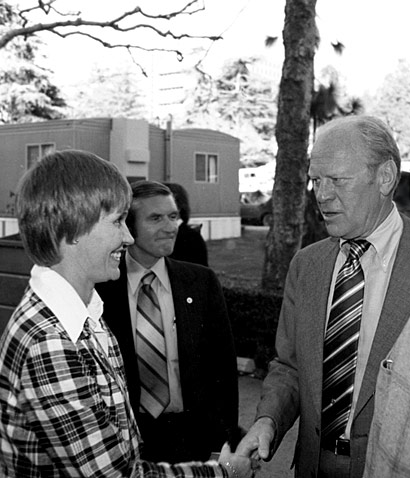
In 1968, only 16,000 females participated in college sport. Today, this number has grown to over 180,000.1 With this increased participation for women in sport, some may take these additional opportunities for granted. Not Judith Holland. She is one of the many women who fought for gender equality in sport. When she was hired as UCLA’s first athletic director for the women’s program, Holland knew she had a tough road ahead of her.
After the passage of Title IX in 1972, UCLA was one of the first schools to comply with the new law and establish a separate women’s athletic program. Holland, given her background in coaching and administration, was deemed the best choice to head the new women’s department. She was given little more than a green RV located outside the women’s gym to house her new athletic department. Furthermore, the women were still a part of the Association for Intercollegiate Athletics for Women (AIAW) and were essentially treated like club sports—receiving limited funding for uniforms, facilities, and transportation to events.
The men’s program, in contrast, had established themselves as one of the most successful programs in the country. Holland wasted no time in attempting to close the gap between these two programs. To get the coaches and athletic staff on board with the department’s new goals, Holland, always a visionary, organized a handbook detailing how she planned to run the new department. “I wanted to have a program that would equal the success of UCLA’s men’s athletics. That’s what my vision was so I had to build it day-by-day.”2
Holland was given a measly budget of $263,000—an unrealistic amount given the program needed money for uniforms, facilities, transportation, and coaches’ salaries. “We spend more than that now on shoelaces,”3 Holland later joked. Not letting this financial challenge deter her, Holland found ways to cut costs and stretch out the budget. Rather than hiring full-time coaches, she hired part-time coaches who also taught to earn extra money. Holland would also participate in fundraisers each year, lobbying student registration fees for additional money for the women’s teams. Michele Kort, a former UCLA basketball player, remembers these tumultuous times. “Road games? That was a four-hour drive to Fresno in clunky university station wagons, followed by an immediate return trip. Forget any overnights at a hotel.”4
Although UCLA had to monitor its spending, Holland refused to be frugal with scholarships, knowing that in order to attract the best players, she would have to entice them with scholarships. However, due to the lack of money, Holland could not afford to be reckless with her decisions—and she was anything but careless. In fact, her choices were flawless. She gave her first scholarship to Ann Meyers, a four-time All-American who became one of the most decorated players in UCLA history and the only female to sign a National Basketball Association (NBA) contract.
The lack of scholarships for women was not the only place where Holland saw a disparity between the two programs. Despite the passage of Title IX in 1972, which sought to eliminate discrimination on the basis of gender, women clearly were still lacking equality. Women, for example, were not eligible for academic tutoring like the men. Holland knew that to take this program to the next level, she needed to take drastic steps. Joining the men in the National Collegiate Athletic Association (NCAA) was the first of these steps—a bold move given Holland was the former president of the AIAW. “I thought it was right for UCLA,” Holland said. “Only the NCAA could take women’s sports to the next level of better recruitment, greater funding, and, ultimately, more recognition.”5 In 1981, the NCAA created a division for women and UCLA promptly enlisted. Although the AIAW would go out of business shortly thereafter, joining the NCAA would make a huge impact on women’s teams across the country.
Holland’s next move would be met with even more resistance. After attending an NCAA convention, Holland concluded that the men’s and women’s programs could not coexist and would need to be joined under the same organization in order for true equality to exist. Although a controversial and very unpopular idea, the two programs merged in 1982. Shortly after, many other collegiate athletic departments followed Holland’s model and sought equality by joining forces with the men’s department.
Holland retired in 1996, but not before leaving behind a legacy. Under her reign, the Lady Bruins won 24 collegiate team titles and earned the National No. 1 Overall Athletic Program title on 10 different occasions. As incredible as these statistics are, her greatest contribution to UCLA was more intangible. “She helped me a lot just in terms of always striving for the best and never settling for anything else. You didn’t have an excuse. She wanted the best out of you. And she would let you know that that performance was good but you could do better,”6 a former athlete remembers.
Today, thanks in large part to Holland’s work, the UCLA women’s department has seen tremendous success. UCLA is currently home to 12 women’s teams that have gone on to win over 30 national championships. Her impact on UCLA has not gone unrecognized. In 1988, she was the recipient of UCLA’s Alumni Association’s University Service Award, as well as the Women’s Basketball Coaches Association (WBCA) Administrator of the Year award.
Judith Holland transformed an athletic department housed in a green RV with a budget of $263,000 into one of the most distinguished programs in the nation. Her impact extended far beyond UCLA, as many women’s departments followed her lead. She was a true pioneer, often having to make controversial and unpopular decisions, but never ceasing the fight for gender equality. When looking at women’s progress in sport over the past four decades, Judith Holland deserves much of the credit. UCLA’s former sports information director, however, would give Judith Holland all of the credit. “Women athletes today owe everything to Judith Holland. Without her, UCLA wouldn’t be recognized as it is. She was so ahead of her time that it gave UCLA an edge.”7
Notes
[1] AP. “Despite Record Female Participation in Athletics, Percentage of Women Coaches Declines,” Diverse: Issues in Higher Education, http://www.diverseeducation.com/artman/publish/article_11232.shtml.
2 Alice I. Chen, “Athletics for Women,” UCLA,. http://www.english.ucla.edu/ucla1960s/7274/chen.htm (accessed May 23, 2008).
3 Kort, Michelle, “The Journey toward Excellence,” UCLA TODAY, http://www.today.ucla.edu/1999/990222the.html (accessed May 23, 2008).
4 Chen, “Athletics for Women.”
5 Chris Umpierre, “After 28 Years, UCLA Women’s Athletics on Even Ground.” University Wire, http://www.highbeam.com/doc/1P1-25811539.html (accessed May 22, 2008).
6 Umpierre, “After 28 Years.”
7 Bruin Athletics, “In a league of their own,” UCLA, http://uclabruins.cstv.com/genrel/040999aaa.html (accessed May 23, 2008).
This excerpt was written by Sara Jane Baker.
IN SEASON:
Tue, Oct 1 at 12:03pm
Fri, Sep 6 at 9:32am
Fri, Nov 8 at 9:29pm
Fri, Nov 1 at 4:39pm
Today at 9:09am
Today at 9:04am
Sun, Nov 10 at 6:59pm
Thu, Nov 7 at 9:08pm
LATEST ARTICLES & POSTS
posted by Swish Appeal
Mon at 9:13am
posted by Swish Appeal
Mon at 9:11am
posted by All White Kit
Sun at 6:42pm

-
The body of this profile is an excerpt from 100 Trailblazers: Great Women Athletes Who Opened Doors for Future Generations.
This book is available on Amazon.com: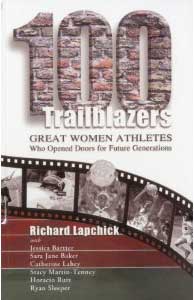
This book was written by Dr. Richard Lapchick, chair of the renowned DeVos Sport Business Management Program at the University of Central Florida, along with several of his students in the renowned program:
- Sara Jane Baker
- Jessica Bartter
- Catherine Lahey
- Stacy Martin-Tenney
- Horacio Ruiz
- Ryan Sleeper

The DeVos program offers students the opportunity to earn their Masters in Sports Business Management and a Masters in Business Administration. Focusing on ethics, diversity, leadership, and community service, the DeVos Program attracts some of the brightest and most committed students from across the country and across the globe.