
Great article but really not true; there are many players involved in the NPF that are not from the ...more
posted 08/26/14 at 1:28pm
on Softball Standouts Plourde and Prezioso Represent Atlantic 10, Exemplify Mid-Major Potential at Next Level




posted by The Rabbit Hole
Tuesday, September 4, 2012 at 11:01pm EDT
Blogger Courtney Szto is a Master's Student studying the socio-cultural aspects of sport, physical activity and health (or as some call it Physical Cultural Studies). Bachelor's in Sport Management. Former tennis coach & ropes course facilitator.
Support women's sports and SHARE this story with your friends!
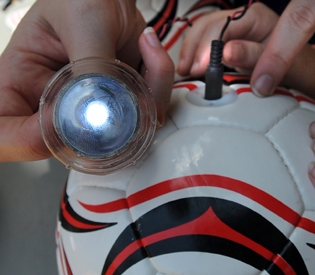 Soccket Ball. Photo from Grand Challenge Stories.
We know all too well how groups like Right to Play use soccer in low-income nations to facilitate peace and "development"; but, have you heard of soccer providing electricity? The Soccket ball was designed by four Harvard graduates as a way of providing electricity for simple devices such as lamps and cell phones. I think it's important to note that the creators are four women who came up with the idea in an engineering class, but are not actually engineers. The Soccket Ball provides an important resource for those living in rural areas with limited access to electricity. Something commonly overlooked is that without electricity children are unable to complete their homework and reading once the sun has gone down. Considering many hours of the day are consumed by getting to and from school, acquiring and preparing food, and school itself, a few extra hours of light could be extremely beneficial for young students. It also reduces the need for kerosene lamps, which is expensive and, according to Unchartered Play, produces fumes equivalent to smoking two packs of cigarettes a day.
Julia Silverman, one of the co-creators of the Soccket ball, explains that "...when the ball is kicked, it moves around a magnet inside a coil and charges a super capacitor. This stores energy that is released by whatever you plug into it."
Where normal balls have a valve to add more air, the Soccket ball has a plug socket that is compatible with a DC adaptor, allowing everything from a lightbulb to a mobile phone to be run from the energy stored inside.
Apparently, kicking the ball for only fifteen minutes generates three hours of light and it feels no different than a regular soccer ball. The creators are debating whether to move production to China or whether to keep production in the areas that will also be the main consumers. I certainly hope they decide for the latter. Moving production to China could undermine their good intentions in many ways. Obviously moving production to China is an attempt to lower the cost but that also comes with lower (or non-existent) labour standards. Does young Chinese children working 20 hour days in order to make affordable Soccket balls for young Africans so that they can improve their scholastic careers negate the goodwill of the Soccket? Similar to how Product (RED) items have been questioned for their manufacturing conditions and Bono has never provided any transparency on the matter a hierarchy of humanitarianism can be created where we rank suffering. As Product (RED) creator Bono has explained, "We are for labour issues. Labour issues are very serious but six and a half thousand dying Africans are more important" (Richey & Ponte, 2006). I ask - more important to who? If these soccer balls can be produced in African communities for African communities then we've got a sustainable solution that could be really positive. But if the Soccket becomes a commodity bought in North America with a donation going to distant Africans, which is one of the pricing options, I think the Soccket will be stifling its own potential.
Time will tell if the Soccket provides as much value as is marketed, but it certainly seems like something worth keeping an eye on.
Works Cited:Richey, L.A., & Ponte, S. (2006). Better (RED) than dead: 'Brand Aid', celebrities and the new frontier of development assistance - Working Paper. Danish Institute for International Studies. Retrieved from: http://www.diis.dk/sw27885.asp
Support women's sports and SHARE this story with your friends!
MORE ABOUT THIS AUTHOR:
Blogger Courtney Szto is a Master's Student studying the socio-cultural aspects of sport, physical activity and health (or as some call it Physical Cu...
full profile
For more, visit Resident_Badass's Full Profile
LATEST ARTICLES & POSTS
Thu at 1:53pm
Thu at 1:52pm
Thu at 1:48pm
Thu at 1:47pm
Wed at 12:52pm
Wed at 12:50pm
Wed at 12:17pm
Wed at 12:16pm
RECENT COMMENTS
Great article but really not true; there are many players involved in the NPF that are not from the ...more
posted 08/26/14 at 1:28pm
on Softball Standouts Plourde and Prezioso Represent Atlantic 10, Exemplify Mid-Major Potential at Next Level

What she did I'd fantastic but she was still a good 14 seconds behind the winner and, really, the Ke...more
posted 07/22/14 at 4:04am
on 2 seconds, no finish clock picture, but satisfaction: Molly Huddle breaks her own AR

Does money make champions ! History have taught us that money does not means success overnight . Mos...more
posted 06/20/14 at 8:25pm
on Sparks need a change, but what kind?
congrats to Maria on her French Open win!!...more
posted 06/11/14 at 10:06pm
on Maria Sharapova Named The Face Of Avon Luck Fragrances
| SAUCUONY 500 MILE CHALLANGE |
| Daily Workout |

No one has commented on this yet. Be the first!