
Great article but really not true; there are many players involved in the NPF that are not from the ...more
posted 08/26/14 at 1:28pm
on Softball Standouts Plourde and Prezioso Represent Atlantic 10, Exemplify Mid-Major Potential at Next Level





posted by The Rabbit Hole
Thursday, March 21, 2013 at 9:45am EDT
Blogger Courtney Szto is a Master's Student studying the socio-cultural aspects of sport, physical activity and health (or as some call it Physical Cultural Studies). Bachelor's in Sport Management. Former tennis coach & ropes course facilitator.
Support women's sports and SHARE this story with your friends!
The Biggest Loser just wrapped up its 14th season. I'm not sure what the ratings were like but from watching social media it seemed that the Biggest Loser is still as relevant to people's lives as it has ever been. I have been working on a research project about the Biggest Loser keeping a close eye on their Twitter account and there was one tweet the other night that raised a very good question: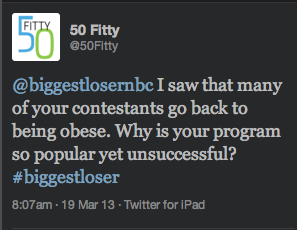
I think this is a great question that not enough people have asked. It has been well documented that approximately 70% of contestants gain weight back (and sometimes more than their starting weight) and that the show exposes their contestants to dangerous behaviours such as dehydration and training through injuries (see below for articles), yet people still watch! People not only watch, they tweet their own weight loss progress, fears, workouts, meals and health questions to the Biggest Loser - a television show. As former contestant Kai Hibbard says she "helped perpetuate a myth that's dangerous." Gaining back some weight is probably healthy given that a lot of the contestants look too thin at the finale but suffice it to say many of them are not their 'thin' selves anymore, which is largely what the show sells - thinspiration. If the show was really about health and not about ratings then contestants wouldn't be kicked off the show and the goal wouldn't be to lose as much weight as possible in comparison to the other contestants.
If we break down what the Biggest Loser is all about you can categorize everything the show is about into the following categories:
When you break it down into bullet points the show seems pretty grim and depressing, but these messages have cleverly been masked by motivational speeches, testimonials of success, and health experts. As inspirational as some of the personal stories can be that statistic of 70%, for lack of a better term, failure rate should be really alarming to people. It's a scam if you think about it. We show you how all these people change their bodies and their lives and tell you that you can do it too by following our advice, but oh, by the way, apparently our method doesn't work as well as it may appear. If you bought the ShamWow, for example, at your local tradeshow because you saw it absorb that 2 litre bottle of Coca Cola and then took it home and it barely absorbed small puddles or only absorbed spills 30% of the time wouldn't you feel cheated? Wouldn't you tell people about what a crappy product the ShamWow is? (Please note: I've never used the ShamWow and am neither promoting or not dissuading people from buying it.) Sooner or later poor quality products fall away from the market because that is how the market works. However, for 14 seasons people have bought every piece of information that the Biggest Loser has sold, why is that?
What is it about this unsuccessful show that continues to draw viewership and create inspiration? Here are my hypothoses:1.) Lack of media literacy: Too many people take television at face value or *ahem* screen value. The assumption is that there are doctors, trainers, dietitians, and therapists on the show; therefore, they must know what they are talking about. Little do they know there are just as many doctors, trainers, dietitians, and therapists not on television who think that the Biggest Loser personalities are crack-pots in search of celebrity over health. Dr. Joanna Dolgoff, the Biggest Loser's official pediatrician and child obesity expert, tweeted during one show:
How many people saw that important tweet? Not enough I would say. Here's another example from one of the former Biggest Loser contestants, Austin, who had this 'conversation' with a doctor who has spoken vehemently against the show: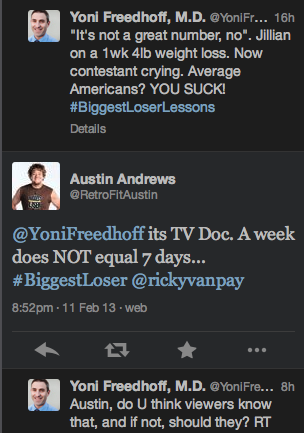
Dr. Freedhoff poses a valid question to Austin. Should viewers know where reality ends and where editing begins? It is referred to as 'reality television' but some of us realize that reality is a term used loosely and others take it as gospel. I think to begin with reality shows need to be more transparent about what they show and what they edit out and we need to learn to take what experts advice with a grain of salt. I am not trying to discredit 'experts' but as a society, I believe, we need to learn how to ask more questions rather than searching for answers and quick fixes.
2.) The Biggest Loser sells hope: The Biggest Loser packages their weight loss ideology in a way that, somehow, makes throwing up on a treadmill seem appealing to people. Viewers can identify with the contestants, which makes them root for them. There is the mom who lost her family in a car accident, the boy who lost his father at an early age, and the young girl who did everything she could for her siblings and never took care of herself. They frame personal stories that tug at our heart strings and 'speak to us' so that we think maybe, just maybe, I can do that too. Even if 70% fail at their quest for thinness that means 30% are successful and we all like to think that we would fall in that 30%. It's the same type of logic that makes us think that nothing bad will happen to us. We know better, but we like to put all our eggs in the basket of hope.
I don't think that the Biggest Loser is an inherently bad show but what is presented on the show is far from applicable to real life, as Dr. Dolgoff alluded to. As Suzy, a former Biggest Loser contestant has stated in an interview "I am not bitter. Just honest. I had a good experience. But truth is truth. Not all losers will tell you all the nitty gritty details. I just want peoples eyes a bit more open before they are quick to judge and put 'losers' on a pedestal."
Here are some articles that have, unfortunately, had little impact on changing hearts and minds:
Former 'Biggest Loser' contestant blasts show: "More Biggest Losers gain their weight back" - Ashley's Reality Roundup
'Biggest Loser': Where are they now - MSNBC
The Biggest Loser destroys participants' metabolisms - Weighty Matters
Biggest Loser winner gains 175 pounds back - US Weekly
"Biggest Loser" contestant Kai Hibbard slams reality show, gained weight back - CBS News
Biggest Loser: Contestants admit dangerous practices, can't speak out - Huffington Post
Support women's sports and SHARE this story with your friends!
MORE ABOUT THIS AUTHOR:
Blogger Courtney Szto is a Master's Student studying the socio-cultural aspects of sport, physical activity and health (or as some call it Physical Cu...
full profile
For more, visit Resident_Badass's Full Profile
LATEST ARTICLES & POSTS
Thu at 1:53pm
Thu at 1:52pm
Thu at 1:48pm
Thu at 1:47pm
Wed at 12:52pm
Wed at 12:50pm
Wed at 12:17pm
Wed at 12:16pm
RECENT COMMENTS
Great article but really not true; there are many players involved in the NPF that are not from the ...more
posted 08/26/14 at 1:28pm
on Softball Standouts Plourde and Prezioso Represent Atlantic 10, Exemplify Mid-Major Potential at Next Level

What she did I'd fantastic but she was still a good 14 seconds behind the winner and, really, the Ke...more
posted 07/22/14 at 4:04am
on 2 seconds, no finish clock picture, but satisfaction: Molly Huddle breaks her own AR

Does money make champions ! History have taught us that money does not means success overnight . Mos...more
posted 06/20/14 at 8:25pm
on Sparks need a change, but what kind?
congrats to Maria on her French Open win!!...more
posted 06/11/14 at 10:06pm
on Maria Sharapova Named The Face Of Avon Luck Fragrances
| SAUCUONY 500 MILE CHALLANGE |
| Daily Workout |

No one has commented on this yet. Be the first!