
Great article but really not true; there are many players involved in the NPF that are not from the ...more
posted 08/26/14 at 1:28pm
on Softball Standouts Plourde and Prezioso Represent Atlantic 10, Exemplify Mid-Major Potential at Next Level




posted by The Rabbit Hole
Sunday, April 21, 2013 at 10:48am EDT
Blogger Courtney Szto is a Master's Student studying the socio-cultural aspects of sport, physical activity and health (or as some call it Physical Cultural Studies). Bachelor's in Sport Management. Former tennis coach & ropes course facilitator.
Support women's sports and SHARE this story with your friends!
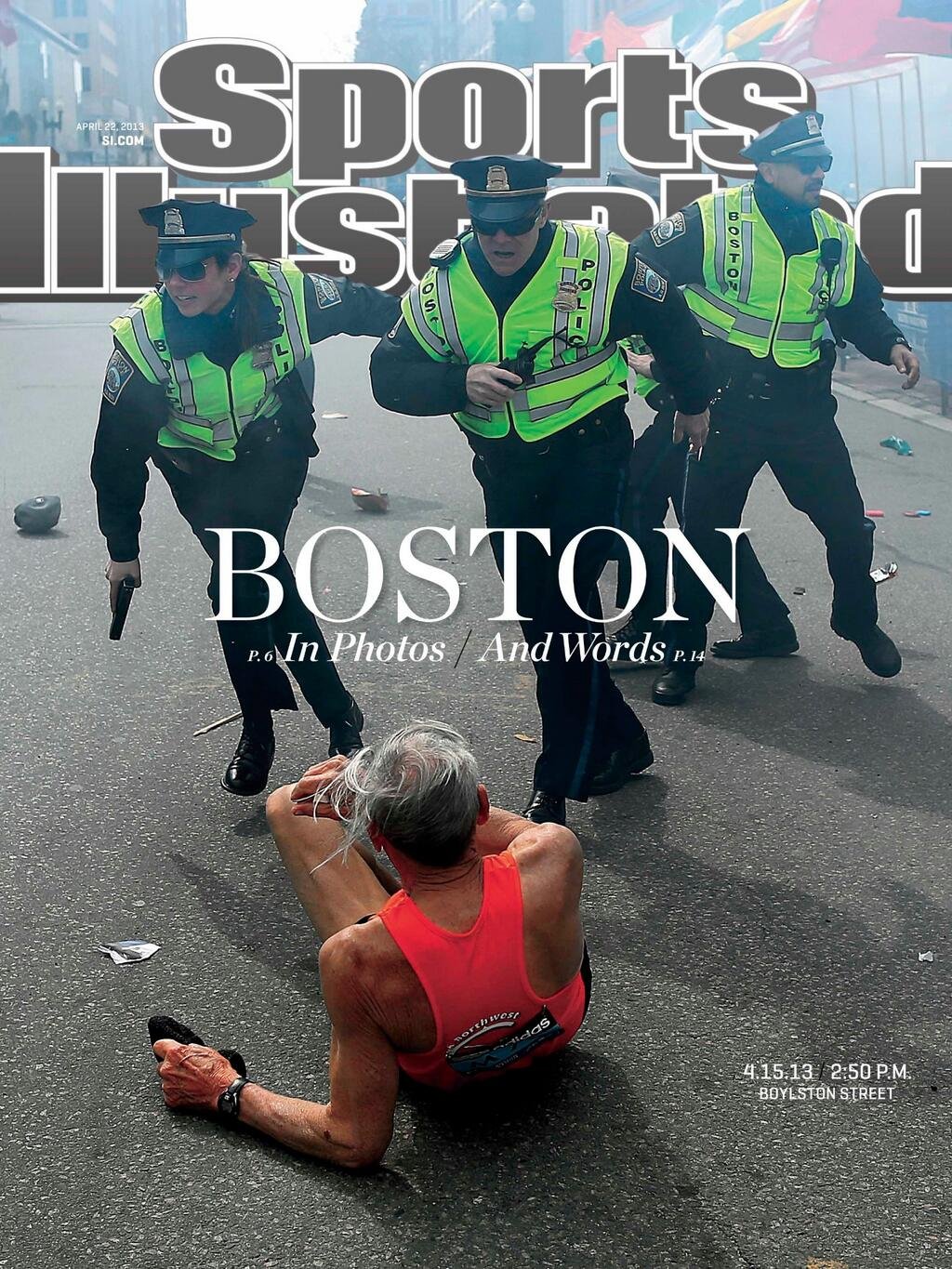 As I write this the sole surviving brother of the alleged Boston Marathon bombings duo is probably being interrogated by Federal Agents in some dimly lit warehouse in Boston. At least, if you watch enough television crime dramas that's what one would assume to be happening. Every Internet news headline reads "we got the guy" or something similar. It is the much needed 'happy' ending to a traumatic event. I first learned about the bombings via a photo on Twitter. I saw blood and people on the ground at the finish line and was confused as to why there would be blood at a marathon. I clicked on another related tweet and saw a different photo of smoke with a caption that explained what had just happened. It is surreal getting news from social media. One tweet can be a funny quip from a comedian and the next below it can be about death and destruction. It will be interesting to see how the information to come in the next few hours and days about the alleged bomber will be represented, packaged and consumed. I write this post because it is my belief that, as horrific as the bombings were, nothing much will change for (North)American society because of it.
It is what Jean Baudrillard would refer to as a non-event. I have written previously about his theory of the non-event as it pertains to the Olympics. Here, I discuss the non-event as a mediated construction by the media that will have "no enduring cultural meanings" (Atkinson & Young, 2012). Baudrillard has claimed that media coverage of so-called 'events' overwhelm us to the point where we no longer can distinguish between fact and fiction. Case in point: when a CNN correspondent announced that one of the FBI suspects was a "dark-skinned male". This turned out to be completely fabricated as were many other 'news' reports. If this isn't mediated information I don't know what is. The news becomes so preoccupied with scooping other stations (and social media) that anything that sounds remotely plausible becomes fact. This type of media creates fear, and it sensationalizes events as if the original source wasn't enough of a spectacle. We only know truth today from what becomes the most consistent news story through all of the media platforms available to us.
In reference to the Gulf War as a non-event, Baudrillard wrote "The prodigious event, the event which is measured neither by its causes nor consequences but creates its own image and its own dramatic effect, no longer exists" (1994, p.21). Similarly, the Boston Marathon bombings have created its own dramatic events to overshadow the actual events as evidenced by the police manhunt, the unity of Boston at the Bruins vs. Sabres hockey game, and the reproduction of the event itself. This is not to say that the consequences are unimportant or not real for those people affected but the drama, unity, and fear created from such events (e.g., the Newtown school shooting, Virginia Tech, Aurora theatre shooting) have become a reflex that dissipates almost as quickly as it is brought forth. The fact that we can list so many horrific events with such ease is proof that nothing really changes. As Knipp (2007) argues "we live in an age of media over-stimulation amid copies of "reality" so intense ("hyperreal") they put the "real" to shame". Knipp (2007) continues
Fighting terror is a non-starter, if it is seen as making war, taking prisoners, torturing them, locking them up and throwing away the key. Doing such things is not really fighting terror at all, but responding to it in exactly the way that most satisfies the terrorists themselves - with state terror...
Sport has become all too common a site for acts of terrorism with the Olympics being a favourite target (i.e., Berlin 1936, Mexico 1968, Munich 1972, Atlanta, 1996) along with World Cups and Commonwealth Games. Sadly, this will probably not be the last time a sporting event is used for such purposes. We can pretend that sport is a break from real life all we want but large sporting events have become too significant as sites of commercialism, social exclusion, and nationalism etc. for them to be safe zones. As Atkinson and Young (2012) contend, the terrorist attacks at the 1972 Munich Games and the 1996 Atlanta Games are "rarely [featured] in contemporary media coverage of terrorism in sports mega-events. It seems as if there is a global amnesia regarding former iterations of terrorism at major games..." (p.303). So what will change because of what happened at the Boston Marathon? Will we stop running marathons? That certainly seems out of the question. Within hours of the bombings the Vancouver news reported that its annual Vancouver Sun Run would continue as planned as would the London Marathon. Will relations between America and Islamic people and nations change? I would say that its business as usual; those who want excuses to bolster their hatred of Islam will carry on with one more tool in their belt.
Baudrillard explains in this excerpt from his book The Spirit of Terrorism that, perhaps the success of terrorism may not lie in changing our way of living but in changing our psyche:
[Terrorists] have even - and this is the height of cunning - used the banality of American everyday life as cover and camouflage. Sleeping in their suburbs, reading and studying with their families, before activating themselves suddenly like time bombs. The faultless mastery of this clandestine style of operation is almost as terroristic as the spectacular act of September 11, since it casts suspicion on any and every individual. Might not any inoffensive person be a potential terrorist? If they could pass unnoticed, then each of us is a criminal going unnoticed (every plane also becomes suspect), and in the end, this is no doubt true. This may very well correspond to an unconsious form of potential, veiled, carfully repressed criminality, which is always capable, if not of resurfacing, at least of thrilling secretly to the spectacle of Evil. So the event ramifies down to the smallest detail - the source of an even more subtle mental terrorism. (p.19)
Thus, I ask again, what will change because of Boston?
Works Cited:
Atkinson, M. & Young, K. (2012). Shadowed by the corpse of war: Sport spectacles and the spirit of terrorism. International Review for the Sociology of Sport, 47, 286-206.
Baudrillard, J. (1994). The Illusion of the End. Cambridge: Polity Press.
Baudrillard, J. (2002). The spirit of terrorism: And, other essays. New York, NY: Verso.
Knipp, C. (2007). Terrorism as a virus: Baudrillard's post-2001 significance. Retrieved from http://baltimorechronicle.com/2007/070307Knipp.html
Support women's sports and SHARE this story with your friends!
MORE ABOUT THIS AUTHOR:
Blogger Courtney Szto is a Master's Student studying the socio-cultural aspects of sport, physical activity and health (or as some call it Physical Cu...
full profile
For more, visit Resident_Badass's Full Profile
LATEST ARTICLES & POSTS
Thu at 1:53pm
Thu at 1:52pm
Thu at 1:48pm
Thu at 1:47pm
Wed at 12:52pm
Wed at 12:50pm
Wed at 12:17pm
Wed at 12:16pm
RECENT COMMENTS
Great article but really not true; there are many players involved in the NPF that are not from the ...more
posted 08/26/14 at 1:28pm
on Softball Standouts Plourde and Prezioso Represent Atlantic 10, Exemplify Mid-Major Potential at Next Level

What she did I'd fantastic but she was still a good 14 seconds behind the winner and, really, the Ke...more
posted 07/22/14 at 4:04am
on 2 seconds, no finish clock picture, but satisfaction: Molly Huddle breaks her own AR

Does money make champions ! History have taught us that money does not means success overnight . Mos...more
posted 06/20/14 at 8:25pm
on Sparks need a change, but what kind?
congrats to Maria on her French Open win!!...more
posted 06/11/14 at 10:06pm
on Maria Sharapova Named The Face Of Avon Luck Fragrances
| SAUCUONY 500 MILE CHALLANGE |
| Daily Workout |

No one has commented on this yet. Be the first!